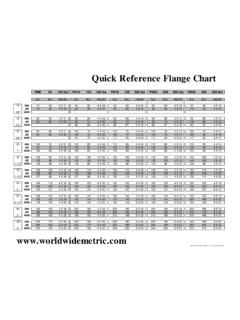
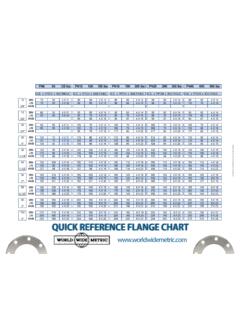
Transcription of FLANGE DIMENSIONS TABLE TYPES
1 Stanbel Road Salisbury Plain, South Australia 5109 Telephone +61 (0)8 8285 0033 Fax +61 (0)8 8285 BRISBANE PERTHFLANGE DIMENSIONS TABLE TYPESOVERVIEWIn Australia the BS and AS FLANGE standards are essentially the same but have been metricated. Consequently metric sizes are stated as DN (Nominal Diameter) in mm. Equivalent imperial sizing is rounded to the nearest multiple of 25mm (for 2 and over) as below. However the actual DIMENSIONS and bore sizes have not changed. NB (Nominal Bore) is also sometimes used when referring to valve DN152 1/2 DN6512 DN30024 DN6003/4 DN203 DN8014 DN35028 DN7001 DN254 DN10015 DN37530 DN7501 1/4 DN325 DN12516 DN40032 DN8001 1/2 DN408 DN20018 DN45036 DN9002 DN5010 DN25020 DN500 The most common flanging used in Australia in oil, gas and mining is now ANSI flanging to ANSI However in general industrial, commercial and waste/water industries AS2129 TABLE flanging is the most common.
2 Increasingly European PN rated flanges are also specified in BS4504 as well as AS4331 and DIN/EN 1092-1 (EN 1092-1 supersedes BS4504). PN stands for Nominal Pressure and roughly equates to the number of bar the cold working pressure of PN10 is 10 bar. Ratings range from to PN420. The latest Australian standard AS4331 references this rating system ( to PN420) but specifies ASME drilling (adopted) from ISO 7005-1. Consequently in Australia most users simply just reference to original ASME standards as this is already in use in Australia for the Oil, Gas and Mining industries and in fact in pressures above TABLE E it has been the predominant standard in use for the last 30 years.
3 However, piping engineers must refer to the new AS standard AS4331 for interpretations and specification Class Ratings based on ASME and corresponding PN rating: FLANGE Class 150 300 400 600 900 1500 2500 FLANGE Pressure Nominal, PN 20 50 68 100 150 250 420PN is the rating designator followed by a designation number indicating the approximate pressure rating in ratings do not provide a proportional relationship between different PN numbers, whereas class numbers STANDARDAS2129 originates from BS10 and has been metricated. In some cases slightly larger bolt holes provide better clearance as metric bolts are specified in lieu of UNC bolts used by BS10.
4 AS4087 is an update of AS2129, however AS2129 is still widely used so it has not been deleted as a standard, however, it now only covers AS TABLE D to is the latest standard for BS TABLE D to H, the same drilling is used but the new PN pressure rating system has been adopted. As the new pressure ratings are slightly higher the FLANGE thicknesses have slightly increased. Also the raised face DIMENSIONS (although rarely specified, flat face is mostly used) are slightly larger. TABLE C, J to R, no longer exist, PN16 is the same drilling as TABLE D, PN21 is the same as TABLE E, PN35 is the same as TABLE H. covers to PN420 and the sizing and drilling used is a replication of ISO 7005-1 which in turn is a metricated equivalent of ASME class 150 to 2500.
5 ISO 7005 also incorporates the superceded DIN 2533 & DIN 2501 flanges which also incorporates (also mirrored in EN1092). flanging is used in Australia in oil drilling and wellhead systems. (see our oilfield slide rule click here. API ratings range from 2,000 to 20,000 psi (cold working pressure). ANSI was originally born from API, consequently in class 600 to 900 and 1500 ANSI the flanges are dimensionally equivalent to API 2,000, 3,000 and 5,000 in most sizes to ANSI 300NB (12 ) API 13 5/8 but ANSI flanges being manufactured from lower yield strength carbon steel are rated to lower working pressure. However GSL stocks high yield carbon steel API6A 45K weld neck flanges which are compatible with ASME A234 WPB fittings and A106B/API5LB pipe.)
6 Click here to find out (American Society of Mechanical Engineers, of which Australian Pipeline Valve is a member company) is a group of standards, which are in turn covered within the American Standards Institute (ANSI), hence their flanges can be referred to as ANSI or ASME class. Class is also traditionally abbreviated CL or LB (verbally spoken as pound) or cross hash (#) but not psi as this can be misconstrued as the cold working pressure (CWP). Since ANSI 150 for instance has a CWP of 285 psi, so unlike the PN system the class is not related to CWP. AS4331 has adaptor ANSI drilling and sizes but uses PN rating classes! Consequently in some sizes flanges are thicker to bring the rating up to the required PN PRESSURE CLASSES OF FLANGESF orged steel flanges, ASME , are made in seven primary ratings:150 LBS 300 LBS 400 LBS 600 LBS 900 LBS 1500 LBS 2500 LBSA Class 300 FLANGE is rated to a higher pressure than a Class 150 FLANGE , because a Class 300 FLANGE is constructed with more metal and therefore can withstand more pressure.
7 However there are a number of factors that can impact the pressure capability of a Pressure Class for flanges is often expressed in pounds . Different names are used to indicate a Pressure Class. For example: 150 Lb or 150 Lbs or 150# or Class 150, all mean the PRESSURE RATINGF langes can withstand different pressures at different temperatures. (Refer to pressure/temperature charts at this website for various material TYPES ). As temperature increases, the pressure rating of the FLANGE decreases. For example a Class 150 A105 FLANGE is rated to approximately 270 PSIG (1861 KPA) at ambient temperature, 180 PSIG (1241 KPA) at approximately 400 F (204 C) 150 PSIG (1034 KPA) at approximately 600 F (315 C), and 75 PSIG (517 KPA) at approximately 800 F (426 C).
8 Consequently when the pressure goes down, the temperature goes up and vice versa. Additional factors are that flanges can be constructed from different materials, such as stainless steel, cast and ductile iron, alloy steel, carbon steel, etc. Each material has a different pressure is an example of a FLANGE NPS 12 (300NB) in all main pressure classes. This example demonstrates that diameter of the raised face are all the same; but outside diameter, bolt circle and diameter of bolt holes become larger in each higher pressure class. The bore is subject to the required schedule. Refer to our FLANGE Chart Online Slide Rule above for FLANGE DIMENSIONS .
9 The number and diameter (mm) of the bolt holes for the example below of 300NB is: 12 x Class 150, 16 x 32mm Class 300, 16 x Class 400, 20 x Class 600, 20 x Class 900, 16 x 54mm Class 1500 and 12 x 73mm Class RATINGSP ressure/temperature ratings are maximum allowable working pressures allowed as per ASME (published in metric and imperial). For intermediate temperatures, linear interpolation is calculated by ratings apply to flanged joints which may be reduced by gaskets or studs temperature shown for a corresponding pressure rating is the temperature of the pressure-containing shell of the valve or FLANGE . In general, this temperature is the same as that of the media in line and the external environment, whichever is greatest (but also lowest temperature of each must be factored for low temperature service).
10 For any temperature below -29 C, the rating shall be no greater than the rating shown for -29 C, depending on materials the rating can be below two tables are examples of two material groups according to ASTM, FLANGE pressure-temperature ratings to ASME Group MaterialsNominal DesignationForgingsCastingsC-SiA105 (1) A216 (1)C-Mn-SiA350 (1) 3 1/2 NiA350 C-Mn-Si-VA350 Cl 1 (3) NOTES:(1) Upon prolonged exposure to temperatures above 425 C, the carbide phase of steel may be converted to graphite. Permissible but not recommended for prolonged use above 425 C.(3) Do not use over 260 Group MaterialsNominal DesignationForgingsCastings16Cr-12Ni-2 MoA182 CF3M18Cr-13Ni-3 MoA182 (1)A351 CF3 NOTES:(1) Do not use over 425 following 2 tables show pressure/temperature ratings for ANSI/ASME class 150 to 2500LB for group and Ratings for ASTM Group MaterialsWorking pressure by Classes, BARTemp.