Transcription of Flange Insulation Sets - KLINGER
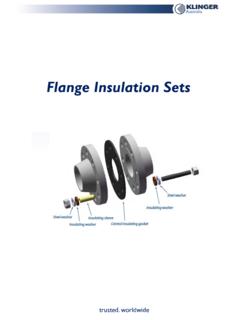
1 Flange Insulation sets ..Connect with Quality Flange Insulation sets Typical Flange Insulation Set components Insulation sets are used to limit corrosion in pipeline systems. Where dissimilar metals are present, the sets remove the possibility of the system acting as a galvanic cell and reduce the risk of galvanic corrosion of the pipe work. Insulation sets are also used to isolate cathodically protected piping systems where they prevent the flow of electro-static charge. Each Flange Insulation set comprises one central flat or oval section gasket, one Insulation , sleeve, two insulating and two plated steel washers per bolt. The sets are individually packed and clearly labelled with the Flange rating, size, type and material combination. Key function of Insulating gaskets: Used to electrically isolate sections of pipe work Designed to minimise electro-chemical erosion Comprising materials with high dielectric strength Manufactured to suit flanged joints to ASME, BS, DIN and customer designs Type E Full Face Gasket Suitable for flat and raised face flanges.
2 This style minimises the ingress of conductive foreign matter and reduces the risk of used on oil and hydrocarbons where Flange Insulation is a from materials with high dielectric strength to ensure minimum electrical contact between flanges Flange Insulation sets * Please see the service recommendations on the next page or refer to KLINGER with operating conditions to select suitable materials. Type F Ring Gasket Utilises a RF gasket which centrally locates within the used on oil and hydrocarbons where Flange Insulation is a requirement. Manufactured from materials with high dielectric strength to ensure minimum electrical contact between flanges Type D Ring Joint Gasket Type D Insulation gaskets use the same basic materials as the standard Insulation sets but are designed for RTJ flanges. The gasket is manufactured from reinforced phenolic resin. Type D gaskets have an oval cross-section and are suitable for low pressure applications. Care must be taken during installation of this gasket so that it is not overstressed during bolt up.
3 Materials available for the components of the set * : Available with a choice of gaskets for Type E & F: KLINGERSIL C-4430 KLINGER top-chem 2000 KLINGER top-chem 2003 Neoprene faced Phenolic (Neophenolic) Other materials on request Available with a choice of insulating sleeves and washers: Phenolic (Washer & Sleeve) Mylar (Sleeve) GRE-G10/G11(Washer/Sleeve) Other materials on request The choice of Insulation gasket for a given duty is dependent on the application conditions under which they will be operating. In addition to the temperature limitations, selection of the gasket must take into account the intended Flange pressure class. Table below presents KLINGER recommendations for safe sealing of ANSI flanges requiring insulating properties. The recommendations are based on both product knowledge and feedback from the field. For applications with specific service conditions ,please refer to KLINGER for a recommendation.
4 Service Recommendations Gasket recommendations for ANSI Raised Face Flange Class -recommended ; -not recommended Flange Insulation sets The above table is applicable to Raised Face Flanges. For ANSI & API 6A Ring Joint Flanges(RTJ) ,insulating oval shape Type D gaskets are available but are not recommended due to their susceptibility to crack under load especially in high pressure applications. KLINGER would recommend to use other styles as per above table for high pressure (600# and above) RTJ flanges. Note: For class 600# and above the Insulation washers to be G10/G11. Please refer to KLINGER for technical advice. Low Temperature Duty Some applications require the use of insulating gaskets at low temperatures. In this case, care must be taken with materials that contain an elastomeric component since elastomers will harden as they pass through the glass transition temperature losing their resilience. The temperature at which this occurs is dependent on the elastomer ,eg.
5 For Neoprene faced Phenolic Gaskets , the transition occurs at around -40 Deg C and should be avoided below this temperature. For low temperature applications, at lower pressures KLINGER recommend either Topchem 2003 or Topchem 2000 ,and for higher pressure applications, a Spring Energised PTFE (Teflon) seal is recommended . Assembly of Insulating Gaskets Assembly of insulating gaskets requires the same good fitting practice used to assemble standard gaskets. When installing a gasket, the correct installation procedures should be followed ,and the Flange surface finish (Ra) should be between and micro meters. However it is important to note that for Neoprene faced Phenolic (Neophenolic) gaskets the following guidelines apply: bolt stress must be limited to 30,000 psi should be tightened with a torque wrench only. Hydraulic tensioning is not recommended for these gaskets. Pressure Class Rating ANSI Raised Face Gasket 150 300 600 900 1500 2500 Neophenolic Topchem 2003 C-4430 * Topchem 2000 * Style PGE High Pressure Spring Energised PTFE *subject to a technical evaluation-please contact KLINGER Flange Insulation sets Facing Materials: Material type: G-10 Glass-reinforced epoxy resin G-11 High temperature resin Compressive strength: 65,000psi 50,000psi Dielectric strength: kV/mm kV/mm Maximum temperature: 150C 200C Water Flexural strength: 65,000psi 57,700psi Tensile strength: 50,000psi 41,000psi Temperature range: - 130C to 150C - 46C to 200C Style VCFS The VCFS Insulation gasket is a development of the VCS design to make a fire-safe Insulation set.
6 VCFS is fire safe tested to API is manufactured with a stainless steel core with glass fibre reinforced epoxy facings with a spring energised PTFE seal. The VCFS gasket features an additional fire safe coated E ring. VCFS can be used on both raised face and RTJ flanges.. High Pressure Spring Energised PTFE Insulation Gasket General Properties : The gasket is a high reliability gasket used for both insulating and general sealing purposes in Very Critical Services. It is suitable in all services up to and including ANSI 2500# and API 15,000# classes. The gasket can be used for both RF and RTJ flanges. Flange Insulation in conjunction with cathodic protection Mitigates galvanic corrosion in dissimilar metal Flange joints Mating mismatched ring-joint to raised-face flanges (it will seal in ring joint, raised-face and flat face/slip-on flanges) Withstands corrosive environments including high CO2, H2S and produced water Matched bore construction protects Flange faces from media-induced corrosion and flow-induced erosion Pressure energised seal reduces the Flange makeup stress Easy installation and removal Reusable seal retainer and seals High strength laminate material resists failure due to overcompression Materials: Metallic Core: 316 Stainless Steel (Duplex & Inconel available) Gasket Insulating Material: G-10 Glass Reinforced Epoxy (GRE) as standard (G-11 available) Seal Material: Spring-energized Teflon(PTFE)as standard (Viton available) Insulating Sleeve Material.
7 GRE as standard (Mylar available) Insulating Washers Material GRE (standard) Steel Washer Material Zinc Plated Steel as standard (Stainless Steel available) Thickness: 1/2 to 5 , 6 to 72 , API 10,000 Style PGE The PGE Insulation set uses a machined, glass-reinforced epoxy (GRE) resin with an o-ring or spring energised seal. PGE can be used for Flange ratings from class 150 to 600 and offers greatly improved compressive strength over conventional Insulation sets with greater resistance to overcompression and cracking. PGE can be constructed from standard G10 or high-temperature G11 resin with a seal ring which can be manufactured from a range of rubbers or PTFE. PGE Insulation sets are supplied with GRE sleeves and washers with zinc plated steel backup washers. Available in Type E (full-face )and Type F (RF) styles. Flange Insulation sets PGE Flange Gasket Advantages & Benefits : Superior sealing for low pressure (ANSI class 150, 300 and 600) service.
8 Pressure activated seals provide high confidence sealing. High strength laminate material resists failure due to excess compression Overlapping seal grooves eliminate potential leak/weep path in laminate material and provide stronger structural integrity versus opposing seal designs. Reinforced laminate retainer material provides excellent Insulation for cathodic protection systems. Gasket is sized to the bore to protect Flange faces from media-induced corrosion and flow induced erosion. Mitigates galvanic corrosion in dissimilar metal flanges. Spring energized Teflon seal provides radial load and encapsulation in the seal groove which eliminates cold flow. This seal truly distinguishes the PGE from all other systems. Also available with a variety of elastomeric seals. Easy installation, make-up and removal: Flanges do not have to be spread as with ring gaskets. The PGE easily slips in place. Sealing system results in low required bolt loads. Less make-up force required resulting in less Flange and bolt stress.
9 Gasket is self-aligning and centering, quick to install, no special tools are required. Maintenance-free, corrosion resistant design. Flange Insulation sets KLINGER Limited guarantees the quality, materials and workmanship of all its products either manufactured or distributed, but cannot be held responsible for the manner in which they are used, fitted or stored Subject to technical alternations 8991090-Issue: May 13 Note: The above values are based upon limited test data. Whilst every effort is made to ensure the information in this data sheet is accurate, it must be stressed that it is the users responsibility to ensure suitability for the intended end use. The values quoted above may be subject to modification at a later date. Component Dielectric Strength (Kv/mm) Water Absorption (%) Maximum Temperature (C) Neoprene faced Phenolic Gasket 107 Klingersil C-4430 Gasket 400 KLINGER Topchem 2000 Gasket 260 KLINGER Topchem 2003 Gasket 260 G10 Gasket, Sleeve, Washer 150 G11 Gasket, Sleeve, Washer 200 Mylar Sleeve 145 Phenolic Sleeve 107 Reinforced Phenolic Washer 107 Properties: For sales and technical advice, please contact: Tel: +61 08 9251 1600 or Toll Free 79 82 79 (in Australia), Fax:+61 08 93509286 Email: or Website.
10 Connect with Quality Flange Protection It is recommended that a KLINGER Flange Band Protector is also used to cover the outside of the Flange to prevent the ingress of conductive matter.