Transcription of FORCES AFFECTING CHANGE IN CROP PRODUCTION …
1 4th Quarter 2010 | 25(4 ) FORCES AFFECTING CHANGE IN CROP PRODUCTION AGRICULTURE Elizabeth Bechdol, Allan Gray, and Brent Gloy JEL Classifications: Q10, Q12, Q13 Keywords: Agricultural Competitiveness, Crop PRODUCTION , Agricultural Biotechnology, Agricultural Sustainability, Agricultural Inputs, Agricultural Profitability A number of factors are significantly reshaping crop PRODUCTION agriculture in the United States. Consider the following: Concentration has been on a steady rise for several decades. Today, 75% of the value of primary field crop PRODUCTION corn, soybeans, wheat, cotton, rice, sorghum, and barley oats is produced by 40% of farms (USDA-NASS, Census of Agriculture, 2007). Productivity increases have been significant.
2 Corn yields increased from an average of 55 bushels per acre in 1960 to 165 bushels in 2009 a 300% increase in 50 years. Wheat and soybean yields have seen 215% and 169% increases, respectively, over the same period. Meanwhile, according to the cost and returns survey of USDA's Economic Research Service, variable costs of corn PRODUCTION have declined on a real basis from $ per bushel in 1975 to an estimated $ per bushel in 2005. Producers are adopting larger pieces of equipment and more sophisticated technologies. Some estimate the time to plant and harvest the crop, two of the most time consuming operations, has been cut in half in the last decade, allowing producers to effectively manage more acres within one operation (Table 1).
3 Crop agriculture is clearly no stranger to CHANGE . This article examines the key FORCES AFFECTING CHANGE in crop PRODUCTION . We describe some of the major industry drivers of CHANGE and use Porter s five FORCES analysis to examine the economic conditions, opportunities, and threats facing this industry (Porter, 1979). Through this discussion, we describe how major crop PRODUCTION businesses are adapting to a changing competitive landscape. We begin with an overview of the drivers of CHANGE for the industry and then discuss the factors influencing profitability and the implications for the future. Drivers of CHANGE for the Industry There are several key factors shaping the economic conditions of the crop agriculture industry. Four dominant FORCES are currently at work Growing and Diversified Demand; Technology; Resource Availability; and Societal Influences.
4 Each in isolation, and also in combination, has implications for the structure of crop PRODUCTION , including farm size, the business models used, and relationships to other parts of the industry. Growing and Diversified Demand The food, feed, and fiber industries are being challenged to meet a growing and diversified demand. According to the Population Reference Bureau s 2010 Population Data Sheet, the global population is expected to reach almost billion by mid-2050, with the majority of the additional billion people located in developing countries where the need for affordable, abundant supplies of basic plant and animal based nutrients is greatest (Table 2). In addition to growing demands for food, feed and fiber, industrial applications for agricultural PRODUCTION are emerging as well.
5 The energy, polymers, chemicals, and pharmaceuticals industries are increasingly looking to the agricultural sector to supply renewable raw materials for their processes. Technology Monitoring and information technology, biotechnology, and a variety of other technologies are converging in agriculture to fundamentally CHANGE the way crops are grown. Today, yield monitors and GPS, global information systems (GIS), satellite or aerial photography and imagery, weather monitoring and measuring systems, and plant and soil sensing systems are commonly used tools. Biotechnology applications shorten the cycle time to develop new hybrids and varieties with higher yield potential and stronger resistance to pests and environmental conditions. By combining biotechnology with mechanical and other technologies to control the growth environment moisture, pest and disease infestation, etc.
6 The process control approach that defines the traditional mechanical manufacturing assembly line also transforms agriculture into a biological manufacturing industry. Resource Availability The availability and cost of natural resources for the agricultural sector has a significant impact on its capacity to respond to growing demand. In some cases, higher prices will be required to bring additional supplies onto the market or to use existing resources more intensively. This is the case for resources such as land, fertilizer, and irrigation. In contrast, supplies of phosphorus and potash are nonrenewable. As agricultural product demand increases, the owners of land, water, and fertilizer resources will benefit. Societal Influences The development of the bioeconomy and the growing use of renewables have intensified the discussion of the complementary or competitive nature of the economic motivation of creating value and the social motivation of environmental responsiveness and sustainability.
7 Likewise, societal concerns over the use of genetically modified organisms have shown that public opinion can significantly influence the ability of agricultural operations to utilize new technologies in crop PRODUCTION . Agribusinesses that rely heavily on natural resources cannot ignore the environmental and social issues that are prevalent today. Faced with increasing government regulations and strengthening public opinions, businesses are ever more accountable for their impacts on society and more transparent in their corporate social responsibility activities. In fact, Rankin (2010) found that 68% of agribusiness firms surveyed were either planning or actively implementing broad sustainability initiatives. Factors influencing Crop PRODUCTION Profitability The above drivers will significantly shape the farming sector.
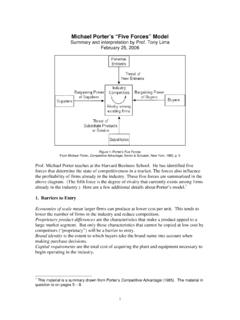
8 The potential profitability of farmers is influenced in part by the economic characteristics of the industry. These economic characteristics can, in large part, be examined using Porter s five FORCES model. Porter posits that the key economic features of an industry can be identified by examining how suppliers, buyers, rivalry, substitution, and barriers to entry affect it. We use this framework to analyze the economic characteristics of crop PRODUCTION agriculture. Suppliers The major supplies, or inputs, for grain/oilseed producers are genetics, crop chemicals, equipment, fertilizers and land. Nonfamily labor on farms is becoming a more important input as well. However, in general, producers are able to substitute capital equipment for labor.
9 Input suppliers to grain/oilseed PRODUCTION tend to be dominated by large agribusiness firms that compete vigorously for farmer business. The substantial investment required to develop new genetics, crop protection chemicals, and automated equipment necessitates that the firms competing in this sector must achieve substantial economies of scale. The investments required to breed and engineer new crop varieties and traits require significant time and substantial costs for regulatory approval. In the short run, intellectual property rights may allow some firms to capture a significant amount of the value created by their technologies. However, the similarity of many competing seed traits and chemistries allows producers to switch products at relatively low costs, thus reducing the bargaining power of input suppliers.
10 Recent large price increases have drawn attention to consolidation in the fertilizer industries. In particular, the potash market has relatively few raw input suppliers. Grain/oilseed producers are subject to substantial price shocks as suppliers are able to pass cost increases in the short-term on to farmers. In the longer-term, there are alternatives that have the potential to reduce this supplier control. There is substantial potential for grain/oilseed producers to better recycle and more efficiently utilize livestock waste nutrients for crop PRODUCTION . However, those crop producers without access to these alternatives will likely continue to face pressure from volatile fertilizer markets. Capital is a critical input to modern agricultural PRODUCTION .