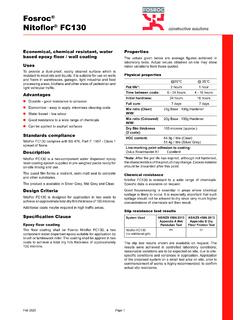
Transcription of Fosroc Nitobond SBR constructive solutions - …
1 Page 1 Feb 2020constructive solutionsWater resistant polymer additive / bonding agent, to provide improved adhesion to concreteUsesFor improving and bonding concrete repair mortars, cementitious floor toppings and screeds, waterproof renders and cementitious slurries. Cementitious mortars are alkaline in nature and will protect embedded steel reinforcement. Mortars produced with Nitobond SBR may be used for horizontal, vertical and overhead repair Excellent bond to concrete, masonry, stonework, plaster and blockwork Improved tensile and flexural properties allow thinner applications Single component liquid can be easily gauged as required Improves cohesion and workability Improves mortars to provide waterproof repairs, renders and toppings which are highly resistant to freeze/thaw cyclingDescriptionNitobond SBR is a modified styrene butadiene rubber emulsion which is supplied as a ready to use white liquid. It is designed to improve the qualities of site-batched cementitious mortars and slurries.
2 Being resistant to hydrolysis, it is ideal for internal and external applications in conjunction with CriteriaThe application parameters for mortars modified by the use of Nitobond SBR will differ depending on the actual mix design used. Generally, however, Nitobond SBR mortars can be applied in sections up to 40mm thickness in horizontal locations and up to 15mm in vertical locations. The thickness achievable in overhead locations without the use of formwork is largely dependent on the profile of the substrate. Vertical and overhead sections greater than those stated above may be built up in layers but may sometimes be possible in a single application dependent on the actual size and configuration of the repair area, and the volume of any exposed reinforcing steel. Nitobond SBR mortars should not be applied at less than 6mm thickness. Thicknesses up to 40mm in a single application can be achieved by the use of results listed below were achieved by assessing the mechanical properties of a 3:1 sand:cement mortar containing Nitobond SBR in the proportions 4 litres per 20kg cement.
3 The test methods used were in full accordance with BS 6319 at 28 days - air strength:62 MPaTensile MPaFlexural strength:9 MPaSlant shear bond:53 MPaVOC content:29g / litreChemical resistance: Cementitious materials have limited chemical resistance. The addition of Nitobond SBR to cement mortars reduces permeability and therefore helps reduce the rate of attack by aggressive chemicals, acid gases and waterApplication InstructionsPreparationSaw cut or cut back the extremities of the repair locations to a depth of at least 10mm to avoid feather-edging and to provide a square edge. Break out the complete repair area to a minimum depth of 6mm up to the sawn the surface and remove any dust, unsound or contaminated material, plaster, oil, paint, grease, corrosion deposits or algae. Where breaking out is not required, roughen the surface and remove any laitance by light scabbling or and grease deposits should be removed by steam cleaning, detergent scrubbing or the use of a proprietary degreaser.
4 The effectiveness of decontamination should then be assessed by a pull-off fully any corroded steel in the repair area and remove all loose scale and corrosion deposits. Steel should be cleaned to a bright condition paying particular attention to the back of exposed steel bars. Grit-blasting is recommended for this corrosion has occurred due to the presence of chlorides, the steel should be high-pressure washed with clean water immediately after grit-blasting to remove corrosion products from pits and imperfections within its steel primingApply 1 full coat of Nitoprime Zincrich to any exposed steel reinforcement and allow to dry before continuing. If any doubt exists about having achieved an unbroken coating, a second application should be made and, again, allowed to dry before Nitobond SBRPage 2constructive solutionsFosroc Nitobond SBRS ubstrate primingThe substrate should be thoroughly soaked with clean water and any excess removed prior to commencement.
5 A slurry primer should be prepared consisting of 1 volume Nitobond SBR to 1 volume clean water to 3 volumes fresh cement. To obtain a smooth consistency, the cement should be blended slowly into the premixed liquids. The slurry primer should be stirred frequently during use to offset slurry primer should be scrubbed well into the surface of the concrete. Avoid applying too thickly and avoid puddling . The repair mortar, topping or render must be applied on to the wet slurry primer. If the slurry primer dries before application of the mortar, it must be removed (ground off) and the area reprimed before exceptional circumstances, where a substrate/repair barrier is required or where the substrate is likely to remain permanently damp, Nitobond EP bonding aid should be used. Contact Fosroc for further should be taken to ensure that Nitobond SBR mortars are thoroughly mixed. A forced-action mixer is essential. Mixing at a slow speed (400/500 rpm) in a suitably sized drum using appropriate equipment such the Ransom 140 x 600 M14 Helical mixing paddle (product code: N4020892-UNIT) fitted to a heavy-duty 1600W mixer, such as Ransom 1602 E (product code: NP7EV160-UNIT) or equivalent is acceptable for small wide range of mix designs is achievable using Nitobond SBR.
6 Typical designs are detailed below:1. Patching and repair mortar: 20kgs GP Cement + 60kgs grade 16/30 sharp sand + 4 litres Nitobond SBR + 3 litres (approximately) clean water. Yield 38 litres. Recommended thickness: 6mm - 40mm2. Heavy-duty floor screed: 20kgs GP Cement + 30kgs 3mm to 6mm crushed rock + 30kgs grade 16/30 sharp sand + litres Nitobond SBR + litres (approximately) clean water. Yield 37 litres. The screed should be of a semi-dry cohesive consistency. Recommended thickness: 10mm - 40mm3. Render: 20kgs GP Cement + 60kgs grade 16/30 sharp sand + litres Nitobond SBR + litres (approximately) clean water. Yield 37 litres. The render should be of a semi-dry cohesive consistency. Recommended thickness: 6mm - 9mm4. Bonding mortar for tiles, etc: 20 kgs GP Cement + 50kgs grade 16/30 sharp sand + 4 litres Nitobond SBR + 3 litres (approximately) clean water. Yield 33 litres. Water is adjusted to give a firm mortar. Support where necessary until the mortar is set.
7 Recommended thickness: 6mm to : these mix designs are based on the use of dry sand and aggregate. Adjustments must be made to the water demand relative to the moisture content of the sand and aggregate used. It should also be noted that, due to the frequent inconsistencies of site-stored materials and variable conditions, actual yields and results may differ from those published the cement, sand and, where required, aggregate into the mixer and dry blend together for 1 minute. With the machine in operation, add the pre-mixed Nitobond SBR and clean water. Continue mixing for 3 minutes to ensure complete dispersal into the sand and cement. Make any small adjustment to the quantity of clean water but do not significantly exceed the litreage shown water should be kept to a minimum. Continue mixing up to a maximum of 5 minutes until a smooth and fully homogeneous consistency is achieved with the required workability and application properties.
8 It is critical that allowance is made for the moisture content of the sand and aggregate, particularly where they are stored on application to all surfaces, Nitobond SBR mortars, toppings and renders must be well-compacted on to the primed substrate by trowel. It is frequently beneficial to work a thin layer of the mortar into the slurry primer and then build the mortar on to this layer. Exposed steel reinforcement should be completely encapsulated by the SBR mortars can be applied at a minimum thickness of 6mm and up to 40mm thickness, dependent on the location and configuration of the repair zone. The thickness achievable in overhead locations without the use of formwork is largely dependent on the profile of the substrate. Refer to the recommended thicknesses shown in the Mix design section above. If the recommended thickness is exceeded and sagging occurs, the affected section must be completely removed and reapplied in accordance with the procedure described above.
9 The use of formwork may facilitate achieving the required build. If formwork is used, it should have properly sealed faces to ensure that no water is absorbed from the repair thicker sections up to a total thickness of 40mm are to be built up by hand or trowel application, the surface of the intermediate layers should be scratch-keyed and cured with diluted Nitoprime 330. Application of the slurry primer and a further application of Nitobond SBR mortar may proceed as soon as this layer has SBR mortars can be finished with a steel, plastic or wood float, or by a damp sponge technique, to achieve the desired surface texture. The completed surface should not be 3 Important noticeA Safety Data Sheet (SDS) is available from the Fosroc website. Read the SDS and TDS carefully prior to use as application or performance data may change from time to time. In emergency, contact any Poisons Information Centre (phone 13 11 26 within Australia) or a doctor for disclaimerThis Technical Data Sheet (TDS) summarises our best knowledge of the product, including how to use and apply the product based on the information available at the time.
10 You should read this TDS carefully and consider the information in the context of how the product will be used, including in conjunction with any other product and the type of surfaces to, and the manner in which, the product will be applied. Our responsibility for products sold is subject to our standard terms and conditions of sale. Parchem does not accept any liability either directly or indirectly for any losses suffered in connection with the use or application of the product whether or not in accordance with any advice, specification, recommendation or information given by it.*Manufactured and sold under license from Fosroc International Limited. Fosroc and the Fosroc logo are trade marks of Fosroc International Limited, used under license. Parchem Construction Supplies Pty Ltd7 Lucca Road, Wyong NSW 2259Ph: 1800 812 ABN 80 069 961 968 Distributed in New Zealand by: Concrete Plus Ltd150 Hutt Park Road Gracefield Ph: 0800 657 156 NZBN 9429033691282 constructive solutionsFosroc Nitobond SBRLow temperature workingIn cold conditions down to 5 C, the use of warm water (up to 30 C) is advisable to accelerate strength development.