Transcription of Foundation Training Year Assessment Strategy: A visual ...
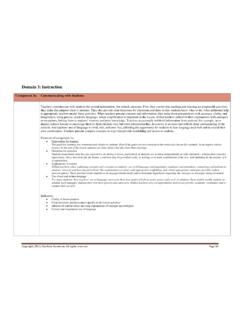
1 Foundation Training Year Assessment Strategy: A visual mapping of the Assessment activities The Health Education England Assessment Strategy describes a range of Assessment activities that are mapped to the GPhC interim learning outcomes. These Assessment activities are designed to provide multiple pieces of evidence against each learning outcome, as detailed in the Assessment Activities Guide available on our website. This short document is intended to be a visual map of the Assessment activities, showing how they are anticipated to provide evidence against each learning outcome.
2 Please note: Completion of an Assessment activity by a trainee pharmacist does not automatically provide evidence against a learning outcome. The trainee must map the Assessment activity to learning outcomes within the e-portfolio. If using a screen reader, please refer to the Assessment Activities Guide, which provides the same information in an accessible format. The guide is available to download on our Trainee Pharmacist Foundation Year Programme website. Mapping key The learning outcomes associated with each Assessment activity are mapped using a grid format.
3 This is intended to help trainee pharmacists decide which learning outcomes to map to each Assessment activity. Within the grid, green shading shows where it is anticipated that an Assessment activity will routinely provide evidence for a learning outcome. = Assessment Activity routinely maps to Learning Outcome Yellow shading shows where it is anticipated that an Assessment activity may be able to provide evidence for a learning outcome, depending on the circumstances of the activity. = Assessment Activity may map to Learning Outcome A visual mapping of the Assessment activities 2 GPhC interim learning outcomes In the Learning Outcome columns of the grid, where the learning outcome or level of demonstration box are shaded blue, with an asterisk, this indicates that either the wording of the learning outcome or the level of demonstration (against Miller s Triangle) have been modified for the interim learning outcomes.
4 This is for information only. Please note that learning outcome 37 is crossed-through and is not being used in the interim learning outcomes for the initial education and Training of pharmacists. It remains in the table as a placeholder so that the numbering of learning outcomes is not altered and will remain consistent when the full learning outcomes are introduced in the future. Key Assessment Activity routinely maps to Learning Outcome Assessment Activity may map to Learning OutcomeLevel of demonstrationMedicines ReconciliationPatient consultation: Medicines usePatient consultation: diagnose, assess recommendMedicines optimisationPatient focussed public health interventionResponding to a medicines enquiryMedicines safety activityService improvementTeaching and mentoringPublic health / health inequalities activityTechnical and legal prescription issues.
5 Identify and resolveDispensing prescriptions and preparing medicinal productsAccuracy checkingFirst aid / Adult Basic Life SupportSafeguarding children and vulnerable adultsDevelopment and application of advanced therapies Health and safetyDigital healthcare systems used in employing organisationMultisource feedbackPDP and LNAS upplementary evidence 1. Demonstrate empathy and keep the person at the centre of their approach to care at all times Does 2. Work in partnership with people to support and empower them in shared decision-making about their health and wellbeing Does 3. Demonstrate effective communication at all times and adapt their approach and communication style to meet the needs of the person Does 4.
6 Understand the variety of settings and adapt their communication accordingly Does 5. Proactively support people to make safe and effective use of their medicines and devices Does 6. Treat people as equals, with dignity and respect, and meet their own legal responsibilities under equality and human rights legislation, while respecting diversity and cultural differences Does 7. Obtain informed consent before providing care and pharmacy services Does 8. Assess and respond to the person s particular health risks, taking account of individuals protected characteristics and background Does 9. Take responsibility for ensuring that personal values and beliefs do not compromise person-centred care Does 10.
7 Demonstrate effective consultation skills, and in partnership with the person, decide the most appropriate course of action Does 11. Take into consideration factors that affect people s behaviours in relation to health and wellbeing Does 12. Take an all-inclusive approach to ensure the most appropriate course of action based on clinical, legal and professional considerations Does 13. Recognise the psychological, physiological and physical impact of prescribing decisions on people Does 14. Work collaboratively and effectively with other members of the multi-disciplinary team to ensure high-quality, person-centred care, including continuity of care Does 15.
8 Demonstrate the values, attitudes and behaviours expected of a pharmacy professional at all times Does 16. Apply professional judgement in all circumstances, taking legal and ethical reasoning into account Does 17. Recognise and work within the limits of their knowledge and skills, and get support and refer to others when they need to Does 18. Take responsibility for all aspects of pharmacy services, and make sure that the care and services provided are safe and accurate Does 19. Take responsibility for all aspects of health and safety and take actions when necessary, particularly but not exclusively during the COVID-19 pandemicDoes 20.
9 Act openly and honestly when things go wrong and raise concerns even when it is not easy to do so Does 21. Apply the science behind pharmacy in all activities Does 22. Demonstrate how the science behind pharmacy is applied in the discovery, design, development and safety testing of medicines and devices Knows how 23. Recognise the technologies that are behind developing advanced therapeutic medicinal products and precision medicines, including the formulation, supply and quality assurance of these therapeutic agents *Knows how* 24. Keep abreast of new technologies and use data and digital technologies to improve clinical outcomes and patient safety, keeping to information governance principles Does 25.
10 Apply pharmaceutical principles to the safe and effective formulation, preparation, packaging and disposal of medicines and products Shows how 26. Consider the quality, safety and risks associated with medicines and products and take appropriate action when producing and supplying themShows how 27. Take responsibility for the legal, safe and efficient supply and administration of medicines and devicesDoes 28. Demonstrate effective diagnostic skills, including physical examination, to decide the most appropriate course of action for the person. During the COVID-19 pandemic all relevant precautions must be taken to ensure the safety of the patient and Foundation trainee when physical contact is necessary.



![Midlands [1 of 2] - hee.nhs.uk](/cache/preview/6/c/1/4/2/e/2/7/thumb-6c142e2790d053a442bd8a3e81c79697.jpg)