Transcription of FRAMEWORK FOR 21st CENTURY LEARNING DEFINITIONS
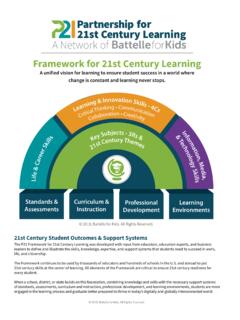
1 2019, Battelle for Kids. All Rights Reserved. | 1 FRAMEWORK FOR 21st CENTURY LEARNING DEFINITIONS 2019, Battelle for Kids. All Rights Reserved. | 2P21 FRAMEWORK DEFINITIONSTo help practitioners integrate skills into the teaching of key academic subjects, the Partnership for 21st CENTURY LEARNING (P21) has developed a unified, collective vision for LEARNING known as the FRAMEWORK for 21st CENTURY LEARNING . This FRAMEWORK describes the skills , knowledge, and expertise students must master to succeed in work and life; it is a blend of content knowledge, specific skills , expertise, and 21st CENTURY skills implementation requires the development of key academic subject knowledge and understanding among all students.
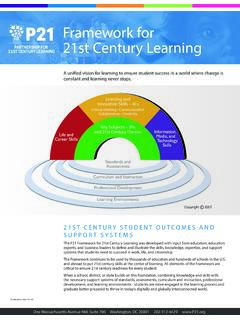
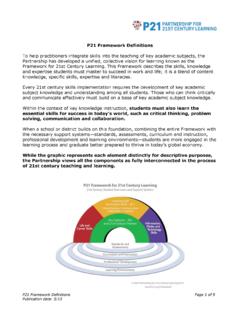
2 Those who can think critically and communicate effectively must build on a base of key academic subject the context of key knowledge instruction, students must also learn the essential skills for success in today s world, such as critical thinking, problem solving, communication, and a school or district builds on this foundation, combining the entire FRAMEWORK with the necessary support systems standards, assessments, curriculum and instruction, professional development, and LEARNING environments students are more engaged in the LEARNING process and graduate better prepared to thrive in today s global the graphic represents each element distinctly for descriptive purposes, P21 views all the components as fully interconnected in the process of 21st CENTURY teaching and & AssessmentsCurriculum & InstructionProfessional DevelopmentLearning EnvironmentsLife & Career SkillsLearning & Innovation skills - 4 CsCritical Thinking CommunicationCollaboration CreativityInformation, Media, & Technology SkillsKey Subjects - 3Rs & 21st CENTURY Themes 2019, Battelle for Kids.
3 All Rights Reserved. 2019, Battelle for Kids. All Rights Reserved. | 3 The elements described in this section as 21st CENTURY student outcomes (represented by the rainbow) are the knowledge, skills , and expertise students should master to succeed in work and life in the 21st subjects and 21st CENTURY themesMastery of key subjects and 21st CENTURY themes is essential for all students in the 21st CENTURY . Key subjects include: English, reading, or language arts World languages Arts Mathematics Economics Science Geography History Government and CivicsIn addition to these subjects, we believe schools must move to include not only a focus on mastery of key subjects, but also promote understanding of academic content at much higher levels by weaving 21st CENTURY interdisciplinary themes into key subjects.
4 GLOBAL AWARENESS Use 21st CENTURY skills to understand and address global issues Learn from and working collaboratively with individuals representing diverse cultures, religions, and lifestyles in a spirit of mutual respect and open dialogue in personal, work, and community contexts Understand other nations and cultures, including the use of non-English languagesFINANCIAL, ECONOMIC, BUSINESS, AND ENTREPRENEURIAL LITERACY Know how to make appropriate personal economic choices Understand the role of the economy in society Use entrepreneurial skills to enhance workplace productivity and career optionsCIVIC LITERACY Participate effectively in civic life through knowing how to stay informed and understanding governmental processes Exercise the rights and obligations of citizenship at local, state, national, and global levels Understand the local and global implications of civic decisionsHEALTH LITERACY Obtain, interpret.
5 And understand basic health information and services and using such information and services in ways that enhance health Understand preventive physical and mental health measures, including proper diet, nutrition, exercise, risk avoidance, and stress reduction Use available information to make appropriate health-related decisions Establish and monitor personal and family health goals Understand national and international public health and safety issues21st CENTURY Student Outcomes 2019, Battelle for Kids. All Rights Reserved. | 4 ENVIRONMENTAL LITERACY Demonstrate knowledge and understanding of the environment and the circumstances and conditions affecting it, particularly as relates to air, climate, land, food, energy, water, and ecosystems Demonstrate knowledge and understanding of society s impact on the natural world ( , population growth, population development, resource consumption rate, etc.)
6 Investigate and analyze environmental issues, and make accurate conclusions about effective solutions Take individual and collective action towards addressing environmental challenges ( , participating in global actions, designing solutions that inspire action on environmental issues) LEARNING AND INNOVATION SKILLSL earning and innovation skills increasingly are being recognized as those that separate students who are prepared for a more and more complex life and work environments in the 21st CENTURY , and those who are not. A focus on creativity, critical thinking, communication, and collaboration is essential to prepare students for the and InnovationTHINK CREATIVELY Use a wide range of idea-creation techniques (such as brainstorming) Create new and worthwhile ideas (both incremental and radical concepts) Elaborate, refine, analyze, and evaluate their own ideas in order to improve and maximize creative effortsWORK CREATIVELY WITH OTHERS Develop, implement, and communicate new ideas to others effectively Be open and responsive to new and diverse perspectives.
7 Incorporate group input and feedback into the work Demonstrate originality and inventiveness in work and understand the real-world limits to adopting new ideas View failure as an opportunity to learn; understand that creativity and innovation is a long-term, cyclical process of small successes and frequent mistakesIMPLEMENT INNOVATIONS Act on creative ideas to make a tangible and useful contribution to the field in which the innovation will occurCritical Thinking and Problem SolvingREASON EFFECTIVELY Use various types of reasoning (inductive, deductive, etc.) as appropriate to the situation Use systems thinking Analyze how parts of a whole interact with each other to produce overall outcomes in complex systems Make judgments and decisions Effectively analyze and evaluate evidence, arguments, claims.
8 And beliefs Analyze and evaluate major alternative points of view Synthesize and make connections between information and arguments Interpret information and draw conclusions based on the best analysis Reflect critically on LEARNING experiences and processesSOLVE PROBLEMS Solve different kinds of non-familiar problems in both conventional and innovative ways Identify and ask significant questions that clarify various points of view and lead to better solutions 2019, Battelle for Kids. All Rights Reserved. | 5 Communication and CollaborationCOMMUNICATE CLEARLY Articulate thoughts and ideas effectively using oral, written, and nonverbal communication skills in a variety of forms and contexts Listen effectively to decipher meaning, including knowledge, values, attitudes, and intentions Use communication for a range of purposes ( to inform, instruct, motivate, and persuade) Utilize multiple media and technologies, and know how to judge their effectiveness a priority as well as assess their impact Communicate effectively in diverse environments (including multi-lingual)
9 Collaborate with others Demonstrate ability to work effectively and respectfully with diverse teams Exercise flexibility and willingness to be helpful in making necessary compromises to accomplish a common goal Assume shared responsibility for collaborative work, and value the individual contributions made by each team memberInformation, Media, and Technology SkillsPeople in the 21st CENTURY live in a technology and media-driven environment, marked by various characteristics, including: 1) access to an abundance of information, 2) rapid changes in technology tools, and 3) the ability to collaborate and make individual contributions on an unprecedented scale. Effective citizens and workers of the 21st CENTURY must be able to exhibit a range of functional and critical thinking skills related to information, media, and LiteracyACCESS AND EVALUATE INFORMATION Access information efficiently (time) and effectively (sources)
10 Evaluate information critically and competentlyUSE AND MANAGE INFORMATION Use information accurately and creatively for the issue or problem at hand Manage the flow of information from a wide variety of sources Apply a fundamental understanding of the ethical/legal issues surrounding the access and use of informationMedia LiteracyANALYZE MEDIA Understand both how and why media messages are constructed, and for what purposes Examine how individuals interpret messages differently, how values and points of view are included or excluded, and how media can influence beliefs and behaviors Apply a fundamental understanding of the ethical/legal issues surrounding the access and use of mediaCREATE MEDIA PRODUCTS Understand and utilize the most appropriate media creation tools, characteristics, and conventions Understand and effectively utilize the most appropriate expressions and interpretations in diverse, multi-cultural environments ICT (Information, Communications, and Technology) literacy 2019, Battelle for Kids.