Transcription of Framework for the implementation of isolation exemptions ...
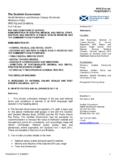
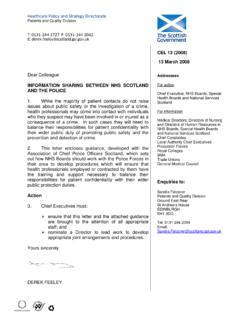
1 The Scottish Government Health Workforce Directorate Dear Colleagues Framework FOR THE implementation OF isolation exemptions FOR HEALTH AND SOCIAL CARE STAFF We are writing to share a Policy Framework and accompanying staff fact sheet outlined in full below. The Framework has been designed with clinical leads within the Scottish Government to enable fully vaccinated and asymptomatic Health and Social Care staff who have been a contact of someone with a positive Covid test to be exempted from self- isolation requirements under specific circumstances.
2 These circumstances are detailed within the Framework which sets out a range of control measures to ensure that we continue to prioritise the safety of Health and Social Care staff and patients / service users. The Scottish Health and Social Care workforce has been impacted by high community Covid transmission rates, with self- isolation policy of contacts contributing to sustained pressure on certain services resulting from increases to staff absence. The Framework will assist Health and Social Care Employers to determine the appropriate in extremis conditions in which they can ask appropriate staff if they are willing to return to support service delivery.
3 It is important to stress that nothing in the Framework would make it mandatory for any self-isolating health and social care worker to return to work, even if asked. No staff member should feel under any pressure to return to work during a period of self- isolation if they don t feel able to do so. The Scottish Government is committed to evidence based policy making and we have supplied the Public Health Scotland SBAR which provides some of the evidence in support of this approach. The recommendation provides an agreed variation to the current policy position in Scotland and can be implemented at service level on a case-by-case basis across both Health and Social Care services.
4 DL (2021) 22 Addresses For action Chief Executives, Chairs, HR Directors, Testing SPOCs, Nurse Directors, Medical Directors, Local Authority Chief Executives, Chief Social Work Officers, Chief Officers. For information Infection Control Managers, Public Health Directors, Employee Directors, Representatives, Workforce Senior Leadership Group Members. Enquiries to: Scottish Government Directorate for Health Workforce St. Andrew s House Regent Road Edinburgh EH1 3DG E-mail Yours sincerely Gillian Russell Director of Health Workforce Professor Amanda Croft Chief Nursing Officer Gregor Smith Chief Medical Officer Appendix A.
5 Policy Framework for the implementation of isolation exemptions for health and social care staff Purpose 1. To set out the specific circumstances in which NHS and social care staff who are fully vaccinated and undertake regular testing in line with Public Health Scotland (PHS) guidance, can (on a voluntary basis) be exempted from the need to isolate to ensure frontline health and social care services can continue to be delivered safely. 2. PHS have undertaken a detailed review of the evidence and balance of risks to staff and those they care for and support, and concluded that where robust mitigations are in place staff can return to work.
6 The PHS advice and evidence is summarised below: PHS advise that with the mitigations of double vaccination, no ongoing exposure to the Covid case, no symptoms, negative PCR result and ongoing LFD testing in place, the risk is extremely low and far outweighed by the risk to service users and the wellbeing of staff where there are severe and significant staff deficits. British Medical Journal study of health and social care workers and household contacts showed that vaccination was effective at reducing Vaccine studies have shown that vaccines are effective against the delta variant, particularly two weeks following completion of second vaccine 2 3 Lateral flow tests are effective at picking up the delta Daily contact testing using lateral flow tests has previously been shown to prove useful in sustaining key 3.
7 A Situation, Background, Assessment, Recommendation (SBAR) from PHS entitled self- isolation guidance following double vaccination setting out this position is included in Annex A. 4. No provision of this policy makes it a mandatory requirement for staff currently self-isolating to return to work. This policy puts into place a temporary set of provisions designed to protect health and social care service provision, by allowing staff who voluntarily wish to end self- isolation to do so safely. Where staff choose to return to work under the terms of this policy, the clinical mitigation requirements outlined, including to undertake testing, are mandatory.
8 1 Effect of vaccination on transmission of COVID-19: an observational study in healthcare workers and their households (preprint) 2 Effectiveness of COVID-19 vaccines against the variant | medRxiv 3 Effectiveness of COVID-19 vaccines against hospital admission with the Delta variant - Public library - PHE national - Knowledge Hub ( ) 4 5 ,testing, 5. While this policy is in place it would be prudent that if a household contact of a healthcare or social care professional needs to get a PCR test then the staff member should get a PCR test at the same time.
9 This is to minimise delays for staff who volunteer to come back to work. 6. The policy would ordinarily only apply to those who are a passing close contact and not those who are a close contact of a case within their own household. A passing close contact can be described as a contact a staff member has encountered that is Covid positive but who is out-with their immediate household and who they don t have on-going exposure to. Only in exceptional circumstances where there is no resilience ( in a highly specialised service), the local risk assessment may justify those with ongoing exposure being exempt.
10 7. For those staff who are willing to return to work to relieve service pressures, they may be supported to do so through the additional provision of FFP3 masks, where this assists with allaying concerns that the staff member might have. Please note however that there is no evidence that FFP3 masks provide additional source control protection ( additional protection to the people whom the mask wearer is caring for or in contact with), as compared with fluid resistant surgical masks (FRSM). 8. The flexibility to wear an FFP3 mask for staff returning from self- isolation does not constitute a change to previous issued policy on the provision of PPE.