Transcription of Fun Math Game Printables - The Mathematics Shed
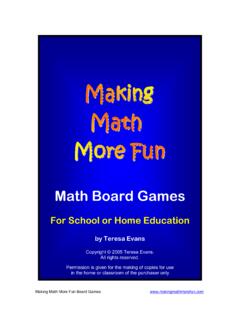
1 MAKING MATH MORE FUN BRINGS YOU FUN MATH GAME Printables FOR HOME OR SCHOOL THESE FUN MATH GAME Printables are brought to you with compliments from Making Math More Fun at and Math Board Games at Copyright 2011 Teresa Evans. All rights reserved. Permission is given for the making of copies for use in the home or classroom of the subscriber only. ContentsContentsContentsContents Math Board Games.
2 4 Add Up Tiles .. 5 Subtraction Tiles 7 Times Tiles . 9 Racing Cars .. 11 Take Four and Add .. 16 Four in a Row Add 17 Busy Beach 21 Print and Play Math Games 23 Fifteen . 24 Lucky 13 . 25 Tic Tac Toe 26 Fifteen Pebbles . 27 Corners 28 Pencil and Paper Math Games .. 29 Math Card Games . 33 Math Board games Add up Tiles 1 7 9 2 6 8 4 6 5 4 3 1 8 2 3 7 9 2 3 7 6 1 7 4 5 1 4 8 5 9 6 9 3 6 2 8 Add Up Tiles A game for 2 players All tiles are placed face down beside the board.
3 Players take turns to choose a tile and cover two spaces on the board that add to the total on the tile. The tile can be laid vertically or horizontally. A tile card cannot be placed on top of another tile. When a player picks up a tile and can t find a place to lay the tile, the other player is the winner. Add Up Tiles Cut along the dotted lines. 8 4 10 11 14 5 10 6 14 17 11 9 7 12 9 3 10 10 10 15 6 16 11 7 SUBTRACTION Tiles 13 6 9 12 7 9 9 15 8 7 5 13 12 7 9 17 8 6 14 8 11 8 15 4 7 16 9 12 6 11 16 6 13 5 14 7 SUBTRACTION Tiles A game for 2 players All tiles are placed face down beside the board.
4 Players take turns to choose a tile and cover two spaces on the board that have a difference of the total on the tile. For example, cover 8 and 6 with a 2 tile. The tile can be laid vertically or horizontally. A tile card cannot be placed on top of another tile. When a player picks up a tile and can t find a place to lay the tile, the other player is the winner. Subtraction Tiles Cut along the dotted lines. 6 2 9 4 8 3 1 9 7 7 5 10 5 3 6 9 8 1 2 7 6 8 4 10 Times Tiles 7 3 8 6 3 8 4 9 2 3 6 2 4 5 4 7 2 9 7 2 9 5 4 6 3 9 4 5 8 3 6 5 4 7 2 8 times Tiles A game for 2 players All tiles are placed face down beside the board.
5 Players take turns to choose a tile and cover two spaces on the board that multiply together to make the total on the tile. For example, cover 6 and 5 with a 30 tile. The tile can be laid vertically or horizontally. A tile card cannot be placed on top of another tile. When a player picks up a tile and can t find a place to lay the tile, the other player is the winner. Times Tiles Cut along the dotted lines. 15 16 20 18 8 35 14 27 12 28 21 30 24 40 45 6 32 42 36 48 10 14 54 25 a game for 2-4 players Spread out the chosen cards face down beside the Game Board.
6 Each player chooses a car and puts a marker on it. Each player turns over a card and says the number. Decide who has the largest number. The player with the largest number moves their counter to the next space. Return the cards and mix them up. Repeat until one player reaches the FINISH. FINISH FINISH FINISH FINISH Choose the set of cards for the skill that you want the children to practice. Choose the set of cards for the skill that you want the children to practice. Choose the set of cards for the skill that you want the children to practice.
7 Choose the set of cards for the skill that you want the children to practice. 26 81 30 64 56 47 72 17 33 91 27 55 63 71 97 38 84 49 13 77 21 68 41 52 951 461 124 579 604 259 673 371 395 535 970 267 290 840 134 482 840 907 457 831 127 513 882 306 1,265 8,036 3,289 2,305 7,409 6,170 1,067 5,138 3,005 2,217 7,193 4,067 8,690 6,450 5,606 2,391 4,313 1,672 4,279 6,801 9,026 5,627 3,240 7.
8 500 Choose the cards with numbeChoose the cards with numbeChoose the cards with numbeChoose the cards with numbers that the children are familiar with and able to that the children are familiar with and able to that the children are familiar with and able to that the children are familiar with and able to compare. TAKE FOUR AND ADD Player 1 + Player 2 + a game for 2 players Place the number cards face down on the table.
9 Each player chooses four number cards and then arranges them in their four boxes to make an addition with the highest possible total. The player who creates the largest total is the winner of the round and scores one point. For example - if a player chooses 2, 8, 4 and 3, they could make 82 + 43. Play several rounds. The winner will be the person who collects the most points. Four In A Row Add Four In A Row Add 2 - 4 players (Three simple steps and you re ready to play!) 1. Print the Four In A Row Add Game Board.
10 2. Print the markers and cut out. (You need a different color for each player.) 3. Get some dice and give the game to the kids to play. Play Four In A Row Add to practice addition to 12. Four In A Row Add A game for 2 4 players Players take turns to throw 2 dice. The numbers on the dice are added together. The player then finds this number on the board and covers it with one of the markers of their color. If none of these numbers are uncovered, the player doesn t cover a number on this turn. The first player to cover a row of four vertically, horizontally or diagonally - is the winner.