Transcription of Fundamental Matrices, Matrix Exp & Repeated Eigenvalues ...
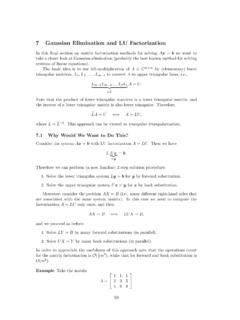
1 Fundamental Matrices, Matrix Exp &. Repeated Eigenvalues Sections & Given Fundamental solutions G. G G dx G. x1 ,.., xn of the ODE = Ax dt we put them in an nxn Matrix G G. , (t ) = ( x1 ,.., xn ). with each of the solution vectors being a column. We call (t) a Fundamental Matrix for the system of ODEs. Example. G. dx 1 2 G. = x dt 2 1 . 1 2 . det = (1 ) 2. 4. 2 1 . = 2 2 3 = ( 3)( + 1). 1. 1 2 . So the Eigenvalues of the Matrix A= 2 1 .. in our ODE are =3,-1. The corresponding eigenvectors are found by solving (A- I)v=0 using Gaussian elimination. We find that 1 . the eigenvector for eigenvalue 3 is: v= . 1 . 1 . w= . the eigenvector for eigenvalue -1 is: 1 . So the corresponding solution vectors for our ODE. system are G 3t 1 G t 1 . u1 = e , u2 = e . 1 1 . Our Fundamental Matrix is: G G e 3t e . t (t ) = ( u1 u 2 ) = 3t t . e e . 2. The general solution is G G G c1 . y (t ) = c1u1 + c2u2 = (t ) . c2 . If you need to find c1,c2 satisfying some initial condition like y(t0)=b, then you need to solve G c1 b1.
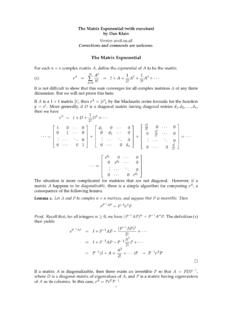
2 Y (t0 ) = (t0 ) = . c2 b2 . c1 1 1 . b = (t0 ) . c2 b2 . The inverse of the Fundamental Matrix exists because the Wronskian is not 0. Matrix Exponential Recall that the Taylor series for exp(x) is 3. n x e = , n ! = n(n 1)" 2 1. x n =0 n ! The series converges for all real numbers x. It also converges for all complex numbers x and for all nxn matrices A.. An A2 A3. exp( A) = = I + A+ + +". n =0 n ! 2! 3! So exp(0)=I=identity Matrix . You can legally differentiate these Taylor series term by term. This says for scalar x and nxn Matrix A, we have: 1 d ( xA ). n . d exp( xA) n n 1 n = = x A. dx n =0 n ! dx n =0 n ! . 1. = A ( xA) = A exp( xA). n 1. n =1 ( n 1) ! And exp(0)=I, the identity Matrix . 4. So we have a solution to the system of ODEs given by G G. dy G G. = Ay, y (0) = b ;. dx G G. y = exp( xA)b When a Matrix is diagonal D, it is easy to compute exp(D). a 0 . exp . 0 b . 1 0 a 0 1 a 2 0 1 a3 0 . = + + 2 . + 3.
3 +". 0 1 0 b 2! 0 b 3! 0 b . a2 . 1 + a + + " 0 ea 0 . 2! = = b . b 0 e . 2. 0 1+ b + . 2! . When an nxn Matrix A has n linearly independent G G. eigenvectors v1 ,.., vn , corresponding to the Eigenvalues ,.., we can write 1 n 5. A = TDT 1 , 1 "0 . G G . T = ( ) & D= # % # . 0 " . G G n . The reason is Av j = j v j . One has exp(TDT 1 ) = T exp( D)T 1. From this, it is easy to compute the solutions to the system of ODEs G G. dy G G. = Ay, y (0) = b ;. dx G G. y = exp( xA)b A = TDT 1 , 1 " 0 . G G . T = ( ) & D= # % # . 0 " . n . 6. Q(x)=exp(xD) and the Fundamental Matrix is (x)=TQ(x), where D is the diagonal Matrix of Eigenvalues of A and T is the Matrix coming from the corresponding eigenvectors in the same order. exp(xA) is a Fundamental Matrix for our ODE. Repeated Eigenvalues When an nxn Matrix A has Repeated Eigenvalues it may not have n linearly independent eigenvectors. In that case it won't be diagonalizable and it is said to be deficient.
4 Example. 7. 1 1 . A= . 0 1 . 1 1 . det =0. 0 1 . The roots of this are both 1. Gaussian elimination solves (A-I)x=0. 1 1 1 0 1 . A I = = . 0 1 1 0 0 . Solutions have x2=0, x1 arbitrary. So we have only 1 linearly independent eigenvector G v1 1 . v = = . v2 0 . This gives us one solution to the ode 8. G. dy G G 1 e x . = Ay; y =e = . x dx 0 0 . How to find a 2nd linearly independent solution? Our first idea is just to multiply this by x, but that will not be linearly independent as it is a multiple of the eigenvector v. Matrix Exp solves the problem. AB=BA implies exp(A+B)=expAexpB. So our Fundamental Matrix is exp(xA). 0 1 . A=I+N, N= 0 0 .. 1 x . N2=0 implies exp(xN)=I+xN= 0 1 .. (t)=exp(x(I+N))=exp(xI)exp(xN). ex xe x .. = 0 x . e . 9. G xG x G. Another way: write u2 = xe v + e w for some constant vector w to be determined. dw =. (. G d xe x ) G de G. v+. x w dx dx dx x G x G. = ( e + xe ) v + e w x G. x G x G. = ( e + xe ) v + e w dw x dx xG x G.
5 = A( xe v + e w). xG G. = xe v + e Aw x Here we used the fact that Av=v. 10. So now equate coefficients of x and 1. G xG xG G. ( e + xe ) v + e w = xe v + e Aw x x x G G G. ( v + w ) = Aw G G. xv = xv G G. We need to v = ( A I ) w;. solve for w 0 1 1 . Gauss ( A I | v) = . 0 0 0 . Solution is x2=1, x1 arbitrary. Putting this all together: G xG x G x 1 x 0 . u2 = xe v + e w = xe + e . 0 1 . G ( x + 1)e x . u2 = x . e . Check that this gives the same Fundamental Matrix as exp did. 11.