Transcription of GABRIEL WYNER - fluent-forever.com
1 1 1byGABRIEL 2 3 Copyright 2016 by GABRIEL WynerPublished digitally worldwide via the Fluent Forever website and design: Sandra SalsburyIllustrations: Sandra Salsbury (illustratingreddit), Zach Weiner (Saturday Morning Breakfast Ce-real), Michelle Czajkowski (Ava s Demon), Christopher Hastings (The Adventures of Dr. McNinja), Katie Tiedrich (Awkward Zombie), Chris Jones (Captain Excelsior and Snowflakes), Anthony Clark (Nedroid), Andrea Tsurumi (her website), Der-shing Helmer (The Meek) and Jess Fink (Chester 5000 XYV).First Edition byGabriel 3 Table of ContentsIntroduction 1 The 625: Story Order 5 The 625: Alphabetical Order 52 The 625: Thematic Order 57 The 625: Sample Translated Pages 63 The Most AW E S O M E WO R D L I S T 1 1 Welcome to the Most Awesome Word List You Have Ever Seen!
2 These words will form the foun-dation of your next new language. They re some of the most frequent words you ll encounter in any language, and they re all relatively easy to learn using pictures. In addition, because these words are grouped together into stories, they will be much easier to memorize when com-pared with the typical word lists that you find in language textbooks and classrooms, where you learn colors one day, types of vegetables the next day, members of the family the following day, s the story behind these lists?The research on this topic revolves around the concept of Here s the idea: Sup-pose you re living in Paris, taking a beginning French class.
3 One day, you learn a bunch of fruit names: une pomme (apple), une poire (pear), une p che (peach). A few days later, you see an apple at a fruit stand and try to recall the word in French. Your brain jumps into action, looking for your word through several possible routes. It s a fruit! It s a French word I learned a few days ago! It starts with a P!And because you happened to learn three French fruits that start with the letter P (and all on the same day), you re kind of screwed. Memo-ries compete. When you try to recall your word, your three French fruits get into a kind of mental tug-of-war, while you try to figure out which one seems the most apple-like.
4 As a result, you ll have a harder time remembering pomme, and even if you do remember, you ll take much longer to find unfortunately, that s not even the end of the story. While you re having this mental fight, you ve probably just made the situation a little worse for next time. Every time you think of two things at once, they interconnect. So if you re busy thinking about pommes, poires and p ches, and you re not particularly sure which one s which, then you re jumbling those three fruits together into a messy jam of Fairly confusing French fruits that start with the letter P. You ll be more likely to remember all three fruits the next time you try to retrieve the word for pear or ve run into this problem quite a bit on my own, especially in French, where I learned a lot of similar words at the same time.
5 I still have prob-lems remembering whether sept is 6 or 7, or whether jaune is yellow or at the numbersThe concept of interference has been researched in a lot of different contexts, and I ve linked five related studies at the end of this article, if you d like to read more. One of the first studies (Waring, 1997) gave test subjects a group of three to six words and their translations into a fake foreign language (apple = tisahl, pear = nugaw), and recorded how Yo u r f i r s t 6 2 5 w o r d s 1 For more on interference, check out this Wikipedia article: 2 3long it took each subject to memorize the trans-lations.
6 Half of the subjects got a group of closely related words (jacket, shirt, sweater), and half got unrelated words (frog, car, rain). The researchers would quiz subjects (what s the word for jacket ?) until they could remember every new translation within three seconds ( jacket !), and recorded the number of times they needed to repeat the tests until a subject successfully memo-rized a word. These are their results: Similar words took more than 35% longer to learn, at repetitions for a group of similar words, compared to repetitions for a group of unrelated words. This isn t particularly efficient.
7 Still, time isn t everything. What about reten-tion? Once you memorize a group of similar or unre-lated words, how well do they stick? In a 2008 study, researchers tested these ideas in a school, teaching Turkish kids 40 unrelat-ed English words (peg, key, rat, sun) and 40 related words (20 foods and 20 animals) in a classroom setting, and testing them afterwards on how well they could match English words and pictures. They tested them immediately after each lesson and again one week later. In both cases, the kids had a harder time remembering similar words: And they took longer to finish every similar-word quiz, taking an average of minutes to fin-ish, compared to minutes for unrelated-word What Are Our Options, Then?
8 When you go by the numbers, learning similar words at the same time is a terrible idea. Granted, it feels a lot more comfortable; you can feel like you ve accomplished something whenever you learn new words (I learned all the colors today!), but given the detrimental effects it has on learning, we need some other options. So what are our alternatives? In most studies, the alternative to word groups involved learning a jumble of totally un-related words, and that works quite well. If you ve browsed through my website or Appendix 5 of my book, you ve probably run across my list of 625 words to learn in every language.
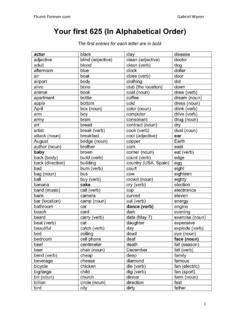
9 2 3 The first version of that list was presented in typical groups (animals, professions, etc.), but based upon the research, I started playing around with the idea of an alphabetical list. Normally, an alphabetical list would solve the similar word prob-lem at the expense of adding a new problem: the words would all sound similar. But if you start with an alphabetical list in English and then translate it into your target language, you basically create a randomly ordered list anyway. So I put my English word list in alphabetical order, translated it into Hungarian, and learned that list. In practice, I found that memorizing words was much easier.
10 I stopped getting my greens confused with my yellows (al-though I still get six confused with seven; I didn t follow my own advice when it came to numbers, and Hungarian s six and seven hat and h t are extremely similar looking). Alphabetical lists are also a lot easier to use; I could just skim through a Lonely Planet Phrase-book, circle my A-words, then circle my B-words, and after 30 minutes, I had good translations for every word in my list. As such, I decided to supply an alphabetical list in my book and added an al-phabetical list to my website. But alphabetical and random orders aren t an especially satisfying way to learn ( I learned 10 random words today is not as rewarding as I learned all the fruits today!)