Transcription of Gait Training - Advanced Prosthetics Center
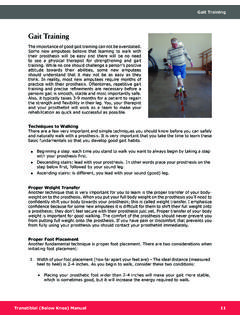
1 gait Training10 gait Training The importance of good gait Training can not be overstated. Some new amputees believe that learning to walk with their prosthesis will be easy and there will be no need to see a physical therapist for strengthening and gait Training . While no one should challenge a person s positive attitude towards their abilities, some new amputees should understand that it may not be as easy as they think. In reality, most new amputees require months of practice with their prosthesis. Oftentimes, repetitive gait Training and precise refinements are necessary before a persons gait is smooth, stable and most importantly safe. Also, it typically takes 3-9 months for a patient to regain the strength and flexibility in their leg. You, your therapist and your prosthetist will work as a team to make your rehabilitation as quick and successful as possible.
2 Fundamentals of WalkingLearning to walk with an above knee prosthesis requires the combined efforts of a well-trained therapist and prosthetist, both working together in a multi-disciplinary clinic. Since this level of amputation requires the user to learn how to operate two prosthetic joints (ankle & knee) it requires a patient to be both highly motivated throughout their rehab process. With the correct therapy many amputees can learn to walk relatively good and get back to doing almost everything they did before losing the biggest challenge in learning to walk with an above knee prosthesis is learning to operate a prosthetic knee joint. Muscles that once flexed and extended the knee no longer serves this purpose; instead the muscles at the hip are now responsible for operating the knee. This is why keeping the muscles at the hip flexible and strong is very important.
3 There are a few very important techniques you need to learn in order to walk with an above the knee prosthesis. These fundamental techniques can only be taught by an experienced limb loss gait Training this process with a sound foundation of strength and flexibility is extremely important. This requires patients to do both stretching and strengthening exercises to help keep their hip flexible and strong. Continuous practice of these exercises is extremely important in the full recovery following an above knee this level of amputation, participating in a Physical Therapy program is absolutely imperative. Transfemoral (Above Knee) ManualGait Training11 Hip Exercises Lay flat on your stomach and place a rolled up towel underneath the end of your residual limb. The object is to let your hip relax downward into bed as your limb stays upward.
4 Try to position your leg close together with your hips flat. Lie completely flat on your back and press your residual limb into the same towel, lifting your hip off of the bed. Be sure to keep your residual limb as close to your other leg as a Constant Body WeightIf you have been fit with a prosthesis that stays on your leg (suspends) with suction, it is very important to maintain a relatively constant body weight. Weight fluctuations or weight gain, should be kept to a minimum; as they can cause many socket-fitting problems. Weight Gain Your residual limb will continue to shrink for the first three years after your amputation. However, weight gain is the grim reaper of a well-fitting prosthesis. Gaining weight will quickly cause your prosthesis to be too tight and uncomfortable. Prosthetic sockets can accommodate up to 5-10 lbs of weight gain without too much discomfort.
5 It is very important to be aware of your diet and eating habits so that you can keep your weight relatively constant. This will be somewhat of a learning process but not an unreasonable one. Diet Considerations The amount of water your body retains is directly related to your diet and eating habits. Eating foods rich in sugar and salt may cause you to retain water, potentially making your prosthesis in technology have brought a lot of exciting materials to the prosthetic industry. Materials such as acrylic resins, carbon fiber, titanium, silicone and urethane have made prostheses stronger, lighter and more comfortable. Even though callous formation is no longer a common occurrence, fitting problems still occur. While there are sometimes other causes to the above socket fitting problems, most of the time residual limb shrinkage is the source of the problem.
6 If you experience any of the below problems that you are unable to remedy with socks you should contact your prosthetist. Common Fitting Problems Fitting problems due to limb shrinkage may include: Excessive pressure on the end of your residual limb. Uncomfortable pressure on the upper inside of your leg. Inadequate suction, causing the prosthesis to rotate or move up and down. Burping or air sound when you put weight on the prosthesis. The socket feels loose (Above Knee) ManualGait Training12 Troubles Applying your Prosthesis It will most likely take you 1-2 weeks to learn how to properly apply your prosthesis. Socket rotation (foot turned in or out) is the most common problem. Improper rotation positioning can cause the prosthesis to be uncomfortable and unstable. If you think you have the prosthesis on incorrectly, remove it and It is very important that you avoid quick fix remedies to your socket-fitting problems.
7 Trimming your liner or putting tissue in the bottom of your socket is not recommended. These home remedies may cause harm to your residual limb. Do not cut, grind or structurally modify your prosthesis in any way. Direct modification to the socket will void warranties unless they are done by a qualified Prosthetist. Never attempt to make alignment changes to your prosthesis by adjusting the allen screws on the ends of the pylon. If done improperly, it can result in not only an unstable walking alignment but possible component failure as well. If you experience any socket fitting problems that cannot be fixed by the suggestions listed above please contact your prosthetist immediately. Sometimes, simply discussing a problem with your prosthetist can result in a quick (Above Knee) Manual