Transcription of Gaze Stabilization Exercises - Activator
1 Gaze Stabilization Exercises Gaze Stabilization Exercises . ( ) Procedures of Gaze Stabilization Exercises : Begin with simpler Exercises , progress to harder ones. So what does it mean harder? These Exercises as incorporate many "dimensions" -- protocol, speed/frequency, target distance (near/far), background, orientation of head on trunk, and orientation of head with respect to gravity. Of course, this defines a gigantic multidimensional treatment space. The goal is to find the relevant areas in this space which are not working well and practice them. A vestibular physical therapist can be very helpful in selecting the appropriate variation. These Exercises are not "done" just at the (weekly) PT session - - you do them EVERY DAY. We usually recommend doing them for at least 30 minutes (which may be split over several sessions). The duration needs to be carefully adjusted so that it is enough to make a person "dizzy", but not enough to make them "sick".
2 exercise dimensions -- how Exercises are made more complex and difficult: 1. Protocol of head movement 1. Head turn with pause (head thrusts, may be very fast) 2. Head turn back and forth continuously without pause (sinusoidal, generally slow and medium only) 3. Occasionally, one adds in linear movement (these are angular movements) such as sitting on a "bouncy ball". These types of movements are sometimes important to driving. 2. Speed of head movement -- you want to practice all of these --not just the fast one. 1. Slow 2. Medium 3. Fast (also called a head thrust) 3. Target distance while moving head --this is to change demands for otolithic participation 1. Near (1 foot) 2. Far (3 feet or greater) 4. Background while moving head -- this is to practice multisensory integration. Very important. 1. Eyes closed (this is for practice of mental imagery) 2.
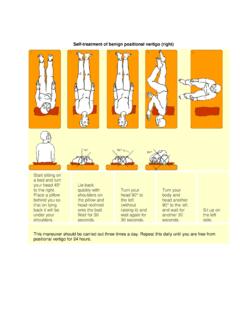
3 Blank background 3. busy background ( checkerboard) 4. Very busy background ( grocery store) 5. Very busy moving background ( crowds, windy outdoors, watching waves come in) 6. Misleading background ( rotating visual surround, twisting golf umbrella, walking against a crowd moving the other direction, x2 Exercises - -where head and target move in different directions) 5. Head position on trunk -- this is to avoid training for a single context. This may not be the most important dimension unless you spend a lot of time with your head off-center. 1. Middle 2. Left and right 3. Up and down 4. Roll (movement of head around front-back axis) 6. Head position with respect to gravity -- to avoid training for a single context. This is not the most important dimension unless you need to have good balance in odd positions. 1. Upright 2. Supine 3.
4 Prone 7. Other things going on that require mental processing by themselves. This is where things can get really hard, when combined with some of the other activities above. 1. Movement such as walking -- outdoors is best, but a treadmill is another possibility. 2. Thinking/talking on your cell phone/driving Measuring outcome. Visual acuity while active and subjective symptoms are the main measures here.