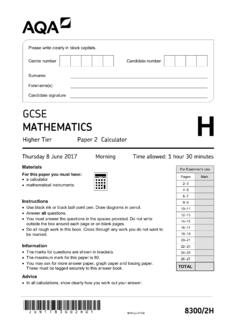
Transcription of GCSE Mathematics - ELITE Tuition
1 Revision Guides GCSE Mathematics ABCDEFGHIJKLMNOPQRSTUVWXYZ higher Tier Stafford Burndred Consultant Editor: Brian Seager, Chairman of Examiners Easingwold School GCSE Mathematics Address .. Date of exams: (1) .. (2) .. Aural .. Coursework deadline dates: (1) .. (2) .. Exam board .. Syllabus number .. Candidate number .. Centre number .. Further copies of this publication, as well as the guides for Foundation and Intermediate tiers may be obtained from: Pearson Publishing Chesterton Mill, French's Road, Cambridge CB4 3NP. Tel 01223 350555 Fax 01223 356484.
2 Email Web site ISBN: 1 84070 272 9. Published by Pearson Publishing 2003. Pearson Publishing No part of this publication may be copied or reproduced, stored in a retrieval system or transmitted in any form or by any means electronic, mechanical, photocopy, recording or otherwise without the prior permission of the publisher. Easingwold School Contents Introduction .. vi Examiner's tips .. vii Number skills Rational and irrational numbers .. 1. Calculator skills Using a calculator: Brackets, memory and fractions .. 2. Using a calculator: Powers, roots and memory.
3 3. Standard form .. 4. Fractions, decimals and Percentages and 5. percentages Calculating growth and decay rates .. 6. Number patterns Patterns you must 7. Product of primes, highest common factor, lowest common multiple and reciprocals .. 8. Equations Trial and improvement .. 9. Equations .. 10. Rewriting formulae .. 11. Iteration .. 12. Variation Direct and inverse variation .. 13. Algebraic skills Using algebraic formulae .. 14. Rules for indices (powers) .. 15. Expansion of brackets .. 16. Factorisation 17. Factorisation 18. Factorisation 19. Solving quadratic equations.
4 20. Simultaneous equations: Solving using algebra .. 21. Simplifying algebraic fractions 1 .. 22. Simplifying algebraic fractions 2 .. 23. Graphs Drawing 24. Simultaneous equations: Solving by drawing a graph .. 25. Solving equations using graphical 26. The straight line equation y = mx + c .. 27. Using tangents to find gradients .. 28. Expressing general rules in symbolic form 1 .. 29. Expressing general rules in symbolic form 2 .. 30. Drawing 31. Sketching graphs 32. Sketching graphs 33. Speed, time and distance graphs .. 34. Area under a 35. Easingwold School Contents Angles Intersecting and parallel lines.
5 36. Bearings .. 37. Similarity 38. Congruency Congruent triangles 1 .. 39. Congruent triangles 2 .. 40. Transformations Combined and inverse 41. Enlargement by a fractional scale 42. Enlargement by a negative scale 43. Measurement Compound 44. Time .. 45. Upper and lower bounds of numbers 46. Upper and lower bounds of numbers 47. Circles Length, area and volume of shapes with 48. Angle and tangent properties of circles 1 .. 49. Angle and tangent properties of circles 2 .. 50. Angle and tangent properties of circles 3 .. 51. Perimeter, area and volume Calculating length, area and volume 1.
6 52. Calculating length, area and volume 2 .. 53. Calculating length, area and volume 3 .. 54. Formulae for length, area and volume .. 55. Ratio for length, area and volume .. 56. Pythagoras' theorem Pythagoras' theorem .. 57. and trigonometry Trigonometry: Finding an 58. Trigonometry: Finding a side .. 59. Trigonometry: Solving 60. Trigonometry and Pythagoras' theorem for 3-D 61. Sine, cosine and tangent of any angle 1 .. 62. Sine, cosine and tangent of any angle 2 .. 63. Sine, cosine and tangent of any angle 3 .. 64. Sine rule, cosine rule, area of a triangle 1.
7 65. Sine rule, cosine rule, area of a triangle 2 .. 66. Vectors Vectors 67. Vectors 68. Vectors 69. Vectors 70. Locus Locus (plural loci) .. 71. Easingwold School Contents Questionnaires Designing 72. Sampling .. 73. Hypotheses .. 74. Tables and graphs Comparing data .. 75. Histograms .. 76. Grouped 77. Cumulative frequency Cumulative frequency .. 78. Using cumulative frequency diagrams to compare distributions .. 79. Standard deviation Standard deviation .. 80. The normal 81. Scatter diagrams Line of best fit .. 82. Probability Estimation of probability by experiment.
8 83. Tree 84. Conditional and independent probability .. 85. Probability (and, or).. 86. Probability (at least).. 87. Supplementary material 3-D co-ordinates .. 88. Inequalities .. 89. Critical path analysis .. 90. Linear 91. Transformations (matrices) 1 .. 92. Transformations (matrices) 2 .. 93. Important facts you are expected to know .. 94. Diagnostic tests Diagnostic tests .. 98. 111. Index .. 116. Easingwold School Introduction The aim of this guide is to ensure you pass your exam and maybe even achieve a higher grade than you expect to. Ask your teacher to explain any points that you don't understand.
9 You will have to work hard at your revision. Just reading this book will not be enough. You should also try to work through the tests at the back and any past papers that your teacher might set you to ensure that you get enough practice. Remember it is your guide, so you may decide to personalise it, make notes in the margin, use the checklist in the contents to assess your progress, etc. You may also find it useful to mark or highlight important sections, pages or questions you find difficult. You can then look at these sections again later. The guide is divided into over 75 short topics to make it easy to revise.
10 Try to set aside time every week to do some revision at home. The guide is pocket-sized to make it easy to carry. Use it wherever you have time to spare, eg registration, break, etc. Using the guide It may help you to place a blank piece of paper over the answers. Then read the notes and try the questions. Do your working out and answers on the blank piece of paper. Don't just read the answers. Compare your answers with the worked answer. If your answer is wrong read the page again and then mark or make a note of the question or page. You will need to try the question again at a later date.