Transcription of GCSE Religious Studies B (Short Course) - Edexcel
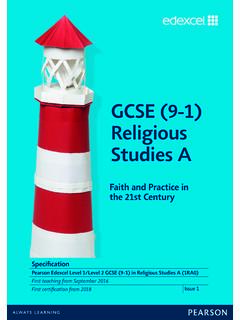
1 gcse Religious Studies B ( short course ). Beliefs in Action This draft qualification has not yet been accredited by Ofqual. It is published to enable teachers to have early sight of our proposed approach to Pearson Edexcel Level 1/Level 2 gcse (9 - 1) in Music (1MU0). Further changes may be required and no assurance can be given at this time that the proposed qualification will be made available in its current form, or that it will be accredited in time for first teaching in September 2016 and first award in 2018. Sample Assessment Materials Pearson Edexcel Level 1/Level 2 gcse (9-1) in Religious Studies B ( short course ) (3RB0). First teaching from September 2016. First certification from June 2018 Issue 1.
2 Edexcel , BTEC and LCCI qualifications Edexcel , BTEC and LCCI qualifications are awarded by Pearson, the UK's largest awarding body offering academic and vocational qualifications that are globally recognised and benchmarked. For further information, please visit our qualification websites at , or Alternatively, you can get in touch with us using the details on our contact us page at About Pearson Pearson is the world's leading learning company, with 40,000 employees in more than 70 countries working to help people of all ages to make measurable progress in their lives through learning. We put the learner at the centre of everything we do, because wherever learning flourishes, so do people. Find out more about how we can help you and your learners at References to third party material made in this document are made in good faith.
3 Pearson does not endorse, approve or accept responsibility for the content of materials, which may be subject to change, or any opinions expressed therein. (Material may include textbooks, journals, magazines and other publications and websites.). All information in this document is correct at time of publication. Original origami artwork: Mark Bolitho Origami photography: Pearson Education Ltd/Naki Kouyioumtzis ISBN 978 1 4469371 0 5. All the material in this publication is copyright Pearson Education Limited 2016. Contents Introduction 1. General marking guidance 3. Paper 1A 5. Paper 1A mark scheme 13. Paper 1B 21. Paper 1B mark scheme 31. Paper 1C 39. Paper 1C mark scheme 47. Paper 1D 55. Paper 1D mark scheme 65.
4 Paper 1E 73. Paper 1E mark scheme 81. Paper 1F 89. Paper 1F mark scheme 97. Paper 1G 105. Paper 1G mark scheme 113. Paper 2A 121. Paper 2A mark scheme 129. Paper 2B 137. Paper 2B mark scheme 145. Paper 2C 153. Paper 2C mark scheme 161. Paper 2D 169. Paper 2D mark scheme 177. Paper 2E 185. Paper 2E mark scheme 193. Paper 2F 201. Paper 2F mark scheme 209. Paper 2G 217. Paper 2G mark scheme 225. iv Pearson Edexcel Level 1/Level 2 gcse (9-1) in Religious Studies B ( short course ) Sample Assessment Materials . Issue 1 June 2016 Pearson Education Limited 2016. Introduction The Pearson Edexcel Level 1/Level 2 gcse (9-1) in Religious Studies B ( short course ) is designed for use in schools and colleges. It is part of a suite of gcse qualifications offered by Pearson.
5 These sample assessment materials have been developed to support this qualification and will be used as the benchmark to develop the assessment students will take. Pearson Edexcel Level 1/Level 2 gcse (9-1) in Religious Studies B ( short course ) Sample Assessment Materials 1. Issue 1 June 2016 Pearson Education Limited 2016. 2 Pearson Edexcel Level 1/Level 2 gcse (9-1) in Religious Studies B ( short course ) Sample Assessment Materials . Issue 1 June 2016 Pearson Education Limited 2016. General Marking Guidance All candidates must receive the same treatment. Examiners must mark the first candidate in exactly the same way as they mark the last. Mark schemes should be applied positively. Candidates must be rewarded for what they have shown they can do rather than penalised for omissions.
6 Examiners should mark according to the mark scheme not according to their perception of where the grade boundaries may lie. All the marks on the mark scheme are designed to be awarded. Examiners should always award full marks if deserved, if the answer matches the mark scheme. Examiners should also be prepared to award zero marks if the candidate's response is not worthy of credit according to the mark scheme. Where some judgement is required, mark schemes will provide the principles by which marks will be awarded and exemplification may be limited. When examiners are in doubt regarding the application of the mark scheme to a candidate's response, the team leader must be consulted. Crossed-out work should be marked unless the candidate has replaced it with an alternative response.
7 Marking guidance for levels based mark schemes Finding the right level The first stage is to decide which level the answer should be placed in. To do this, use a best-fit'. approach, deciding which level most closely describes the quality of the answer. Answers can display characteristics from more than one level, and where this happens markers must use their professional judgement to decide which level is most appropriate. Placing a mark within a level After a level has been decided on, the next stage is to decide on the mark within the level. The instructions below tell you how to reward responses within a level. However, where a level has specific guidance about how to place an answer within a level, always follow that guidance.
8 Statements relating to the treatment of students who do not fully meet the requirements of the question are also shown in the indicative content section of each levels based mark scheme. These statements should be considered alongside the levels descriptors. Markers should be prepared to use the full range of marks available in a level and not restrict marks to the middle. Markers should start at the middle of the level (or the upper middle mark if there is an even number of marks) and then move the mark up or down to find the best mark. To do this, they should take into account how far the answer meets the requirements of the level: If it meets the requirements fully, markers should be prepared to award full marks within the level.
9 The top mark in the level is used for answers that are as good as can realistically be expected within that level If it only barely meets the requirements of the level, markers should consider awarding marks at the bottom of the level. The bottom mark in the level is used for answers that are the weakest that can be expected within that level The middle marks of the level are used for answers that have a reasonable match to the descriptor. This might represent a balance between some characteristics of the level that are fully met and others that are only barely met. Pearson Edexcel Level 1/Level 2 gcse (9-1) in Religious Studies B ( short course ) Sample Assessment Materials 3. Issue 1 June 2016 Pearson Education Limited 2016.
10 4 Pearson Edexcel Level 1/Level 2 gcse (9-1) in Religious Studies B ( short course ) Sample Assessment Materials . Issue 1 June 2016 Pearson Education Limited 2016. Write your name here Surname Other names Pearson Edexcel Centre Number Candidate Number Level 1/Level 2. gcse (9 1). Religious Studies B. ( short course ). Paper 1: Area of Study 1 Religion and Ethics Option 1A: Catholic Christianity Sample assessment material for first teaching Paper Reference September 2016. Time: 50 minutes 3RB0/1A. You do not need any other materials. Total Marks Instructions Use black ink or ball-point pen. Fill in the boxes at the top of this page with your name, centre number and candidate number. Answer all questions.