Transcription of General Guidelines for Administering Medication …
1 253 VIRGINIA SCHOOL HEALTH Guidelines General Guidelines for Administering Medication in School Note: The following information is a reprint from: Keen, T. (Ed.) with Ford, N., Henry, J., and Cox A. (Consulting Eds.). (1996). Medication Administration. Guidelines for Specialized Health Care Procedures. Richmond, Va.: Virginia Department of Health. This reprint contains some updated information, which is contained within brackets: [ ]. Overview Administering prescriptive and over-the-counter Medication during school hours is a complex issue. In order for many students with chronic illnesses or disabilities to remain in school, they must receive Medication . However, Administering Medication in school has the potential for many problems, such as storage problems, who will administer the Medication , potential undesirable side effects, and emergency situations which may arise as a result of the Medication .
2 Medication must be administered under the safest possible conditions. Therefore, these Guidelines are offered to assist school divisions in developing a policy for Administering Medication to students at school. The following Guidelines were developed to provide guidance for Administering Medication to students who have specialized health care needs. Prior to Administering Medication Prior to Administering any prescriptive Medication the following three items should be addressed: Authorization for Medication . Labeling for the Medication . Parental consent. Note: Policies for over-the-counter medications vary greatly from one school division to another. Refer to local school division policies for policies for over-the-counter medications. Medication Authorization. The use of all prescriptive medications should be authorized in writing by a licensed prescriber, which includes physicians, dentists, physician assistants, or licensed nurse practitioners.
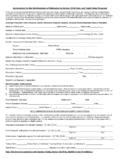
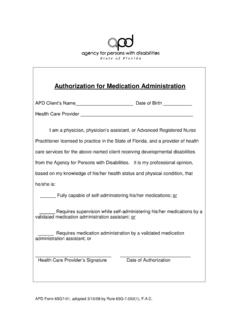
3 The written authorization should include the following information: Student s name. 254 254 Licensed prescriber s name, telephone number, and signature. Date prescription written. Name of the Medication . Dosage. Time of day to be given. Anticipated length of treatment. Diagnosis or reason the Medication is needed (unless reason should remain confidential). Serious reactions that the student might experience. Any serious reactions that may occur if the Medication is not administered. Special handling instructions. (See example of a Medication authorization/parental consent form at the end of this section.) Any changes in the original Medication authorization require a new written authorization and a corresponding change in the prescription label. Faxed authorizations may be acceptable as long as there is a signed parental consent for the medications authorized by fax.
4 Changes in medications via the telephone should be taken only under extreme or urgent circumstances. Telephone changes should be taken directly from the licensed prescriber by a licensed nurse only if this is consistent with the local school division policy. The telephone authorization for changes in medications should be recorded on the student s record and be a one-time-order only. A telephone authorization should be followed by a written order from the licensed prescriber within 24 hours. Medication authorizations should be received on a standardized authorization form. However, authorizations on stationary or prescription pads from the licensed prescriber or an acceptable label on the prescription container (see Medication labeling below) are acceptable if the parents/legal guardian sign and date the form/label. Parental Consent. In addition to the authorization for Administering Medication , parental consent must be obtained before a Medication is given to a student.
5 For each Medication , the parental consent should include the following information: Student s name. Parent s name. Parent s emergency/daytime phone number. 255 VIRGINIA SCHOOL HEALTH Guidelines Statement of parental consent. Date of consent. Allergies. Name of the Medication (if not on Medication authorization form). Reason for the Medication (if not on Medication authorization form). Duration of treatment (if not on Medication authorization form). If a Medication is administered over a long period, a renewed consent form should be obtained every six months, or if it is a standing order, parental consent should be renewed yearly. (See example of a Medication authorization/parental consent form at the end of this section.) Medication Labeling. The final area that should be addressed prior to Administering Medication is labeling. The Medication must be in its original container before it is given to a student.
6 The pharmacist can divide the Medication into two containers one for home and one for school. The original container should be labeled with the student s name, name of Medication , directions for dosage, frequency to be administered, the licensed prescriber s name, and the date the prescription was filled. Medications in plastic bags or other non-original containers are not acceptable. Administering Medication School Staff. In schools where school nurses are available on a daily basis, it is recommended that school nurses assume responsibility for arranging the administration of Medication to students. In schools where school nurses are not available on a daily basis, it is recommended that the principal assume responsibility for arranging the administration of the Medication . If an aide is assigned to administer the Medication , the Medication authorization, parental consent, and Medication label should be reviewed by the school nurse, principal, or principal s designee prior to giving the first dose.
7 [Note: First dose of a new Medication should be given at home.] It is recommended that the principal or school nurse ensure that: Medication is given correctly and documented appropriately. The appropriate forms are completed prior to giving a Medication to include authorization and parental consent. (See sample form at end of this section.) The Medication is properly labeled and stored properly in a secure, safe place. 256 256 Documentation of Administering Medication . When Medication is brought to school, the amount of Medication in the container should be noted ( , the number of capsules or the volume of liquid). Each time a Medication is administered a record should be kept of who administered it (initials may be used as long as a complete signature that corresponds with the person s initials is noted on the record), to whom it was given, the name of the Medication , the time it was given, the dose given, the manner in which it was delivered ( , by mouth, in ear), the effect of the Medication , and any side effects or reactions.
8 Any changes in the type or dosage of the Medication or the time it is to be given, should be accompanied by a new Medication authorization/parent consent form, and a newly labeled Medication container from the pharmacy. The school nurse or principal should establish the date when written Medication renewals will be required. Storage of Medications. A two-week supply or less of medications (unless Medication is taken on a daily basis throughout the school year) should be kept in an appropriately labeled container which is locked and secured in a designated space ( , a locked box stored within a locked cabinet). Access to keys for the storage space in which Medication is kept should be limited to the school nurse, the principal, and authorized staff. A listing of authorized staff should be maintained by the principal and updated routinely. Keys to the Medication storage area should never leave the school grounds.
9 Arrangements need to be made for medications requiring refrigeration. The school nurse or principal should establish a date when any unused Medication should be picked up by parents. Parents/Guardian. Prior to Administering a Medication at school the parents should: 1. Provide the school with a written authorization from the licensed prescriber that includes the following information: the student s name, name of the Medication , dosage, hours to be given, method by which it is to be given, name of the licensed prescriber, date of the prescription, expected duration of administration of the Medication , and most importantly, possible toxic effects and side effects. For any changes in Medication , the parents must provide a written authorization signed by the licensed prescriber. 2. Provide the Medication in a container labeled as required. 3. Provide a completed parental consent form.
10 4. Administer the first dose of any new Medication , unless the Medication is an in school Medication only. 5. Transport Medication to the school so that the student is not responsible for bringing the Medication to school. (See example of a Medication authorization/parental consent form at the end of this section.) Unused Medication should be picked up by parents within one week of the expiration date. After one week the Medication should be destroyed by the school nurse, principal, 257 VIRGINIA SCHOOL HEALTH Guidelines or the principal s designee. Medication given on a daily basis throughout the year should be destroyed two weeks after the last day of school. It is advisable that the destruction of the Medication be witnessed by another person. [Note: School divisions should establish their own policy regarding disposal of medications based on available staff after the last day of school.]