Transcription of General Information About Proxies - Florida …
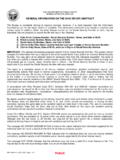
1 General Information About Proxies A condominium or cooperative unit owner may use a proxy form to vote on an issue in the event that he or she cannot attend the meeting at which the issue will be decided. The proxy form is given to someone (the proxy holder) who is expected to attend the meeting in the absent owner's place and act on the owner s behalf. A unit owner who plans to attend a meeting by proxy should make sure that the entrusted person plans to attend the meeting and can be relied upon to deliver the proxy form to the association. (Many associations require proxy holders to give the proxy form to the association secretary before the meeting begins.)
2 The unit owner should consult the association bylaws and articles of incorporation.) It would be wise for the unit owner, or the proxy holder, or both, to keep a copy of the proxy form that was delivered to the association. General vs. Limited Proxy A limited proxy form is one in which the owner has specified how the proxy holder is to vote on a specific issue. With a limited proxy, the proxy holder may not decide how the owner's vote will be cast, and the owner s vote must be counted as indicated on the limited proxy form . A General proxy form , on the other hand, generally indicates that the owner has authorized the proxy holder to attend the meeting on the owner s behalf.
3 The holder of a General proxy may exercise his or her own judgment regarding how to vote on issues presented at the meeting. However, the Condominium and Cooperative Acts prohibit holders of General Proxies from voting on certain matters. Limited Proxies are required for: (1) voting on waiving reserves or on assessing for reserves that will be less than adequate; (2) voting on an amendment to the declaration of condominium (except in cooperatives), articles of incorporation, or bylaws; (3) voting on reducing the financial reporting requirements at year's end; and (4) voting on any other issues when the vote is specifically required or permitted by the Condominium Act or Cooperative Act.
4 Although General Proxies may not be counted for such matters, they may be counted for the purpose of establishing a quorum at a meeting where such matters are decided. Limited proxy forms must substantially conform to the format adopted by the Division of Condominiums, Timeshares, and Mobile Homes. BPR form CO 6000-7 can be found at the Division s website. Instructions for the Limited Proxy form Responsibilities of the association Responsibilities of unit owners 1. Fill in the condominium or cooperative name, date and time of the meeting, and the location at which the meeting will be held.
5 2. Fill in the name and/or position of an officer or director who will serve as proxy holder in the event that no other proxy holder is names by the voter. 3. Under the section for limited powers, write clearly the question or issue for which the owner may indicate a vote, both for and against, to be cast. 4. Provide instructions to the voter regarding the completion of the proxy. Revised 04/2014 1. If not already shown on the proxy, write in your unit number. 2. In the appropriate place, print the name of your designated proxy holder. If you do not name anyone, your vote will be cast by the officer or director designated on the form .
6 3. In the General powers area, decide whether or not you wish to have your proxy holder determine how to cast your vote on issues other than those listed under limited powers. If you choose to do so, mark the appropriate space granting that power 4. Read the issues in the limited powers area, and mark your vote for or against each. 5. Sign and date the form and give it to the designated proxy holder or return it to the association.