Transcription of GENETICS AND PLANT BREEDING - ICAR
1 Publication (A)/Pub- 13/3-2001 CURRICULA AND SYLLABI FORMASTER'S DEGREE PROGRAMSGENETICS AND PLANT BREEDINGANDSEED SCIENCE AND TECHNOLOGYACCREDITATION BOARD SECRETARIATEDUCATION DIVISIONINDIAN COUNCIL OF AGRICULTURAL RESEARCH,KRISHI ANUSANDHAN BHAVAN II, NEW DELHI-11Q O12 CURRICULA AND SYLLABI FORMASTER'S DEGREE PROGRAMSGENETICS AND PLANT BREEDINGANDSEED SCIENCE AND TECHNOLOGYCURRICULA AND SYLLABI FORMASTER'S DEGREE PROGRAMSGENETICS AND PLANT BREEDINGANDSEED SCIENCE AND TECHNOLOGYACCREDITATION BOARD SECRETARIATEDUCATION DIVISIONINDIAN COUNCIL OF AGRICULTURAL RESEARCH,KRISHI ANUSANDHAN BHAVAN II, NEW DELHI-110 012 Publication No. 1 CAR/Ed.(A) : NOVEMBER 2001 DIRECTOR (DIPA) : ARVIND CHAKRAVARTYCHIEF PRODUCTION OFFICER : V K BHARTITECHNICAL OFFICER : ASHOK SHASTRIP ublished by Shri Arvind Chakravarty, Director, Directorate of Information and Publications ofAgriculture, Krishi Anusandhan Bhavan, Pusa, New Delhi, Laser typeset at M/s.
2 HD ComputerCraft, EA-1/75, Inderpuri Main Market, New Delhi 110012 and Printed at M/s. Power Printers,2/8A, Ansari Road, Delhi-110002 PrefaceThe agricultural scenario in the post Green Revolution era has changedIndian agriculture from the subsistence farming to a commercial enter-prise. Signing of World Trade agreement by India has exposed Indianfarmers to the global competition. This demands rapid modernization ofIndian agriculture so that our farm produce meets not only national butinternational quality standards, is produced at internationally competi-tive price and is sustainable. This, therefore calls for developing andimparting proper training to the farmers, which is possible only if thetrainers which are produced by the agricultural universities are them-selves properly educated in the advances in science of agriculture par-ticularly at the post-graduate level where they have not only to learn therecent advances in their subject but have also to be trained in the mod-ern and latest techniques in their disciplines so that they can partici-pate and contribute in the development and advancement of agricul-tural science in this in view, the ICAR which is vested with the responsibilitiesof guiding and coordinating agricultural education in the country.
3 Tookseveral steps to ensure quality education to meet the ever changing na-tional and global scenario in agriculture and allied sciences. One ofthese steps was to set up an Accreditation Board, which among otherthings is required to periodically assess the curricula of various educa-tional programs offered by the National Agricultural Education Systemand suggest second step in this connection was the constitution of Broad Sub-ject Matter Area (BSMA) Committees for modification of PG Curriculaand related issues. The BSMA Committee on PLANT Science was consti-tuted through ICAR Office Order No. l-3 to revise PG Curricula in GENETICS and PLANT BREEDING , andSeed Science and Technology. The Committee comprised Dr S. ChandraShetty, UAS, Bangalore; Dr Gautam, NBPGR, New Delhi; Dr , GBPUAT, Pantnagar; Dr Singh, BHU, Varnasi; Dr MMKD urga Prasad of ANGRAU, Dr Singhal, IARI, New Delhi and Dr , ICAR, New Delhi with Dr Sarkar, IARI, New Delhi as some of the members met informally and exchanged their views,formal meeting of the Committee could not be held.
4 Therefore, Dr , Head of Division, GENETICS , IARI, New Delhi and Dr Singhal,Professor, Seed Science and Technology, IARI, New Delhi were identifiedand requested to take lead in restructuring the PG curricula in respec-tive disciplines. These identified Subject Matter Specialist took pains tocompile the draft curricula based on the syllabi of leading institutions,both in India and abroad. The compiled curricula and course outlineswere sent to different institution in India for their comments. The com-ments were analyzed and incorporated in the draft syllabi, which werediscussed in separate workshops organized for the purpose and final-ized. The workshop on GENETICS and PLANT BREEDING was held at IARI,New Delhi on 27-28 April, 2001, which was attended by 39 Scientist(Appendix I). Similarly, the workshop on Seed Science and Technologywas organized at NAARM, Hyderabad on 6-7 April, 2001, where 34 per-sons participated (Appendix-II).
5 The curricula and course outlines, which emerged from these workshopswere placed before the Sectoral Committee of Accreditation Board onCurricula and Equivalence, which recommended the same to the Boardfor approval. The Board approved the curricula and course outlines inits 6th meeting held on 20th June,2001, which are brought out in students of GENETICS and PLANT BREEDING are required to have indepth knowledge about classical and latest developments in the scienceof GENETICS , PLANT BREEDING and biotechnology. In modifying amd devel-oping post-graduate course in GENETICS and PLANT BREEDING , emphasishas been given to keep a balance among major components like basicgenetics, cytogenetics, PLANT BREEDING , quantitative GENETICS , molecularbiology and biotechnology. The courses in GENETICS include principles ofgenetics, gene regulation and genetic control of PLANT reproduction.
6 Like-wise, to cover the entire facets of cytogentics, the courses like principlesof cytogenetics, crop cytogentics & genome analysis, and appliedcytegentics were developed. Different courses have been designed in PlantBreeding to cover the basic principles , methodology for improvement ofspecific crops, stress resistance, quality improvement, mutagenesis, andpopulation GENETICS . In Genetic Engineering and Biotechnology section,emphasis has been given on basic principles of genetic engineering, de-velopment of transgenic crops and molecular BREEDING . Due weightagehas been given to practicals wherever it was felt necessary to provideopportunity to learn and do the exercises on topics covered in the earlier curriculum of Seed Science & Technology, there were dif-ferent courses with similar titles and duplication of course contents indifferent courses.
7 While restructuring postgraduate curriculum, theseproblems were overcome. Some of the courses of elementary nature weredeleted and some advanced courses and emerging trends in seed qualityenhancement containing new topics like pelleting, film coating, seed tapemats, seed priming, synthetic seed, embryo encapsulation etc were topics like IPR, PVP and molecular fingerprinting were also includedin the curriculum. A new course on seed production in fruits and plan-tation crops, medicinal plants, and flowers was also bridge the gap between theory and practical and to give the besttraining to students, the workshop suggested an innovative approachfor practical training in the form of student attachment with some seedindustry/related organization. If this is implemented, this will be firstnew approach in post-graduate education in agricultural gratefully acknowledge the guidance and encouragement receivedfrom Dr Paroda, Secretary, (DARE) and DG, ICAR, and Chairman ofAccrediation Board, in restructuring PG sincerely thank Dr Mehta, the then DDG (Edn.)
8 Who took per-sonal interest and guided the deliberations, particularly in Seed Scienceand Technology workshop. We also thank the members of the BSMA committee and Heads of Departments of GENETICS and PLANT BREEDING ,and Seed Science and technology from various agricultural universities,who sent their comments and suggestions, and specially to those whoparticipated in respective workshops organized for the purpose. But fortheir help, the restructuring of curricula and course outlines would nothave been are grateful to Dr Singh, Dr Mishra and Dr Singh ofthe GENETICS Division, IARI, New Delhi for their keen interest and valu-able contribution in restructuring the syllabus of GENETICS and thanks are due to Dr Panjab Singh, Director, IARI, New Delhiand Dr Katyal, Director, NAARM, Hyderabad, who hosted the work-shops on GENETICS and PLANT BREEDING , and Seed Science & Technologyrespectively at their hope that this document will serve as a guide and help in achievinguniformly high standards of post-graduate education in the concerneddisciplines.
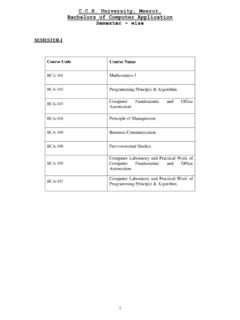
9 The Accrediation Board Secretariat will appreciate commentsand suggestions for improving and updating this publication in MauryaContentsPreface1. GENETICS and PLANT BREEDING 12. Seed Science and Technology 22 AppendicsI List of Participants in Subject Matter Workshop 38II List of participants in Subject Matter Workshop 40on Seed Science and Technology1. GENETICS and PLANT BreedingA. MAJORA 1. Core Courses 12 Credits1. principles of GENETICS 2+12. principles of Cytogenetics 2+13.
10 principles of PLANT BREEDING 2+14. principles of Quantitative GENETICS 2+1 Seminar 0+1 1 CreditA 2. Optional Courses 8 Credits1. Theory and Advanced PLANT BREEDING 2+02. Improvement of Field Crops 1+13. Heterosis BREEDING 1+14. BREEDING for Crop Quality 2+15. Bredding for Stress Resistance 2+16. Population GENETICS 2+07. Molecular GENETICS 2+08.
![List of Summer/Winter School [21 Days] Approved …](/cache/preview/0/6/1/5/2/b/1/a/thumb-06152b1a0458831206fb26f7ca1b05a4.jpg)