Transcription of GEORGIA PERFORMANCE STANDARDS - Home - …
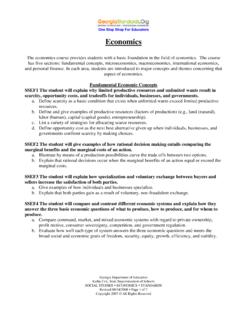
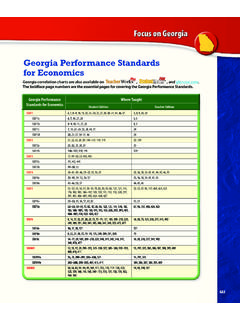
1 GEORGIA PERFORMANCE STANDARDS International Domain [Type the author name] Page 2 of 8 GEORGIA PERFORMANCE STANDARDS INTERNATIONAL ECONOMICS Fundamental economic Concepts SSEF3 The student will explain how specialization and voluntary exchange between buyers and sellers increase the satisfaction of both parties. a. give examples of how individuals and businesses specialize Specialization is the basis of trade and interdependence among individuals, cities, regions and countries. Most countries do not produce all of what they consume. Instead, they focus more heavily on producing certain products and trading with other countries.
2 Thus, the global economy is a network of trade and interdependence. Specialization is a situation in which people produce a narrower range of goods and services than they consume. Specialization increases productivity; it also requires trade and increases interdependence. People do not make everything that they and their family use: that is, they do not grow all their own food, sew their own clothes, build their own house and provide themselves personally with health care and education. Instead, people focus on a particular job and then use the wages that they earn from that job to purchase the goods and services they desire.
3 In this way, an economy forms an interlinked network of trade, exchange and interdependence. Because individuals have different skills and interests and because the time and resources necessary to learn new skills are scarce, there is a tendency toward specialization in the production of goods and services. A cobbler specializes in making shoes, while a farmer specializes in growing food. They then exchange (trade) with each other to get the goods they want. By concentrating their talents and efforts in one area, they can produce more shoes and good than if each tried to produce both products. A major consequence of increased productivity due to specialization and exchange is interdependence.
4 The more individuals and national specialize and trade, the more dependent they become on each other to supply their basic wants. Few of us grow all our own food; we rely on farmers. Farmers, in turn, rely on other producers to provide farm machinery. The complex web of interdependence that develops from trade among individuals and nations creates a strong incentive for social cooperation and peaceful coexistence. The more people specialize and trade, the more they must depend on each other. An advantage of specialization and interdependence is that there is a much higher STANDARDS of living for both trading partners. Individuals, businesses and governments are motivated by and respond to positive and negative incentives in predictable ways.
5 B. explain that both parties gain as a result of voluntary, non-fraudulent exchange. Trade and voluntary exchange occur when buyers and sellers freely and willingly engage in market transactions. When trade is voluntary and non-fraudulent, both parties benefit and are better off after the trade than they were before the trade. Page 3 of 8 International Economics SSEIN1 The student will explain why individuals, businesses and governments trade goods and services. a. define and distinguish between absolute advantage and comparative advantage Comparative Advantage The ability to produce a good or service at a lower opportunity cost than some other producer.
6 This is the economic basis for specialization and trade. Absolute Advantage The ability to produce more units of a good or service than some other producer, using the same quantity of resources. b. explain that most trade takes place because of comparative advantage in the production of a good or service BENEFITS OF TRADE/COMPARATIVE ADVANTAGE Comparative advantage is the principle which holds that every country should produce and trade the good in which it has a comparative advantage. A nation's comparative advantage occurs when it focuses on producing the good in which the opportunity cost of production is lowest. To understand why this is so, remember that the opportunity cost is the cost of one good in terms of the reduced production of other goods that could have been produced.
7 When a nation focuses on producing the good at which its productivity advantage is greatest, or at which its productivity disadvantage is smallest, it, in effect, chooses to produce the good for which the trade-off with other goods in terms of opportunity cost is smallest. The principle of comparative advantage shows how benefits of trade are available to all parties who participate, both those with a productivity advantage and those with a productivity disadvantage. But it's also important to remember that international trade offers economic benefits for other reasons: it increases competition between firms; it increases the variety available to consumers; it often increases the level of training about matters such as accounting, management and law in low-income countries; and it disseminates new technologies and production methods.
8 To understand the intuition behind comparative advantage, consider a group of volunteers who gather to build a home. One of the volunteers is an expert builder who is better at all tasks than anyone else in the group. However, if that person has to build the house alone, it will take him or her a long time. Comparative advantage says that the skilled builder should focus on the tasks at which that person's advantage is greatest, that is, at which the person's efforts would be hardest to replace. Others should each take on the tasks at which their disadvantage is smallest. In this way, all parties can benefit from the division of labor.
9 Similarly, a high-productivity economy like the United States can benefit from trading with a low-productivity economy like Mexico or certain nations in Africa, because it will be better for all parties if the United States focuses on those products at which its productivity advantage is greatest, and trades with the other countries as they produce those goods in which their productivity disadvantage is least. The gains from trade will be largest when the parties focus on producing in their area of comparative advantage. Page 4 of 8 c. explain the difference between balance of trade and balance of payments BALANCE OF TRADE AND BALANCE OF PAYMENTS Balance of Trade The part of a nation's balance of payments accounts that deals only with its imports and exports of goods (also called merchandise or "visibles").
10 When "invisibles," or services, are added to the balance of trade, the result is a nation's balance on the current account section of its balance of payments. Balance of Payments The record of all transactions (in goods, services, physical and financial assets) between individuals, firms and governments of one country with those in all other countries in a given year, expressed in monetary terms. The balance of trade is calculated by subtracting imports from exports. The goods and services trade balance counts both exports and imports of goods and services. This measure is increasingly useful because service trade has increased substantially in recent years.