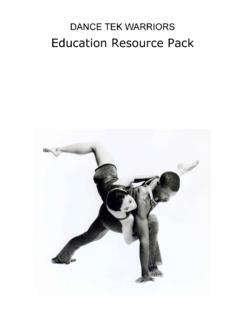
Transcription of Get help and support GCSE DANCE - …
1 Get help and support GCSE. DANCE . Visit our website for information, guidance, support and resources at You can talk directly to the DANCE subject team E: (8236). T: 01483 437 750. Specification For teaching from September 2016 onwards For exams in 2018 onwards Version 11 March 2016. Copyright 2016 AQA and its licensors. All rights reserved. AQA retains the copyright on all its publications, including the specifications. However, schools and colleges registered with AQA are permitted to copy material from this specification for their own internal use.
2 G00635. AQA Education (AQA) is a registered charity (number 1073334) and a company limited by guarantee registered in England and Wales (company number 3644723). Our registered address is AQA, Devas Street, Manchester M15 6EX. AQA GCSE DANCE 8236. GCSE exams June 2018 onwards. Version 14 March 2016. Contents 1 Introduction 5. Why choose AQA for GCSE DANCE 5. support and resources to help you teach 6. 2 Specification at a glance 9. Subject content 9. Assessments 9. 3 Subject content 11. Performance 11. Choreography 15. DANCE appreciation 18.
3 4 Scheme of assessment 21. Aims and learning outcomes 21. Assessment components 22. Assessment objectives 27. Assessment weightings 27. Assessment grids 28. 5 Non-exam assessment administration 35. Supervising and authenticating 35. Submitting NEA evidence and marks to AQA 35. Avoiding malpractice 36. Teacher standardisation 36. Internal standardisation 36. Factors affecting individual students 37. School and college consortia 37. After moderation 37. 6 General administration 39. Entries and codes 39. Overlaps with other qualifications 39.
4 Awarding grades and reporting results 39. Re-sits and shelf life 40. Previous learning and prerequisites 40. Access to assessment: diversity and inclusion 40. Working with AQA for the first time 41. Private candidates 41. Visit for the most up-to-date specification, resources, support and administration 3. Are you using the latest version of this specification? You will always find the most up-to-date version of this specification on our website at We will write to you if there are significant changes to the specification.
5 4 Visit for the most up-to-date specification, resources, support and administration AQA GCSE DANCE 8236. GCSE exams June 2018 onwards. Version 14 March 2016. 1 Introduction Why choose AQA for GCSE DANCE An exciting and diverse specification We've worked with DANCE teachers and subject experts to create a qualification that gives you the freedom to create lessons that will inspire and motivate all your students. DANCE is a powerful and expressive subject which encourages students to develop their creative, physical, emotional and intellectual capacity, whatever their previous experience in the subject.
6 This specification recognises the role of DANCE in young people's lives and students will study a range of DANCE styles and style fusions. Apart from the solo performance, they can choose any style in which to perform and choreograph, providing it meets the assessment criteria. The study of the anthology of professional works will develop their ability to critically appraise professional DANCE works and provide a springboard for engaging in practical tasks. Clear, well-structured exams, accessible for all We realise most GCSE DANCE students choose DANCE for the practical rather than theoretical focus.
7 That's why our written assessment is clear, well-structured and easy for students to understand. Students will enjoy the variety of question styles, which include multiple choice, short and extended answer. Marking you can trust Your students will receive the grade that fairly represents their achievement and skills. Clear progression to A-level, higher education and beyond We've bridged the gap between GCSE, AS and A-level, giving your students the skills and experience to better prepare them for the demands of AS and A-level if they choose to progress with their study.
8 You can find out about all our DANCE qualifications at A specification designed for you and your students We have worked closely with teachers to design our specification to inspire, challenge and motivate every student, no matter what their level of ability, while supporting you in developing creative and engaging lessons. This specification focuses on the aesthetic and artistic qualities of DANCE and the symbolic use of movement to express and communicate ideas and concepts through the interrelated processes of performance, choreography and appreciation.
9 DANCE is a powerful and empowering form of non- verbal communication and it is both physical and expressive, which makes it similar to and different from other art forms and physical activities. DANCE develops creative, imaginative, physical, emotional and intellectual capacities. Visit for the most up-to-date specification, resources, support and administration 5. This specification acknowledges the important role that DANCE plays in young people's lives. Whilst many students will bring some previous experience of DANCE , others will have very little.
10 This specification aims to value and build on whatever experience they have. GCSE students will study a range of DANCE styles which acknowledge aspects of the repertoire of DANCE that can be seen in the United Kingdom today. Skills-based approach The practical component of the course enables students to study DANCE by doing' and the anthology of professional works will provide a springboard for the development of creative and engaging practical tasks. The study of the anthology will facilitate the development of students'.