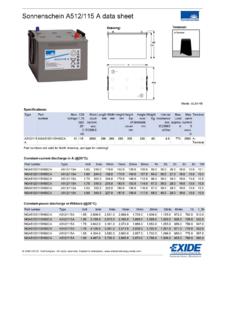
Transcription of GHS SAFETY DATA SHEET - Exide
1 Page 1 of 7 GHS SAFETY data SHEET I. PRODUCT IDENTIFICATION MANUFACTURER/SUPPLIER Exide technologies 13000 Deerfield Parkway, Bldg. 200 Milton, GA 30004 CHEMICAL/TRADE NAME *Lead-Acid Battery Non-spillable (* as used on label) Valve Regulated Lead-Acid Battery (VRLA) Absorbed Electrolyte Battery PRODUCT ID UN2800 FOR FURTHER INFORMATION Primary Contact: Exide SDS Support (770) 421-3485 Secondary Contact: Joe Bolea (423) 989-6377 Joe Kumper (678) 566-9380 Fred Ganster (610) 921-4052 CHEMICAL FAMILY/ Electric Storage Battery CLASSIFICATION FOR EMERGENCY CHEMTREC (800) 424-9300 (703) 527-3887 Collect 24-hour Emergency Response Contact Ask for Environmental Coordinator II. HAZARD IDENTIFICATION Signal Word: Danger Category: GHS Codes Description Health: STOT RE 2 Acute Tox.
2 4 Repr. 1A Skin Corr. 1A Flamm Gas 1 Aquatic Acute 1 Aquatic Chronic 1 H302/H312/H332 H314 H315/H318 H302/H313/H332 H350 H360 H373 H220 H203 H410 P260 P314 P301/330/331 P303/361/353 P304/340 P305/351/338 P311 H362 Harmful if swallowed, inhaled, or in contact with skin. Acid causes severe skin burns and eye damage. Causes skin irritation, serious eye damage. Contact with internal components may cause irritation or severe burns. May cause cancer if ingested or inhaled. May damage fertility or the unborn child if ingested or inhaled. Causes damage to central nervous system, blood and kidneys through prolonged or repeated exposure if ingested or inhaled. Extremely flammable gas (hydrogen). May form explosive air/gas mixture during charging. Explosive, fire, blast or projection hazard. Very toxic to aquatic life with long lasting effects. Do not breathe dust/fume/gas/mist/vapors/spray. If exposed/concerned, or if you feel unwell seek medical attention/advice.
3 IF SWALLOWED OR CONSUMED: rinse mouth. Do NOT induce vomiting. Call a poison center/doctor if you feel unwell. IF ON CLOTHING OR SKIN (or hair): Remove/Take off immediately all contaminated clothing and wash it before reuse. Rinse skin with water/shower. IF INHALED: Remove person to fresh air and keep comfortable for breathing. IF IN EYES: Rinse cautiously with water for several minutes. Remove contact lenses, if present and easy to do. Continue rinsing. Immediately call a POISON CENTER or doctor/physician. May cause harm to breast-fed children. Handling: P201 P202 P210 P263 P264 P270 P280 P403/P405 P271 P501 P201 Obtain special instructions before use. Do not handle until all SAFETY precautions have been read and understood. Keep away from heat/sparks/open flames/hot surfaces. No smoking. Avoid contact during pregnancy/while nursing. Wash thoroughly after handling. Do not eat drink or smoke when using this product. Wear protective gloves/protective clothing/eye protection/face protection.
4 Store locked up, in a well-ventilated area, in accordance with local and national regulation. Use only outdoors or in a well-ventilated area. Dispose of contents/container in accordance with local & national laws. Keep out of reach of children. WARNING: Batteries subjected to abusive charging at excessively high currents for prolonged periods of time without vent caps in place may create a surrounding atmosphere of an offensive, strong inorganic acid mist containing sulfuric acid. Reactivity: highly reactive with water and alkalis Page 2 of 7 III. COMPOSITION/INFORMATION ON INGREDIENTS Ingredient CAS Number % by Wt. Inorganic compounds of Lead 7439-92-1 65-69 Electrolyte (no fluid/completely absorbed) sulfuric acid/water/solution 7664-93-9 17-30 Case Material: Polypropylene 9003-07-0 3-8 Separator: N/A 1-3 Note: Inorganic lead and electrolyte (water and sulfuric acid solution) are the primary components of every battery manufactured by Exide technologies or its subsidiaries.
5 Other ingredients may be present dependent upon battery type. Polypropylene is the principal case material of automotive and commercial batteries. IV. FIRST AID MEASURES Take proper precautions to ensure you own health and SAFETY before attempting to rescue a victim and provide first aid. Inhalation: Electrolyte: Remove to fresh air immediately. If breathing is difficult, give oxygen. Lead compounds: Remove from exposure, gargle, wash nose and lips; consult physician. Skin Contact: Electrolyte: Flush with large amounts of water for at least 15 minutes; remove contaminated clothing completely, including shoes. Lead compounds: Wash immediately with soap and water. Eye Contact: Electrolyte and Lead compounds: Flush immediately with large amounts of water for at least 15 minutes; consult . physician immediately Ingestion: Electrolyte: Give large quantities of water; do not induce vomiting; consult physician.
6 Lead compounds: Consult physician immediately. V. FIRE FIGHTING MEASURES Flash Point: Not Applicable Flammable Limits: LEL = (hydrogen gas in air) ; UEL = Extinguishing media: CO2; foam; dry chemical Fire Fighting Procedures: Use positive pressure, self-contained breathing apparatus. Beware of acid splatter during water application and wear acid-resistant clothing, gloves, face and eye protection. If batteries are on charge, shut off power to the charging equipment, but, note that strings of series connected batteries may still pose risk of electric shock even when charging equipment is shut down. Hazardous Combustion Products: In operation, batteries generate and release flammable hydrogen gas. They must always be assumed to contain this gas which, if ignited by burning cigarette, naked flame or spark, may cause battery explosion with dispersion of casing fragments and corrosive liquid electrolyte.
7 Carefully follow manufacturer's instructions for installation and service. Keep away all sources of gas ignition and do not allow metallic articles to simultaneously contact the negative and positive terminals of a battery. VI. ACCIDENTAL RELEASE MEASURES Remove combustible materials and all sources of ignition. Stop flow of material and contain spill by diking with soda ash, etc. Carefully neutralize spill with soda ash, etc. Make certain mixture is neutral then collect residue and place in a drum or other suitable container with a label specifying "contains hazardous waste" or (if uncertain call distributor regarding proper labeling procedures). Dispose of as hazardous waste. If battery is leaking, place battery in a heavy duty plastic bag. Wear acid resistant boots, face shield, chemical splash goggles and acid resistant gloves. Do not allow discharge of acid to sewer. Acid must be managed in accordance with approved local, state, and federal requirements.
8 Consult state environmental agency and/or federal EPA. VII. HANDLING AND STORAGE Handling: Single batteries pose no risk of electric shock but there may be increasing risk of electric shock from strings of connected batteries exceeding three 12-volt units. Batteries are non-spillable - potential for exposure to contents only during recycling or if outer casing is cracked or damaged. Storage: Store batteries under roof in cool, dry, well-ventilated areas that are separated from incompatible materials and from activities which may create flames, sparks, or heat. Keep away from metallic objects that could bridge the terminals on a battery and create a dangerous short-circuit. Charging: There is a possible risk of electric shock from charging equipment and from strings of series connected batteries, whether or not being charged. Shut-off power to chargers whenever not in use and before detachment of any circuit connections. Batteries being charged Page 3 of 7 will generate and release flammable hydrogen gas.
9 Charging space should be ventilated. Keep battery vent caps in position. Prohibit smoking and avoid creation of flames and sparks nearby. Wear face and eye protection when near batteries being charged. VIII. EXPOSURE CONTROLS AND PERSONAL PROTECTION Occupational Exposure Limits (mg/m3) Ingredient: US OSHA US ACGIH US NIOSH Quebec PEV Ontario OEL EU OEL Inorganic Lead (a) Electrolyte (sulfuric acid/water solution) 1 1 1 (b) NOTES: (a) as inhalable aerosol; (b) thoracic fraction Engineering Controls (Ventilation): Store and handle in well-ventilated area. If mechanical ventilation is used, components must be acid-resistant. Handle batteries cautiously. Make certain vent caps are on securely. If battery case is damaged, avoid bodily contact with internal components. Wear protective clothing, eye and face protection, when charging or handling batteries. Hygiene Practices: Wash hands thoroughly before eating, drinking or smoking after handling batteries.
10 Respiratory Protection (NIOSH/MSHA approved): None required under normal conditions. When concentrations of sulfuric acid mist are known to exceed PEL, use NIOSH or MSHA-approved respiratory protection. Skin Protection: None required under normal conditions. If battery case is damaged, use rubber or plastic acid-resistant gloves with elbow-length gauntlet, acid-resistant apron, clothing, and boots. Eye Protection: None required under normal conditions. If battery case is damaged, chemical goggles or face shield. Other Protection: In areas where water and sulfuric acid solutions are handled in concentrations greater than 1%, emergency eyewash stations and showers should be provided, with unlimited water supply. IX. PHYSICAL AND CHEMICAL PROPERTIES - ELECTROLYTE Boiling Point@760 mm Hg 226 to 237 F Specific Gravity @ 77oF (H2O=1) to Melting Point Not Applicable Vapor Pressure (mm Hg) to % Solubility in Water 100 pH Less than 1 Evaporation Rate (Butyl acetate=1) Less Than 1 Vapor Density (AIR=1) Greater than 1 Viscosity Not applicable Appearance and Odor Threshold Sulfuric Acid: Clear liquid with a sharp, penetrating, pungent odor.