Transcription of Giant Hogweed - Pennsylvania
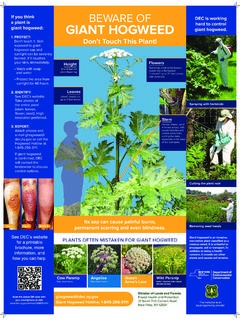
1 Invasive Plants in Pennsylvania Giant Hogweed heracleum mantegazzianum Description: Giant Hogweed is an incredibly tall biennial or perennial herb, growing up to 20 feet in height. Its stout stems are hollow with purple splotches and course bristles. Deeply incised compound leaves with stiff hairs can grow up to five feet in width. The large umbrella-shaped flower heads have numerous small white flowers, which develop into flattened, oval-shaped fruit. Habitat: Giant Hogweed can be found along railroads, roadsides, rights-of-ways, vacant lots, streams, rivers, waste areas and fallow fields, particularly in disturbed soils.
2 Background: Giant Hogweed , an enormous member of the carrot family Apiaceae, was brought to the United States as an ornamental and as a source for the anise-scented spice golpar, which is used in Iranian cooking. It is now designated as a federal noxious weed. Range: This plant is native to central and southwest Asia, but has been introduced into Europe and North America. In the United States, it can be found primarily in the Northeast, Great Lakes and Northwest regions. Biology and Spread: Over 100,000 seeds are produced annually by each plant.
3 These seeds can be spread by animals, surface runoff of rain, or by wind. Prolific seed production, combined with a rapid growth rate, results in dense colonies. Ecological Threat: Because of its size and rapid growth, Giant Hogweed is an aggressive competitor capable of displacing native plants. It dies back during the winter months, leaving bare ground open to erosion on riverbanks and steep slopes. The sap of Giant Hogweed makes human skin sensitive to ultraviolet light, resulting in severe burns and blisters. Contact with the eyes can cause permanent blindness.
4 Donna R. Ellis, University of Connecticut Robert Vid ki, Doronicum Kft. Terry English, USDA APHIS PPQ Physical Individual plants can be dug up, making sure to remove the entire root system. Repeated mowing or cutting can eventually starve the plant of energy. This practice needs to be performed numerous times during a growing season. Extreme care should be taken when undertaking these methods. Protective clothing and eye protection are a good idea. Look-A-Likes: Some of our larger native members of the carrot family, such as cow parsnip ( heracleum maximum) and purple-stemmed angelica (Angelica atropurpurea), may be confused with Giant Hogweed .
5 References: New York Sea Grant: St. Lawrence-Eastern Lake Ontario PRISM of New York State: USDA Forest Service: For More Information: DCNR Invasive Species Site: Chemical Foliar treatments with glyphosate or triclopyr have been effective. Glyphosate is considered the best choice, and should be applied in spring or early summer when plants are actively growing. A follow-up application in mid-summer may be necessary. Glyphosate is nonselective and may kill desirable plants, including grasses.
6 Biocontrol Cattle and pigs are apparently not affected by the sap and eat Giant Hogweed without harm. How to Control this Species: Robert Vid ki, Doronicum Kft. William M. Ciesla, Forest Health Mgmt. Intl. Cow Parsnip If You See This Plant: Giant Hogweed is on the Pennsylvania Noxious Weed Control List. It is illegal to sell, plant or transport this species. If you believe that you have found a new population of this plant, please contact Melissa Bravo, PA Dept. of Agriculture, at 717-787-7204.