Transcription of GOING DIGITAL: MAKING THE TRANSFORMATION …
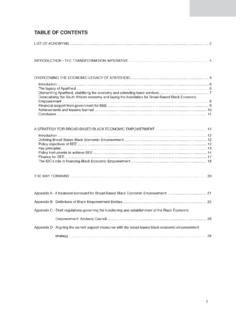
1 Meeting of the OECD Council at Ministerial Level Paris, 7-8 June 2017. GOING DIGITAL: MAKING . THE TRANSFORMATION . WORK FOR GROWTH. AND WELL-BEING. GOING Digital: MAKING the TRANSFORMATION Work for Growth and Well-Being TABLE OF CONTENTS. KEY MESSAGES FOR MINISTERS ..3. Seizing the opportunities and mitigating the challenges ..3. Fostering access and effective Facilitating social adjustment and ensuring inclusion ..4. Leveraging the digital TRANSFORMATION for better policies ..5. Introduction ..5. GOING Digital - What's at Stake? ..6. GOING Digital - The Scope of the TRANSFORMATION ..9. GOING Digital - Shaping the TRANSFORMATION ..11. Ensuring infrastructure and access for all ..12. Fostering digital trade and ensuring market openness ..13. MAKING the digital TRANSFORMATION work for firms ..15. MAKING the digital TRANSFORMATION work for governments ..17. Helping workers adapt ..20. Continuously assessing the skills needed for a digital world and adapting formal education and training systems to remain up-to-date.
2 21. Enhancing trust and social acceptance ..23. Using the digital TRANSFORMATION to foster Policy coherence and strategy Conclusions and Next ANNEX - THE GOING DIGITAL PROJECT ..27. REFERENCES ..28. Figures Figure 1. Internet users, 2005 and 2015 ..6. Figure 2. The diffusion of selected ICT tools and activities in enterprises, 2015 ..8. Figure 3. A preliminary framework for policies towards the digital TRANSFORMATION ..12. Figure 4. Enterprises using cloud computing by firm size, Figure 5. Individuals using the Internet for sending filled forms via public authorities websites in the past 12 months, by education level, 2015 ..18. Figure 6. Younger people are better prepared for the digital working environment than older people 22. Boxes Box 1. Digitalisation and Productivity - What is the Relationship? ..7. Box 2. Vectors of Digital TRANSFORMATION ..10. Box 3. Data - the new resource of the digital economy ..24. 2. KEY MESSAGES FOR MINISTERS.
3 Seizing the opportunities and mitigating the challenges We are in the midst of a digital TRANSFORMATION , with 40% of the world population now connected to networks, up from 4% in 1995. The TRANSFORMATION is at an early stage with a range of new technologies still to come. The digital TRANSFORMATION can spur innovation and productivity growth across many activities, transform public services, and improve wellbeing as information, knowledge and data become more widely available. It will be instrumental in addressing pressing policy challenges such as the shift to renewable energy, care for ageing populations and injecting efficiency and transparency into the delivery of government services. These benefits go hand-in-hand with challenges to jobs and skills, to privacy and security, to markets and taxation, to social security systems and public financing, and to public institutions and social interactions. The speed of change can be alienating to some and fits uneasily with the fixed timeframes, lengthy administrative procedures or adherence to predetermined cycles that can characterise policy MAKING .
4 To ensure that policies harness the benefits while mitigating the challenges, policy makers need to be pro-active and act now. Many policies are the legacy of an analogue era and ill-adapted to today's digital era. This gap between Technology and Policy needs to be closed. Catching up with the rapid pace of change will also help in "fixing" globalisation. MAKING the digital TRANSFORMATION work will require inclusive, coherent and well-coordinated policies, reflecting a multi-stakeholder and whole-of-government approach to policy MAKING , that pro-actively consider those who will benefit from the digital TRANSFORMATION and those who risk being left behind. Fostering access and effective use Fully benefiting from the opportunities linked to digitalisation will require that all individuals, businesses and governments have reliable and affordable access to digital networks and services. This requires a wide coverage of digital networks, and targeted measures for disadvantaged people, firms ( certain SMEs) and regions.
5 But mere access to digital networks does not ensure effective use. Policy will need to help equip people with appropriate skills to use the technology; enable complementary investments in organisational change and process innovation; and foster competition and sound firm dynamics. Sector-specific aspects of the digital TRANSFORMATION also require attention, in financial services or manufacturing. 3. SMEs face challenges in the use of ICT but also have important opportunities, such as global e-commerce, to access new markets and improve their performance. Improving their access to finance is particularly important, as are policies to diffuse digital technologies to SMEs, such as technology extension services. Digital trade is creating new economic opportunities, allowing firms to access new markets, and bringing new goods and services to consumers globally. To seize the opportunities, governments need to work together to facilitate digital trade across borders, whether digitally or physically delivered, address existing cross-border barriers and frictions, and avoid unnecessary new restrictions, including in considering the impacts on market openness of other policies.
6 Trust is fundamental to the success of the digital TRANSFORMATION . Greater international co- operation in developing coherent strategies for digital security and privacy, and implementing security and privacy risk management frameworks, are essential, as is the protection of consumers engaged in online activities. Facilitating social adjustment and ensuring inclusion The digital TRANSFORMATION will provide new job opportunities for many but raises challenges for others, with the risk of growing inequalities in access to jobs. Sound labour, skills and social policies can make it easier for workers to grasp the new opportunities and help navigate the challenges. Workers displaced by the digital TRANSFORMATION should be provided with active job search and adequate income support, to speed up job finding and reduce the cost of job loss. Such interventions should come early in the unemployment spell, and be coupled with retraining and requalification so that displaced workers can take advantage of new job opportunities arising elsewhere in the economy.
7 Strengthening ICT skills for all workers and citizens is important, but will not be enough to thrive in the digital economy. Good literacy and numeracy skills are also essential, while other complementary skills are needed, including socio-emotional skills to work collaboratively and flexibly. Skills policies should seek to: ensure initial learning equips all young people with relevant skills (including media competence); encourage flexibility and responsiveness to changing skill needs; promote more effective use of skills within or outside workplaces; and strengthen incentives and opportunities for further learning. It is essential to continuously assess and anticipate changing skill needs and foster more responsive education and training provision, in order to adapt programmes and pathways offered and guide students towards choices that lead to good employment outcomes. New digital business models are creating new job and income opportunities for people who may have no access to regular jobs, but may also offer less promising employment trajectories, less protection and stability and lower access to social protection and training.
8 Governments need to ensure strong social and regulatory protection for all workers. Digital technologies can foster social inclusion by strengthening access to health care, financial services and skills development, and by helping disadvantaged groups connect to such services. At the same time, negative aspects of the digital era, such as Internet-enabled criminal activities, need to be addressed, with policies grounded in respect for human rights and the rule of law. 4. Leveraging the digital TRANSFORMATION for better policies Governments can leverage digital technologies to re-invent policy design and experimentation, implementation, monitoring and evaluation, and better serve the needs of citizens, in fostering smart cities. To enable evidence-based policies, better measurement and analysis of the digital TRANSFORMATION and its impacts are urgently needed. Introduction 1. The GOING Digital (GD) Horizontal Project was officially launched at the start of 2017.
9 It originated as a vision from the four Chairs of STI policy Committees in the autumn of 2015 as they reflected on the 2017-18 PWB, and gained further support and momentum from a range of sectoral Ministerial meetings, notably on science and technology policy (October 2015), employment (January 2016), skills (June 2016) and the digital economy (June 2016), as well as the Ministerial Council Meeting 2016 and the corresponding statement that "encourage[s] the OECD to develop a horizontal policy strategy on digitalisation, its opportunities and challenges." Following the 2016 MCM, the initiative was further developed and included in the PWB 2017-18 as a Horizontal Project. It was approved by Council at its meeting on 16 November 2016. 2. The overarching objective of the GOING Digital project is to help policymakers better understand the digital TRANSFORMATION that is taking place and develop tools to help create a policy environment that enables their economies and societies to prosper in a world that is increasingly digital and data-driven.
10 The project will deliver a whole-of-house perspective on the state, effects, expected benefits and issues raised by digitalisation in different sectors and policy areas, and will provide focused analysis of key cross- cutting issues, : jobs and skills; productivity, competition and market structure; social challenges and well-being; as well as measurement of the digital TRANSFORMATION (see Annex). 3. The project involves a lead Committee, the Committee on Digital Economy Policy, and benefits from work by thirteen other Committees involved in the Horizontal 4. This paper is intended to provide Ministers with a first and preliminary set of policy conclusions that are emerging from OECD work on the digital TRANSFORMATION . Not all policy areas that will eventually be included in the project are covered in detail in this paper, reflecting the current state of the work. 5. Further work will deepen the analysis of key policy issues, and provide more concrete policy recommendations and a roadmap for the OECD to better measure the digital TRANSFORMATION .