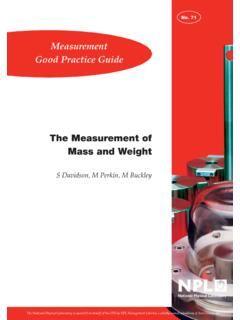
Transcription of Good Practice Guide No. 118 A Beginner’s Guide
1 good Practice Guide No. 118A beginner s Guide to MeasurementiNational Physical LaboratoryTeddington, Middlesex, United Kingdom, TW11 0 LWFor more information, or for help with measurement problems, please ISSN: 1368-6550 Queen s Printer and Controller of HMSO, 2010. NPL wishes to acknowledge the support of NMO, LGC and NEL in the production of this beginner s Guide to MeasurementVersion 3 Mike GoldsmithThis beginner s Guide explains the fundamental concepts and basic facts about measurement , and in particular accurate measurement . It includes brief accounts of the role of measurement in modern and historical societies and explains the SI system, its base units and their relation to other units. The various organisations involved in measurement are introduced and their roles in linking all measurements to the SI base units through traceability chains explained.
2 It includes general guidance about practical issues that affect the making of measurements, gives the meanings of key measurement terms, and explains the significance of such fundamental concepts as measurement traceability and calibration. iiiMessen ist Wissen ( measurement is knowledge)Georg Simon Ohm (1789-1854)ivForewordThis beginner s Guide is intended for people with little or no experience of making accurate measurements but who wish to find out more about them, either because they intend to make or use accurate measurements themselves or to work with those who do. It may be of use to those starting careers in metrology or engineering, and to managers, research scientists, teachers, university students and those involved in the sale or marketing of measuring has been written in a form that is intended to be as painless as possible for those who are being required to read it, while being sufficiently accurate to avoid undue irritation to any actual metrologists who may happen to encounter it.
3 For readers who wish to find out more, suggestions for further reading are listed at the end of the Guide is likely to have two audiences and has been divided into two parts accordingly: the first contains background information on the concepts and history of measurement , which may be of interest to the general reader or to those involved in marketing or management within the measurement field. The second part summarises the types of practical issues that impact the actual making of accurate measurements, and may be more relevant to working metrologists. The subject of accurate measurement is more important than ever. It is key to such disparate areas as global warming, the control of performance-enhancing drugs and observational cosmology. Consequently, and despite the vast number of science and technology books, magazines, TV programmes and websites, it is surprising that the subject has been almost entirely overlooked.
4 Perhaps this book will go a small way towards demonstrating that, despite its low profile, measurement world of measurements1. Why measure?We all make measurements, every day of our lives: think how often you glance at your watch or your car s speedometer. And we are surrounded by the outputs of measurement devices too, from the wind speeds on weather forecasts to the figures on gas bills. Then there are all those behind-the-scenes measurements needed to ensure that pills contain the doses they should, to prepare and package food and to check whether our houses are full of everyday measurement devices are very accurate and some aren t. Even the cheapest digital watches are accurate to a few seconds a year, while the readings of oven thermometers are frequently wrong by several degrees. If your watch was only as accurate as your oven, it might easily lose an hour a week.
5 That s fine for cooking, because the accuracy of the measurement you need not to miss an appointment isn t the same as is required to bake a cake*. As we ll see, making measurements that are neither more, nor less accurate than we need is important for many of the measurements on which modern life depends are hidden. For instance, though the precise dimensions and electrical properties of the many components of your car or computer are of no interest to you, they make all the difference between functioning and failure. Long ago, when cars and other machines were hand-built, exact measurements didn t matter each part was made to fit together with the parts that were already there, thanks to a considerable amount of shaving bits off and forcing things however, all that individual attention was liable to cost the customer a small.
6 Which led Henry Ford, and people like him, to pioneer the idea of standard-sized , this approach is vital: about 80% of the components used by any manufacturer are made by other companies - often overseas - so every manufacturer needs to tell its subcontractors the ranges of acceptable values of the dimensions, electrical characteristics and other parameters of all those components. Otherwise a lot of things would fall apart, or not fit together in the first place.* Having said that, the fact that so many ready-meals bear some such discouraging words as all ovens vary or adjust cooking times to suit your oven may suggest a bit more work needs to be done was Ford who applied the idea of standardised parts to industrial processes. However, the idea of using standardised parts had a more violent origin: in about 1778, Honor Blanc began producing some of the first firearms with interchangeable parts, and, twenty years later, Eli Whitney demonstrated the same idea to the US Congress by jumbling a heap of parts together and then assembling guns from parts selected at random from the pile.
7 Congress loved the idea and it wasn t long before new pieces could simply be ordered for guns that failed, rather than being specially made to fit. Then there s science. A brave new theory might start with an apple falling on your head, but it won t get much further without accurate measurements to confirm or reject Newton, for example, delayed publishing his Law of Universal Gravitation for years because the brilliantly simple equation he came up with could not quite predict the right value for the speed of the Moon. Finally, when Jean Picard came up with an improved value of the radius of the Earth, it turned out that the equation worked just fine, and went on to explain the motions of the rest of the Solar System very nicely too. Except, that is, for the planet Mercury accurate measurements of its orbit revealed regular changes that could not be accounted for by Newton s equations.
8 Many years later, Einstein s theory of gravity explained those changes, and scientists had to accept that Einstein s theory was superior to Newton s. As Lord Kelvin (after whom a unit of temperature is named) said: When you measure what you are speaking about and express it in numbers, you know something about it, but when you cannot express it in numbers your knowledge is of a meagre and unsatisfactory As a result of its importance, measurement has a science of its own, called metrology, from the Greek words metron ( measure ) and logos ( study ).Metrological definitionsScientific metrologythe science of measurement , including the development and provision of measurement standardsIndustrial metrologythe application of measurement science to manufacturing and other processes Legal metrologymeasurement activity underpinning fair trade and consumer protectionWhat do we really mean by a measurement ?
9 The fundamental idea is that of a quantitative comparison, made using one of more instruments. So, to measure the length of a piece of wood, one might compare it with a tape-measure on which units of length, such as centimetres, are marked the result of the measurement being expressed as a number of centimetres. 32. measurement through historyPeople have been measuring since they began to buy, own and sell things, which means that the history of measurement is as long as that of civilisation. In fact, many aspects of civilisation would be impossible without measurement : science, for instance. Throughout history, science and measurement have worked in a virtuous circle, in which the technological developments that science produced permitted accurate measurements to be made, which then fed back into the testing and refinement of new scientific theories.
10 Meanwhile, the growing internationalism of trade led to clarification and harmonisation of measurement systems. It s too long a story for a short space, but some of its highlights are:About 3000 BCE, EgyptThe cubit is defined as the length of the Pharaoh s forearm plus the width of his hand. Once this measurement has been made and carved into a granite block, wooden and stone copies are given to builders. Architects have the responsibility to check them each full Moon with execution the penalty if they don ADE, EnglandThe first documented call is made for standardisation of units in England, in the Assize of Measures. The primary concern is that beer and wine are properly , EnglandMagna Carta requires uniform measures throughout England, stating that There shall be standard measures of wine, ale, and corn.