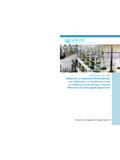
Transcription of GPAT060406-printversion.qxd (Page 1)
1 Chapter 4 united nations office on Drugs and crime (UNODC) trafficking in persons : global patterns April 2006 DisclaimerThis Report has been reproduced without formal designations employed and presentation of the material in this publication do notimply the expression of any opinion whatsoever on the part of the Secretariat of theUnited nations concerning the legal status of any country, territory, city or area of itsauthorities, or concerning the delimitation of its frontiers or boundaries. 03 Table of of 1: The global Programme againstTrafficking in Human Defining trafficking in Human Summary and Conclusions ..53 Chapter 2: Human trafficking : global Human trafficking as a Organized crime involvement (or crime that is organized).. Summary and 3: Human trafficking : Regional Reported Human trafficking in Reported Human trafficking in Reported Human trafficking in Reported Human trafficking in the Commonwealth of Independent Reported Human trafficking in the Reported Human trafficking in Summary and 4: Data, Methodology and Coding of Methodology used to collect Data contained in the trafficking Types and Levels of Data in the trafficking The Citation Index - Coding of Limitations and Nature of the Summary and 1: Source InstitutionsAppendix 2: Geographical Regions and Sub-regionsAppendix 3: Origin CountriesAppendix 4: Transit CountriesAppendix 5: Destination CountriesAppendix 6.
2 Country ProfilesNote, in the printed format, these appendices are included in an attached compact Report was prepared by the Anti-Human trafficking Unit (AHTU) of the united nations office onDrugs and crime (UNODC), global Programme against trafficking in Human Beings (GPAT), under thesupervision of Kristiina Kangaspunta. The following persons contributed to the Report:Martin Fowke, AHTU, Research and DraftingAlexis A. Aronowitz, Consultant, Research and DraftingFabrizio Sarrica, AHTU, Data AnalysisSilke Albert, AHTU, Data AnalysisJana Symalzek, Consultant, Graphic-DesignThe preparation of this Report would not have been possible without the contribution of several individualsand sections of the united nations office on Drugs and crime , especially the Research and was designed by UNODC in collaboration with the united nations Interregional crime and JusticeResearch Institute (UNICRI).
3 UNODC maintains a close working relationship with UNICRI, and a numberof case studies drawn from collaborative efforts in research and technical cooperation projects are includedin this would like to acknowledge and thank the following photographers for the use of their work in thisreport: Mattia Insolera, Kay Chernush and Isabel convened a meeting of a panel of independent experts on 24 and 25 January 2006 in Vienna,Austria. The purpose of the meeting was to provide for an independent evaluation of the methodology andfindings of the draft Report. The final version of this Report reflects the advice and suggestions provided bythe expert panel. The members of the expert panel were: Patrick Belser, International Labour Organization(ILO); Michele Clarke, Organization for Security and Co-operation in Europe (OSCE); Andrea De Nicola,TRANSCRIME; Ineke Haen Marshall, Northeastern University; Frank Laczko, International Organizationfor Migration (IOM); Elke Schmidt, INTERPOL; Gert Vermeulen, University of Ghent; and Daja Wenke,UNICEF-Innocenti Centre.
4 The united nations crime Prevention and Criminal Justice Programme Network(PNI) was also invited to give comments regarding the Report to the expert panel. The Report is based on the analysis of the united nations office on Drugs and crime Database on HumanTrafficking Trends. The trafficking Database has received financial support from the governments ofBelgium and term refers to the "bundles" of trafficking information that(of trafficking in persons ):were identified and entered into the trafficking Database. These maydiffer from actual individual cases or episodes of trafficking , as the datareported may be incomplete. A single account of trafficking in persons ,as reported by a source institution, contains at least information on thetrafficking route and possibly also fuller details, such as informationregarding the victim/s (including the number of victims and their profile), the traffickers and the exploitative purpose of the trafficking .
5 A single account of trafficking in persons may involve any number :Actual instances or episodes of human index:The index indicates the number of sources reporting aninformation variable concerning a particular country according to a 5-point scale, from very low to very high, in comparison to all othercountries ( information indicating that a specific country or territory is an origin, transit or destination of trafficking in persons ).Convention:The united nations Convention against Transnational Organized labour:All work or service which is exacted from a person under the menaceof penalty and which is undertaken criminal group: A structured group of three or more persons existing for a period of time and acting in concert with the aim of committing one or moreserious crimes or offences established in accordance with theConvention, in order to obtain, directly, or indirectly, a financial or othermaterial crime :Conduct constituting an offence punishable by a maximum deprivation of liberty of at least four years or a more serious penalty.
6 Smuggling of migrants:The procurement, in order to obtain, directly or indirectly, a financial orother material benefit, of the illegal entry of a person into a country ofwhich the person is not a national or a permanent :The 'sources' referred to throughout the Report are the 113 differentindividual source institutions that reported information on human trafficking , involving 161 countries and special administrative territoriesduring the period, 1996-2003, that were identified by UNODC. Thesesources are listed in Appendix group: A group that is not randomly formed for the immediate commission of an offence. It does not need to have formally defined roles for itsmembers, continuity of its membership or a developed :All those who are involved in the criminal activity of trafficking of persons . The term does not apply solely to persons convicted ofhuman trafficking offences, but also refers to suspects, arrested andprosecuted persons who, through various means, have come to theattention of criminal justice system actors.
7 trafficking in persons :The recruitment, transportation, transfer, harbouring or receipt of persons , by means of the threat or use of force or other forms of coercion, of abduction, of fraud, of deception, of the abuse of power orof a position of vulnerability or of the giving or receiving of payments orbenefits to achieve the consent of a person having control over another person, for the purpose of exploitation. Exploitation includes,at a minimum, the exploitation of the prostitution of others or otherforms of sexual exploitation, forced labour or services, slavery or prac-tices similar to slavery, servitude or the removal of Protocol:The Protocol to Prevent, Suppress and Punish trafficking in persons ,especially Women and Children, supplementing the united NationsConvention against Transnational Organized Database:The united nations office on Drugs and crime Database on Human trafficking offence:An offence is transnational if: (a) it is committed in more than oneState; (b) it is committed in one State but a substantial part of its preparation, planning, direction or control takes place in another State.
8 (c) it is committed in one State but involves an organized criminalgroup that engages in criminal activities in more than one State; or (d)it is committed in one State but has substantial effects in another of AcronymsThe following abbreviations have been used in this Report:AICA ustralian Institute of CriminologyAHTUAnti-Human trafficking Unit of UNODCBKAG ermany's Federal Criminal Police office (Bundeskriminalamt)CEDAWC onvention on the Elimination of All Forms of Discrimination Against WomenCEEC entral and South Eastern EuropeCIAThe united States of America's Central Intelligence AgencyCISThe Commonwealth of Independent StatesCPIC orruption Perceptions IndexECOSOCU nited nations Economic and Social CouncilESCAPU nited nations Economic and Social Commission for Asia and the PacificEuropolEuropean Police OfficeGDIG ender-related Development IndexGDPG ross Domestic ProductGPATG lobal Programme Against trafficking in Human BeingsHDIThe Human Development IndexHEUNIThe European Institute for crime Prevention and Control.
9 Affiliated withthe united NationsIGOI nter-governmental organizationILOI nternational Labour Organization09 InterpolInternational Criminal Police OrganizationIOMI nternational Organization for MigrationNGONon-governmental OrganizationOCIThe Organized crime IndexOSCEO rganization for Security and Co-operation in EuropePNIU nited nations crime Prevention and Criminal Justice Programme NetworkPPPP urchasing Power ParitySARS pecial Administrative RegionSECIS outheast European Cooperative InitiativeTITransparency InternationalTIP ReportThe united States' State Department " trafficking in persons " reportUMCORThe united Methodist Committee on ReliefUNThe united NationsUNDPU nited nations Development ProgrammeUNHCRThe office of the united nations High Commissioner for RefugeesUNICEFU nited nations Children's FundUNICRIU nited nations Inter-regional crime and Justice Research InstituteUNODCU nited nations office on Drugs and CrimeWEFThe World Economic Forum10 Foreword of the Executive DirectorThe fact that slavery - in the form of human trafficking - still exists in the 21st century shames , international organizations and civilsociety are devoting considerable efforts to counterit, but there is still an information deficit about theextent of this tragedy.
10 Only by understanding itsdepth, breadth and scope can we design policies tofight it. This understanding still eludes us: effortsto counter trafficking have so far been uncoordinated and Report by the united nations office on Drugsand crime is our first attempt to close the knowledge gap. It uses information from open sources, both private and public, to map an impressionistic journey into global patterns of trafficking in persons . Complaining that accuratestatistics are difficult to come by may sound like anexcuse. But it is a fact, which is due only in part tothe hidden nature of the crime . The lack of systematic reporting by authorities is the real problem. Information is available on certain countries, but worldwide comparative analysis -- thekind of assessment the united nations excels in --has so far not been possible.