Transcription of GRADE 7 NATURAL SCIENCES TERM ONE: LIFE AND LIVING …
1 1. GRADE 7 NATURAL SCIENCES . TERM ONE: LIFE AND LIVING . CONTENTS. TOPIC 1 THE BIOSPHERE. GM 2021. 2. Contents Where are LIVING things found? .. 5. Identifying areas where life is found .. 6. Activity 1 .. 6. The Biosphere .. 6. Life in the 7. Lithosphere .. 7. Hydrosphere .. 8. Atmosphere .. 8. Activity 2 .. 8. The Seven Life Processes .. 9. Activity 3: 9. Requirements for life .. 11. Topic 2: Biodiversity .. 12. Activity 4 .. 14. MNEMONIC TO REMEMBER THE CLASSIFICATION LEVELS .. 15. Differences between plants and animals .. 16. Activity 5(a) .. 16. Classification .. 16. Classification of vertebrates and invertebrates .. 17. Vertebrates .. 17. Invertebrates .. 17. Vertebrates - Classification .. 17. Refresher: Activity 5(b) .. 17. Fish (Osteichthyes pronounced as os-tay-yek-thies) .. 18. Amphibians .. 18. Reptiles .. 18. Birds .. 18. Mammals .. 19. Activity 6 .. 19. GM 2021. 3. 20. 20. 20. Arachnids .. 21. Crustaceans .. 21. Molluscs .. 22.
2 Activity 7 .. 23. Diversity of Plants .. 24. Gymnosperms .. 25. Angiosperms (angi enclosed, sperma seed) .. 25. 26. Dicotyledons .. 27. Activity 8: Test yourself .. 28. Topic 3: Plant and human reproduction .. 29. Sexual reproduction in Angiosperms .. 29. Seeds and flowers .. 29. Components of a flower .. 29. Activity 9: Identify the parts and functions of a flower .. 30. Pollination .. 30. Activity 10 .. 31. Fertilisation and fruit/seed dispersal .. 32. Fruit and seed dispersal .. 33. Activity 11 .. 34. Sexual reproduction in humans .. 35. Activity 12 .. 36. Reproductive Organs .. 37. The male reproductive organ .. 37. The female reproductive organ .. 37. Activity 13 .. 38. Fertilisation, pregnancy and menstruation .. 38. Fertilisation and pregnancy .. 38. GM 2021. 4. Activity 14 .. 39. Sexual health and Responsibility .. 40. Sexually transmitted diseases (STDs) .. 40. HIV and AIDS .. 40. Myths about menstruation and sex .. 41. Activity 15.
3 41. Variation within a species .. 42. Activity 16 .. 43. GM 2021. 5. Where are LIVING things found? Organisms, or LIVING things , are found in almost every place on Earth's surface. They are found in the air, in water and on land. In order to survive, organisms need access to water, air, food, space, favourable temperatures and protection from enemies. Organisms can only survive in environments that meet their needs. Organisms are adapted to survive in their specific environment. KEY WORDS: Biosphere all of the areas on Earth where life exists. Decomposers organisms, such as fungi and bacteria that break down dead plants and animal matter. Ecosystem all of the LIVING things that live in a specific area and the non- LIVING things that make up their environment. Species a group of similar organisms that can mate and produce offspring. GM 2021. 6. Identifying areas where life is found Activity 1. Discuss the following questions in groups and write the answers in your workbooks.
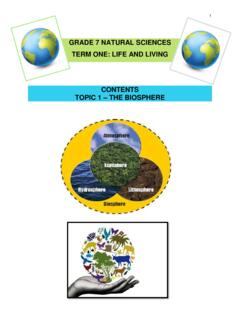
4 1. List at least 5 places where life is found. 2. Name 5 LIVING things that you might expect to find in the different places. 3. Suggest some relationships between the LIVING things shown in the above image. 4. Find the meaning of adapted and write down a definition. The Biosphere The biosphere1 is a group of different areas where life exists on earth. The biosphere can be divided into smaller units called ecosystems. An ecosystem can be large or small. The Biosphere is made up of the atmosphere, hydrosphere and the lithosphere. 1. Biosphere (say: bye oh- sfeer) bio = life and sphere = the shape of the earth GM 2021. 7. The atmosphere This is the layer of gases around the earth. These gases are necessary for life on earth. The hydrosphere This is made up of all the water on earth. It includes all the rivers, dams, oceans and underground water. The lithosphere This is made up of all the rocks and soils on the earth's crust including the seabed.
5 Life in the Biosphere Life is found in all three parts of the biosphere. This includes micro-organisms, plants and animals. Lithosphere Many different plants and animals live in the Lithosphere. Some live above the ground and others live underground. Bacteria and micro-organisms, like protozoa, help to break down dead organic material (consisting of plants and animals). GM 2021. 8. Hydrosphere Plants such as algae and seaweed live in the hydrosphere. Many animals also live here. Micro -organisms such as plankton and amoeba live here. Bacteria are also present. Atmosphere Birds, insects, some other animals and bacteria are found here. Activity 2. 1) Draw the table below in your workbooks. 2) Write the different headings of the spheres. 3) Write down at least two/three LIVING things for plants and animals, you can think of that live in the different spheres: Lithosphere Hydrosphere Atmosphere Animals Plants GM 2021. 9. The Seven Life Processes All LIVING things carry out the following life processes.
6 1) Nutrition (Feeding). Most plants make their own food and animals eat plants or other animals. 2) Growth All LIVING things increase in size as they mature. 3) Reproduction LIVING things produce new individuals with the same characteristics as their parents. 4) Respiration (Breathing). LIVING things break down food to produce energy. 5) Excretion Waste substances are removed from the body. 6) Sensitivity to the environment LIVING things detect changes or stimuli in the environment and react to them. For example, you may sneeze, to remove dust and germs from your nasal passages. 7) Movement Animals move from place to place to find food and shelter, or to avoid danger. Plants do not move although they can grow towards the light and the petals of a flower can open and close in response to light. Activity 3: Experiment AIM: To investigate the requirements of seedlings for growth. If we had to take 4 similar seedlings and add the following requirements for growth, we would look at the four images, to see what seedlings need to grow and what they are deprived of and then write a hypothesis.
7 A hypothesis is a statement explaining what you think will happen in an experiment. GM 2021. 10. A: ENERGY, GASES, B: ENERGY, WATER, WATER, LIGHT. LIGHT. D: ENERGY, GASES, C: ENERGY, WATER, LIGHT. GASES. Variables are the things that are different, no sunlight, too much water, not enough nutrients, etc., that can have an effect on the growth of plants. INSTRUCTIONS: 1. Write your own hypothesis for this experiment. (2). 2. List the variables that you think will affect this experiment. (3). 3. Predict what you think will happen in the experiment. (1). 4. Write a conclusion for this experiment. Do seedlings need water and light to grow? (2). 5. Suggest ways of improving this experiment. What could we do differently? (2). Total: 10. GM 2021. 11. Requirements for life 1. Energy Producers make their own food by photosynthesis. Consumers eat plants or animals. 2. Gases 78% of the air is made up of Nitrogen. 21% of the air is made up of Oxygen.
8 Less than 1% of the air is made up of Carbon dioxide. Nitrogen is used in the body to make protein (hair, skin, cells, etc. Oxygen is used in the body for respiration. Carbon dioxide is used by plants to photosynthesize. 3. Water Water helps the body to absorb the nutrients in food. It is also needed for photosynthesis. 4. Soil Soil is abiotic (non- LIVING ) and is essential for plant growth. 5. Favourable Temperature Not many LIVING organisms can survive in very high or low temperatures. GM 2021. 12. Topic 2: Biodiversity Biodiversity refers to the large variety of plants, animals and micro-organisms in their habitats. The most widely accepted system of classification divides LIVING organisms into five main groups, called kingdoms. Monera: Organisms in this kingdom are usually single- celled organisms with no nucleus. A nucleus is a cell structure that contains hereditary information or DNA. Plant cells are surrounded by a thick, rigid cell wall and animal cells have a thin layer of cell membrane, called cytoplasm-the jellylike material outside the cell.)
9 An example of an organism in this kingdom is bacteria. Protista: Organisms in this kingdom are called protists. They are single-celled and usually move by cilia, flagella, or by amoeboid mechanisms. Slime mould Amoeba Euglena Dinoflagellate Paramecium Diatom Macroalga Fungi: Fungi are multicellular organisms. They have no mechanisms for locomotion. Fungi range in size from microscopic to very large (such as mushrooms). Organisms in this kingdom cannot photosynthesize. They must get their food from the surrounding environment usually decaying plants and animals. GM 2021. 13. Plantae: Plants are multicellular and most don't move. Nutrients are acquired by photo- synthesis. This means that plants require sunlight. Animalia: Animals are multicellular organisms that are usually able to move. They acquire nutrients by eating plants or other animals. Each of the kingdoms is very large and contains many different types of organisms. The pie chart on the next page shows the approximate number of different organisms in each of the kingdoms.
10 Animalia 1 200 000. Plantae Monera Fungi Protista GM 2021. 14. KEY WORDS: Classify arrange objects in groups based on similar characteristics. Taxonomy branch of science that is concerned with classification. Kingdoms highest category in taxonomic classification. Activity 4. 1) Create a document on your tablet and save it as NS GRADE 7 ____ Activity 4. 2) Create a table, in landscape format, with headings for the five kingdoms. 3) Provide a brief definition of each kingdom, under the relevant heading. 4) Look at the pictures below. Classify the organisms according to their kingdoms. A: lion B: mushroom C: amoeba D: frangipani F: bread mould E: jellyfish G: spirillum H: lilac breasted roller I: mouse spider GM 2021. 15. MNEMONIC TO REMEMBER THE CLASSIFICATION LEVELS. Within each kingdom, the organisms that belong to it can be classified even further. In total, there are seven levels of classification: Kingdom, Phylum, Class, Order, Family, Genus and Species.