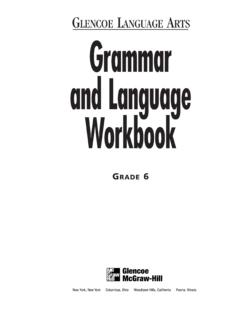
Transcription of Grammar and Language Workbook-Student Edition
1 Grammar and LanguageWorkbookCourse 2 Copyright by The McGraw-Hill Companies, Inc. All rights reserved. Except as permitted under the United StatesCopyright Act of 1976, no part of this publication may be reproduced or distributed in any form or means, or stored ina database or retrieval system, without the prior written permission of the all inquiries to:Glencoe/McGraw-Hill8787 Orion DriveColumbus, Ohio 43240 ISBN 0-07-820540-9 Printed in the United States of America2 3 4 5 6 7 8 9 10 009 03 02 01 00 Glencoe/McGraw-HillHandbook of Definitions and Rules ..1 Troubleshooter ..23 Part 1 Grammar ..45 Unit 1 Subjects, Predicates, and of Sentences: Declarative and Interrogative .. of Sentences: Exclamatory and Imperative .. and Predicates .. Subjects and Predicates .. Fragments .. and Compound Sentences ..57 Unit 1 Review ..59 Cumulative Review ..60 Unit 2 : Proper and Common .. : Concrete, Abstract, and : Compound and : Distinguishing Plurals, Possessives, and Contractions.
2 2 Review ..71 Cumulative Review: Units 1 2 ..72 Unit 3 : Transitive and Intransitive .. with Indirect Objects .. Verbs and Predicate Words .. Tenses: Present, Past, and Future .. Verbs and Helping Forms: Present and Past .. Tenses: Present and Past .. Verbs Verbs II ..97 Unit 3 Review ..101 Cumulative Review: Units 1 3 ..102 Unit 4 : Personal .. and Antecedents .. Pronouns : Possessive and Indefinite .. : Reflexive and Intensive .. : 4 Review ..115 Cumulative Review: Units 1 4 ..116 Unit 5 Adjectives and .. and Proper Adjectives .. and Superlative Adjectives .. Comparative and SuperlativeAdjectives .. : Comparative and Superlative .. Adverbs and Adjectives .. Double Negatives ..135 Unit 5 Review ..137 Cumulative Review: Units 1 5 ..138 Unit 6 Prepositions, Conjunctions, and and Prepositional as Objects of Prepositions .. Phrases as Adjectives and Adverbs .. and 6 Review ..149 Cumulative Review: Units 1 6.
3 150 Unit 7 Clauses and Complex and Compound Sentences and Main Clauses .. Sentences and Subordinate Clauses .. 7 Review ..163 Cumulative Review: Units 1 7 ..164 Unit 8 and Participial Phrases .. and Gerund Phrases .. and Infinitive Phrases ..175 Unit 8 Review ..179 Cumulative Review: Units 1 8 ..180 Unit 9 Subject-Verb Subjects and Verbs Agree .. the Nouns and Other Special Subjects .. Pronouns as Subjects .. with Compound 9 Review ..193 Cumulative Review: Units 1 9 ..194 Unit 10 Diagraming Diagraming Simple Subjects and Simple Predicates ..197 Table of ContentsiiiCopyright by Glencoe/McGraw-HillContentsivGrammar and Language workbook , Grade 7 Copyright by Diagraming the Four Kinds of Diagraming Direct and Indirect Objects and Predicate Words .. Diagraming Adjectives and Adverbs .. Diagraming Prepositional Phrases .. Diagraming Compound Sentence Parts .. Diagraming Compound Sentences.
4 Diagraming Complex Sentences withAdjective and Adverb 10 Review ..213 Cumulative Review: Units 1 10 ..214 Part 2 Usage Glossary ..217 Unit 11 Usage Usage: accept to a Usage: beside to Usage: in to Usage: leave to Usage: than to 11 Review ..229 Cumulative Review: Units 1 11 ..230 Part 3 Mechanics ..233 Unit 12 Capitalization of Sentences, Quotations, and Letter Parts .. Capitalization of Names and Titles of Persons .. Capitalization of Names of Places .. Capitalization of Other Proper Nouns and 12 Review ..249 Cumulative Review: Units 1 12 ..250 Unit 13 Using the Period and Other End Marks .. Using Commas to Signal Pause or Separation .. Using Commas in Clauses and Compound Sentences .. Using Commas with Titles, Addresses, and Dates .. Using Commas with Direct Quotes, inLetters, and for Clarity .. Commas in Using Semicolons and Colons .. Using Quotation Marks I.
5 Using Quotation Marks Italics (Underlining) .. Using Using Hyphens, Dashes, and Using Writing 13 Review ..281 Cumulative Review: Units 1 13 ..282 Part 4 Vocabulary and Spelling ..285 Unit 14 Vocabulary and Building Vocabulary: Learning from Building Vocabulary: Word Building Vocabulary: Prefixes and Synonyms and Homonyms .. Basic Spelling Rules I .. Basic Spelling Rules II ..299 Review: Building Vocabulary ..301 Review: Basic Spelling Rules ..303 Part 5 15 The Writing Process: The Writing Process: The Writing Process: Revising .. The Writing Process: Editing .. The Writing Process: Outlining .. Writing Effective Sentences .. Building Paragraph Ordering .. Personal Letters: Formal .. Personal Letters: Informal .. Business Letters: Letters of Request or Business Letters: Stating Your Opinion ..341 Index ..343 TAE TestsUnit 1: Subjects, Predicates, and 2: Nouns.
6 351 Unit 3: 4: Pronouns ..359 Unit 5: Adjectives and 6: Prepositions, Conjunctions, and Interjections ..363 Unit 7: Clauses and Complex Sentences ..367 Unit 8: 9: Subject-Verb Agreement ..371 Unit 10: Diagraming 11: Usage Glossary ..375 Unit 12: Capitalization ..377 Unit 13: Punctuation ..379 Unit 14: Vocabulary and Spelling ..381 Unit 15: Composition ..383 Answer Key ..387 Handbook1 Handbook ofDefinitionsand RulesHandbook3 Copyright by Glencoe/McGraw-HillHandbookSUBJECTS AND simple subjectis the key noun or pronoun that tells what the sentence is about. Acompound subjectis made up of two or more simple subjects that are joined by aconjunction and have the same lantern and bugs fly simple predicateis the verb or verb phrase that expresses the essential thoughtabout the subject of the sentence. A compound predicateis made up of two or moreverbs or verb phrases that are joined by a conjunction and have the same jogged down the stretched and exercised for an complete subjectconsists of the simple subject and all the words that modify curly hairframed the child s soft glow of sunset made her complete predicateconsists of the simple predicate and all the words that modifyit or complete its ate a delicious muffin for apple muffin also contained the subject comes before the predicate in a sentence.
7 In inverted sentences, allor part of the predicate precedes the subject.(You) Waitfor me at the corner. (request)Through the toys raced the children. (inverted)Is the teacher feeling better? (question)There are seatsin the first OF singular nounis a word that names one person, place, thing, or plural nounnames more than one person, place, thing, or help you determine whether a word in a sentence is a noun, try adding it to thefollowing sentences. Nouns will fit in at least one of these sentences:He said something about know something about a(n) said something about know something about a common nounnames a general class of people, places, things, or proper nounspecifies a particular person, place, thing, event, or idea. Proper nounsare always AhabRomeMemorial DayTreasureIsland4 Grammar and Language workbook , Grade 7 Copyright by concrete nounnames an object that occupies space or that can be recognized by anyof the abstract nounnames an idea, a quality, or a collective nounnames a group.
8 When the collective noun refers to the group as awhole, it is singular. When it refers to the individual group members, the collectivenoun is family eats dinner together every night. (singular)The council vote as they wish on the pay increase. (plural) possessive nounshows possession, ownership, or the relationship between two s bookthe rabbit s earsthe hamster s verb is a word that expresses action or a state of being and is necessary to make astatement. A verb will fit one or more of these sentences:He _____ sees action verbtells what someone or something does. The two types of action verbs aretransitive and intransitive. A transitive verbis followed by a word or words called thedirect object that answer the question what? or whom? An intransitive verbis notfollowed by a word that answers what? or whom?Transitive: The tourists saw the janitor washed the : Owls hooted during the children played indirect object receives what the direct object sent her brothera linking verblinks, or joins, the subject of a sentence with an adjective or trucks were red.
9 (adjective)She became an excellent swimmer. (nominative) verb phraseconsists of a main verb and all its auxiliary, or helping, had been toldof his are listeningto a have four principle partsor forms: base, past, present participle, and : I Participle: I am : I Participle:I have by verbsform their past form and past participle without adding -ed to the PARTS OF IRREGULAR VERBSBase FormPast FormPast Participlebewas, werebeenbeatbeatbeatenbecomebecamebecome beginbeganbegunbitebitbitten or bitblowblewblownbreakbrokebrokenbringbro ughtbroughtcatchcaughtcaughtchoosechosec hosencomecamecomedodiddonedrawdrewdrawnd rinkdrankdrunkdrivedrovedriveneatateeate nfallfellfallenfeelfeltfeltfindfoundfoun dflyflewflownfreezefrozefrozengetgotgot or gottengivegavegivengowentgonegrowgrewgro wnhanghung or hung orhangedhangedhavehadhadknowknewknownlay laidlaidBase FormPast FormPast Participleleadledledlendlentlentlielayla inloselostlostputputputrideroderiddenrin grangrungriseroserisenrunranrunsaysaidsa idseesawseensetsetsetshrinkshrank orshrunk or shrunkshrunkensingsangsungsitsatsatspeak spokespokenspringsprang or principle parts are used to form six verb tenses.
10 The tense of a verb expresses TensesPresent Tense: She speaks. (present or habitual action)Past Tense:She spoke. (action completed in the past)Future Tense: She will speak.(action to be done in the future)Perfect TensesPresent Perfect Tense: She has spoken. (action just done or still in effect)Past Perfect Tense:She had spoken. (action completed before some other pastaction)Future Perfect Tense: She will have spoken. (action to be completed before somefuture time)6 Grammar and Language workbook , Grade 7 Copyright by formsof verbs are made up of a form of beand a present participle andexpress a continuing formsare made up of a form of doand a baseform and add emphasis or ask :Marla is toddlers have been nappingfor an :They do preferbeef to did askfor a quiet voice of a verb shows whether the subject performs the action or receives the actionof the verb. A sentence is in the active voicewhen the subject performs the action.