Transcription of GROSS ANATOMY
1 1 GROSS ANATOMYL ecture syllabus 2008 ANAT 6010 - GROSS AnatomyDepartment of Neurobiology and AnatomyUniversity of Utah School of MedicineDavid A. MortonK. Bo ForemanKurt H. AlbertineAndrew S. WeyrichKimberly Moyle2 GROSS ANATOMY (ANAT 6010) ORIENTATION, FALL 2008 Welcome to Human GROSS ANATOMY !Course DirectorDavid A. Morton, ce: 223 Health Professions Education Building; Phone: 581-3385; Email: H. Albertine, , (Assistant Dean for Faculty Administration) K. Bo Foreman, PT, , ( GROSS and Neuro ANATOMY Course Director in Dept. of Physical Therapy) (bo. A. Morton, ( GROSS ANATOMY Course Director, School of Medicine) edu) Andrew S. Weyrich, (Professor of Human Molecular Biology and Genetics) )Kerry D. Peterson, (Body Donor Program Director) Cadaver Laboratory staffJordan Barker, Blake Dowdle, Christine Eckel, MS ( ), Nick Gibbons, Richard Homer, Heather Homer, Nick Livdahl, Kim Moyle, Neal Tolley, MS, Rick WebsterCourse ObjectivesThe study of ANATOMY is akin to the study of language.
2 Literally thousands of new words will be taught through-out the course. Success in ANATOMY comes from knowing the terminology, the three-dimensional visualization of the structure(s) and using that knowledge in solving problems. The discipline of ANATOMY is usually studied in a dual approach: Regional approach - description of structures regionally and their relationships to each other (back, thorax, abdomen, pelvis, perineum, neck, head, upper limb, lower limb)Systemic approach - description of the major systems of the body musculoskeletal, nervous cardiovascu- lar, lymphatic, digestive, respiratory, endocrine, urinary and reproductiveThe GROSS ANATOMY course (ANAT 6010) is organized around a regional approach to ANATOMY , but time is taken throughout the course to review information from a systemic standpoint because true understanding requires that both approaches be used. The regional approach is divided into the following 4 Units:Unit #1 Back and ThoraxUnit #2 Abdomen, Pelvis and PerineumUnit #3 Neck and HeadUnit #4 Upper and Lower Limb3 Lecture SyllabusThe goal of the lecture syllabus was to:Create lecture outlines that are practical and easy to follow during self study and during lecture Provide students with clear expectations of the anatomic content to be mastered Each lecture session of the syllabus begins with a list of Objectives that identifi es anatomic structures and concepts to be mastered.
3 The goal of the objectives list is to help students focus study time on required con-tent instead of guessing what the instructor expects them to memorize and learn. Similarly to learning a new language there is a large amount of memorization required. However, the end goal is not in memorizing long lists of terms and verbs but of communicating. ANATOMY is much the same. There are long lists of structures and concepts to memorize and learn but that is not the end goal. The end goal is applying the anatomic content to clinical/analytical problems. The syllabus is meant to help serve as a guide in this study process. The sylla-bus and associated objectives are meant to serve as a focus to study time. In addition, homework exercises are provided to aid students in applying anatomic concepts in clinical situations to assess self-mastery of anatomic knowledge and to prepare for the end-unit examinations. The syllabus does not supplant the required authoritative source for lectures (written exams) is Gray s ANATOMY for Students, not the syllabus .
4 The authoritative source for the laboratory practical exam is Gray s Dissection Guide for Human ANATOMY , not the syllabus . If you discover format mistakes or inconsistencies between the content of the syllabus and text books, please let us know, constructively, so that we may revise the syllabus for next year. Grading and TestingCumulative scores for exams, and cadaver autopsy report for a total of 455 possible lecture exams consist of multiple choice and constructed response questions (50 points each). Hard copies of the written exams will not be practical exams (50 points each). 4-Dissection area cleanliness and Dissection completeness (5 points each) 1-Written cadaver autopsy report (35 points .. 5 group report and 30 individual report) Medical students: Honors/Pass/Fail; Dental students: Letter grade (A-F)Cheating is unacceptable. Please do not wear baseball caps or other brimmed hats during exams. Exam dates: Unit #1 - Monday September 15th, Unit #2 - Friday October 10th, Unit #3 - Wednesday No-vember 12th and fi nally Friday November dates of exams is not an option, without prior written approval from the Dean s Offi ce and Course medical school summer ANATOMY courses ( , University of Louisville in Kentucky or PT GROSS ANATOMY course at UofU)MaterialsScrubs and/or white laboratory coat, latex gloves, scalpel blades, scissors, forceps/hemostats (2 sets of other dis-section tools are included for each table).
5 4 Required textsDrake et al., Gray s ANATOMY for Students (2005)Morton et al., Gray s Dissection Guide for Human ANATOMY (2007)Atlas: Your choice (recommend Netter s, or Thieme)Dissection Groups6 medical students are assigned to each cadaver. They are further subdivided into group A and group B . Each group will alternate each laboratory period between cadaver dissection and small group activities in the HSEB ( , osteology tutorials, radiology review, practice problem solving ). The dissecting group will teach the dissected material to the non-dissecting group. For example, when Group A is dissecting the triangles of the neck in the cadaver lab, Group B will be reviewing the osteology of the head and neck. Group A will be responsible for teaching Group B the ANATOMY of the triangles of the neck to Group AidsThe offi cial ANATOMY website is DIGANAT. The site contains photographic dissections for each session, osteol-ogy tutorials, radiographic tutorials, homework questions and other computer assisted instructional aids.
6 Username: GROSS password: ANATOMY Bone boxes: A bone box is assigned to each cadaver table (to be shared between groups A and B)Skulls: A skull is assigned to each dissection group (Group A and Group B both are assigned skulls)Health Professions Education Building (HPEB)Address: 520 Wakara Way, Research Park between the Marriott Hotel and Orthopedic Building 15 walk from HSEB. The HPEB is shared with the College of Health s Physical and Occupational Therapy programs (good citizenship is therefore obligatory). The building has 3 levels with a mezzanine between levels and 2 and 3. (Level 1 is the bottom level). Each student is given access to the building 7 days a week from 6AM to 11PM. For the students protection against liability, we advise that more than one student be in the laboratory at a time. The cadaver laboratories are located on Level 2 (middle level). The labs have keypad locks with the code for each door being .. 2 and 4 at the same time followed by 3.
7 The student com-mons area is on Level 3 (top fl oor). Please feel free to take advantage of the common areas. Changing-Rest rooms are located on all three fl oors. Shuttle bus: To see a schedule for shuttles to and from the medical school and cadaver lab please refer to : Limited parking is available at the HPEB facility. Additional parking is located at 615 on the map on the following page. Individual property managers control all other lots in Research Park. Unauthorized use is subject to private, not University, enforcement. Please do not park in the Patient Parking at the bottom of the hill in HPEB. Those spots are reserved for patients with multiple sclerosis and Parkinson s. If student s take their parking spots they are forced to park else where and will be unable get to the rehab room on Level 1 and will miss their session. Thank-you for your consideration in this LaboratoryRespect the cadaversTheir donation is for your benefi t. No tissues are to leave the laboratory.
8 All inorganic materials accompanying the body ( , false teeth, fi llings, pacemakers, artifi cial joints) are to remain with the eating, drinking smoking, cameras or visitors are allowed in the sanitary reasonsScrubs and/or white laboratory coat, close toed shoes and gloves are required in the laboratory Sandals are discouraged (no protection from dropped scalpels)Do not touch anything while you are wearing soiled gloves, except your cadaver, texts and instruments Keep the dissection table surface and the fl oor in your immediate area clean of cadaver wastes At the end of each dissection, sweep and mop the area around your table, spray and wipe down your table edges, wash all dissection tools and place them in the plastic container underneath your cadaver the lab stools under the table before you leave the laboratory The ANATOMY laboratory must always look clean out of respect for the donors and their families. When laboratory equipment (saw, mallet, chisel) is used:Clean and return the equipment to the proper place immediately after use.
9 Care must be used with all instruments to prevent injuryWhen fi rst aid is needed please fi nd one of the laboratory staff Cadaver MaintenanceThe cadaver must remain wrapped in moist shrouds when not being dissected to prevent dehydrationDissection is enhanced when the area being dissected is sprayed periodically with wetting agent; this also re-tards dehydrationRefi ll the bottles from container marked wetting agent in the supply roomKeep areas of the cadaver not being dissected covered with moist shrouds and plastic; additional shrouds are available upon requestDo not allow body fl uids to pool (build up) in the plastic covers or on the dissection table surfacesDisposal - 4 ContainersWhite pail - Body tissues and body tissues only ( , fat, skin, muscle ). Located under dissection tableRed Sharps container - Scalpel blades and any item that can puncture the skin. Located in each pail - All fl uids from the cadaver are drained into the grey bucket at the foot of each cadaver Trash Can - Gloves, paper towels and anything else that is not a body tissue, a sharp item or a fl to these policies sustains the integrity of the body donor program, improves the laboratory environ-ment and reduces the risk of illness or injury to you and your fellow students.
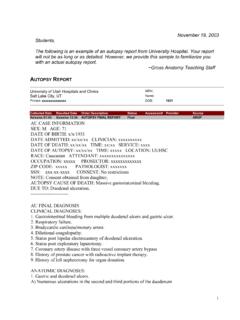
10 For more information on the body donor program go to Autopsy Report Project DescriptionIntroductionIn the human GROSS ANATOMY course, the primary teaching and learning tool is the human cadaver. Often,the cadaver is introduced as the medical student s fi rst patient. Because the cadaver was at onetime a living, breathing human being, the cadaver was in fact a real patient at some point in time. Forsome reason, often unknown to the student, the patient passed away and his or her body was sent tothe University of Utah s Body Donor Program per the patient s wishes. As a student, the only informationyou receive about the cause of death of the cadaver you are dissecting comes from the death certifi in mind, however, that the cause of death listed on the death certifi cate is often listed asthe immediate cause of death. However, the immediate cause of death may have been preceded bysome other long-term disease process(es). As you dissect the cadaver, you may discover pathology orvariations from normal ANATOMY that may or may not have contributed to the death of the will use these discoveries to compose an autopsy report for your cadaver.