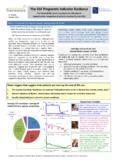
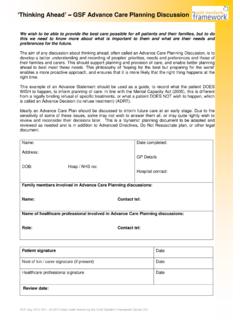
Transcription of Guidance Document to support the Holistic …
1 Guidance Document to support the Holistic Patient Assessment Background People with cancer require supportive and palliative care at different stages of the patient pathway from a range of service providers in the community, hospitals, hospices, care homes and community hospitals. Supportive Care is defined by the National Council for Palliative Care: ..Supportive Care helps the patient and their family to cope with cancer and treatment of it from pre-diagnosis, through the process of diagnosis and treatment, to cure, continuing illness or death and into bereavement. It helps the patient to maximise the benefits of treatment and to live as well as possible with the effects of the disease.
2 It is given equal priority alongside diagnosis and treatment. 1 NICE Improving Outcome Guidance for Supportive and Palliative Care for Adults with Cancer (2004) identified that there are a series of points on the patient pathway where a patient may have particular or greater supportive care needs and recommends that at these key points the patient should be offered a Holistic assessment (2). These points occur generally when there is a significant change in diagnosis, treatment, condition, prognosis or the carer s ability to cope. (3) Key points are: 1. At or around the time of diagnosis (this may include circumstances in which supportive care needs are manifest before diagnosis and particularly where the process of investigation is protracted) 2.
3 Commencement of treatment 3. Completion of the primary treatment plan 4. At each new episode of disease recurrence 5. At any other time that the patient may request 6. At any other time that the professional carer may judge necessary 7. The point of recognition of incurability (in some cases this may precede death by years) 8. The beginning of end of life (in most cases this precedes death by less than one year) 9. The point at which dying is diagnosed Points 7 to 9 can be more difficult to determine and are heavily reliant on professional judgement in recognising these points. In respect of end of life the Gold Standards Framework Team has developed a set of prognostic indicators that may help professionals decide when it begins.
4 Three triggers are suggested: The Surprise Question Would you be surprised if this patient were to die in the next 6-12 months? Patient Choice The patient with advanced disease makes a choice for comfort care only (not curative treatment) Patient Need The patient is in special need of supportive or palliative care Clinical Indicators General predictors of end stage illness (5) The Liverpool Care of the Dying Pathway documentation provides Guidance information for healthcare professionals about recognising dying and the key indicators to identify when to place a dying patient on the pathway.(6) Cancer patients may not be offered or have access to a Holistic assessment at the key points of need outlined and this affect whether they receive appropriate and timely There are broadly four distinct barriers to the provision of services for patients and carers.
5 1. Needs may not be met because they are not recognised either by healthcare professionals or by patients themselves 2. The relevant services may not be available because they had not been planned or funded 3. The relevant services may exist but not be accessed because key professionals are unaware of them 4. The relevant services may fail to bring maximum benefit because of poor communication and coordination. There are a number of assessment tools currently being used by various health and social care professionals (eg: FACE and single assessment) but as yet these tools do not cover all the domains of a Holistic assessment and there is a lack of co-ordination between health and social care to support sharing of patient information required.
6 This results in patients having repeated assessments at a point in the pathway, providing the same information to different professionals. The White Paper, Our Health, Our Care, Our Say (4) included a commitment to develop a common assessment framework for all adults. The work around a Common Assessment Framework aims to deliver a more person-centred and integrated approach to assessing people s need for support from health and social care services and the support needs of their carers. The specific aims of a common assessment framework are to: Improve outcomes for adults by ensuring a person centred and Holistic assessment of need, focused on delivering individual outcomes; support improved joint working between health and social services; Increase efficiency through better information sharing.
7 Developments are on-going with regard to the Common Assessment Framework through the testing process and eventual development of an electronic care plan and tool. Connecting for Health are undertaking further work to define the content of the NHS Care Record and cancer assessment specification needs to become a standard template in the electronic messaging systems. In West London, the Holistic Assessment Cancer Network Working Group was set up and carried out a review of the tools for implementation of the Holistic Patient Assessment. The group then developed an aide memoire that would be adaptable and relevant to all assessments currently in use (Appendix 1).
8 The Aide Memoire was adapted from the Gold Standards Framework PEPSI COLA aide memoire. The aide memoire is a tool to support practitioners carrying out assessments and can be used with assessment tools currently in use. It promotes communication and support and provides a framework to consider patients Holistic needs. The aide memoire encompasses all the domains of a Holistic assessment through the acronym PEPSI COLA: P Physical E Emotional P Personal S Social support I - information and communication C Control and autonomy O Out of Hours L- Living with your illness A Aftercare In each domain the tool identifies: Potential anticipated patient issues and concerns Cue questions to ask patients and carers And resources for professionals to signpost to.
9 Key principles of carrying out a Holistic assessment are that: The assessment should be patient concerns-led Helping patients to assess their own needs should be central to the process Patient consent is necessary to the assessment process Professionals undertaking assessment should have reached an agreed level of competency in key aspects of assessment Patient preferences for communicating with particular professionals, their family and friends, should be taken into account Documenting the assessment should be in accordance with the current assessment tool being used, : FACE. The Holistic Assessment should be undertaken by staff at the key stages of the patient pathway as indicated above.
10 The documented assessment should be transferred to the relevant health care professionals involved in the patient s care. The role of the Key Worker is vital in the process of making the assessment and ensuring this is shared within the multidisciplinary team. Patient held records will facilitate this process. References 1. National Council for Hospice and Specialist Palliative Care Services. Definitions of Supportive and Palliative Care. Briefing paper 11. London: NCHSPCS. September 2002. 2. National Institute for Clinical Excellence (NICE) Improving the Supportive and Palliative Care for Adults with Cancer.