Transcription of Guidance on packaging for sterilization and …
1 Address: Wipak Oy 45 (Wipaktie 2) FIN-15561 Nastola Finland Tel. +358 (0)20 510 311 Fax +358 (0)20 510 3333 e-Mail : Websites: , Registered Domicile Wipak Oy, Nastola VAT No FI 2079181-5 BID No 2079181-5 Bankers Nordea Bank Finland Plc, Helsinki Swift NDEAFIHH IBAN: FI 522147800005322 Guidance on packaging for sterilization and sterilizer loading A well-designed and correctly used sterilization pack provides for effective sterilization and safe handling and storage of all items until the moment they are used. A pack must remain sealed against bacteria and facilitate aseptic presentation of the packaged product. The sterile state of medical device, which is achieved through sterilization , is maintained with the help of an appropriate packaging . The design, materials and manufacture of the packaging materials have to be compatible with the medical device to be packed, the handling processes of the medical device, the sterilization method to be used, the labeling systems and distribution and storage conditions as well.
2 Sterility maintenance is event-related rather than time-related and as such the definition of the Best before dates lays in control of the packer. In the following sections we will examine some key aspects connected with packaging and autoclave loading. Selecting a correct packaging When choosing appropriate packaging material, careful attention shall be laid on the following aspects: the product to be packaged, its size, shape and nature, the method of packaging ; ease and speed of the packaging process, the closing method of the package; sealing and folding processes, the sterilization method to be used; stability to high temperatures and high pressure variations, freedom from dust, fluff and such, resistance to moisture and dirt, porosity needs depending on sterilization method, protection against bacteria and mechanical wear, storage conditions and storage-time related issues, ease of opening the package and facilitating aseptic presentation of the sterile item.
3 Page 1 of 3 Address: Wipak Oy 45 (Wipaktie 2) FIN-15561 Nastola Finland Tel. +358 (0)20 510 311 Fax +358 (0)20 510 3333 e-Mail : Websites: , Registered Domicile Wipak Oy, Nastola VAT No FI 2079181-5 BID No 2079181-5 Bankers Nordea Bank Finland Plc, Helsinki Swift NDEAFIHH IBAN: FI 522147800005322 Packing Guidance : See-through Peel Pouches & Rolls The see-through peel packaging is a time saving concept. It is fast and easy to pack an item into a pouch and to close it by a heat sealer. Recommended sealing temperatures and pressures and other technical advice shall be followed carefully. When using a self seal pouch, the attached adhesive strip provides for a tight closing. The identification of packed instrument(s) is easy because of the transparent plastic film. The green color of the film facilitates visual control of the sealed lines and their integrity. The peel packs are developed for packing individual instruments, smaller sets and other items. The packs are available in a wide range of sizes and shapes as ready-made pouches or tubing fit for the large variety of items in hospitals.
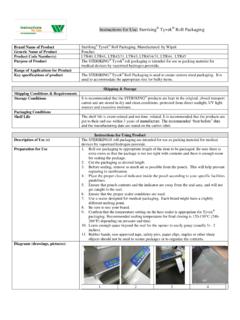
4 The regular range of products is manufactured of medical grade paper and plastic film and is suitable for sterilization in steam and EO or FO gas processes. A dedicated range of products featuring Tyvek (Du Pont s registered trade name) is developed for low temperature sterilization , for example by H2O2. The less air left inside the final pack when packaged, the easier it will be to evacuate the air by means of a vacuum process from the pack and especially from the products to be sterilized, and thus to enable the steam to penetrate into the products. Porous loads shall be packed loosely. Some practical tips for sterilizer loading: Tip 1 The packs shall be arranged in the sterilization tray or shelves so that smaller items stand vertically on their edges. The packs may stand adjacent as paper-to-paper or as paper-to-film when allowing free circulation for facilitating air removal and steam penetration. Heavier and more bulky packs may lay flat. If double pouching is used, the inner and the outer pouch must be arranged by film-to-film.
5 The inner pack shall not be folded, and it is recommended to close it by sealing. Tip 2 Plastic films are, in practice, fully airtight, and as such they form an excellent protection against bacteria for the packaged product. They withstand moisture and wetness extremely well. The steam permeability of plastics is minimal practically nil. The packages are to be placed on their edges in the direction of the steam flow. Tip 3 The sterilization trays must not be packed tightly or too full. In the chamber and in the trays shall be sufficient free space for steam to circulate and to replace any air pockets in the products. The peel packs must not be folded in a way that the plastic side is turned on top of the paper side. On the other hand, the products are not to be packed too loosely so that they could move around during processing, causing folding effects by themselves, wrinkled corners, "turn-ups" and depressions, as those would negatively impact processing result. Page 2 of 3 Address: Wipak Oy 45 (Wipaktie 2) FIN-15561 Nastola Finland Tel.
6 +358 (0)20 510 311 Fax +358 (0)20 510 3333 e-Mail : Websites: , Registered Domicile Wipak Oy, Nastola VAT No FI 2079181-5 BID No 2079181-5 Bankers Nordea Bank Finland Plc, Helsinki Swift NDEAFIHH IBAN: FI 522147800005322 Tip 4 The packs should be arranged in the sterilizer chamber in such a way that they do not touch the walls or other interior surfaces. If they do, then quality-weakening factors may appear in the products, because the free passage of steam is hindered and wet pack risk grows. Tip 5 Bandaging supplies and textiles shall be packed loosely and carefully with their folding direction aligned equally. The lids of bowls and boxes shall be left open a crack to facilitate the steam flow. Some typical packaging failures packaging failures are usually the results of 1) bursting during sterilization processing or 2) film tear and/or paper shear when opening a package. The packaging can fail during sterilization and burst open, if the pack is too full or wrapped too tightly (see Tips 2, 3 and 5 for support), the sterilization tray is too fully loaded, thus the packs cannot breathe during the vacuum process, the pre-vacuum or the post-vacuum process is too radical for the packed products and their packaging .
7 As a general guideline it is recommended filling a pouch up to maximum of its packing volume in order to allow the package to conform to air evacuation processing during sterilization . In case of heavier packs (like instrument trays) and more voluminous packs (like porous textile sets) this is a very important matter to consider. The peel pouches are permeable only through the paper side (or alternatively through Tyvek ) and it takes time to evacuate the air from the package during the pre- or drying vacuum process. If bursting occurs when packing in pouches with gussets, using an ordinary flat pouch without gussets may eliminate the problem. A flat pouch without gussets presents more paper surface permeable to air and steam. A pack must remain sealed against bacteria and facilitate aseptic presentation of the packaged sterile product. If the package is damaged during sterilization , warehousing or transports, the packed item shall be sent for re-packing and reprocessing. A well designed and correctly used sterilization pack provides for effective sterilization and safe handling and storage of all items until the moment they are used.
8 WIPAK OY Wipak Medical * STERIKING is the registered trade name by Wipak. The Steriking products are developed and designed to ensure optimal reliability of use in hospitals and other health care facilities. Steriking product range for healthcare facilities comprises of sterilization packaging materials, sterilization monitoring products and sealing equipment and accessory products for sterile supplies. * Wipak is focused in special barrier systems providing protection and is widely respected in the research and pioneering development of new technologically advanced products for medical and food applications. Focus in sustainability of its products and processes, Wipak applies various production and converting technologies consuming a minimum of carefully selected raw materials. Revision: May 2009 (AL/ms) Page 3 of 3