Transcription of Guideline on process validation for the …
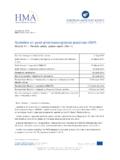
1 30 Churchill Place Canary Wharf London E14 5EU United Kingdom An agency of the European Union Telephone +44 (0)20 3660 6000 Facsimile +44 (0)20 3660 5555 Send a question via our website European Medicines Agency, 2016. Reproduction is authorised provided the source is acknowledged. 28 April 2016 EMA/CHMP/BWP/187338/2014 Committee for Medicinal Products for Human Use ( CHMP) Guideline on process validation for the manufacture of biotechnology-derived active substances and data to be provided in the regulatory submission Draft Agreed by Biologics Working Party April 2014 Adoption by CHMP for release for consultation 25 April 2014 Start of public consultation 1 May 2014 End of consultation (deadline for comments) 31 October 2014 BWP Drafting Group review of comments November 2014 - January 2016 Agreed by BWP February 2016 Adoption by CHMP 28 April 2016 Date for coming into effect 1 November 2016 Keywords active substance, biologics, process validation , process evaluation, process verification, lifecycle Guideline on process validation for the manufacture of biotechnology-derived active substances and data to be provided in the regulatory submission EMA/CHMP/BWP/187338/2014 Page 2/13 Guideline on process validation for the manufacture of biotechnology-derived active substances and data to be provided in the regulatory submission Table of contents Table of contents.
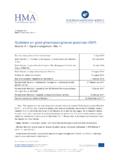
2 2 1. Introduction .. 3 2. 4 3. Legal basis .. 4 4. process characterisation .. 4 process development .. 4 process evaluation .. 5 5. process verification .. 6 Approaches to process verification .. 6 Ongoing process verification during lifecycle .. 7 6. Points to consider in process characterisation and verification .. 8 Upstream process .. 8 Evaluation of upstream process .. 8 Verification of upstream process .. 9 General issues related to single use equipment .. 9 General issues related to multiple harvests .. 9 Downstream process .. 9 Evaluation of downstream process .. 10 Verification of downstream process .. 10 Reprocessing .. 10 Hold time, storage and transportation .. 11 Multifacility production .. 11 Definitions .. 12 References .. 13 Guideline on process validation for the manufacture of biotechnology-derived active substances and data to be provided in the regulatory submission EMA/CHMP/BWP/187338/2014 Page 3/13 Executive summary The Guideline covers process validation which includes process characterisation and process verification of biotechnology-derived active substances in the manufacture of medicinal products.
3 This Guideline addresses the data requirements for process characterisation and verification for submission of a marketing authorisation application or variation. process characterisation can be based on a traditional or enhanced approach to process development. Traditional and enhanced approaches are not mutually exclusive. process verification can be performed in a traditional way regardless of the approach to development taken. However, there is also the possibility to implement continuous process verification if an enhanced approach to development has been performed or where a substantial amount of product and process knowledge and understanding has been gained through historical data and manufacturing experience. Current experience shows that a company can use a traditional or an enhanced approach to process validation , or a combination of both. Regardless of the approach followed, the validation data to be included in the regulatory submission should cover information relating to the evaluation and the verification of the manufacturing process .
4 1. Introduction process validation is the documented evidence that the process , operated within established parameters, can perform effectively and reproducibly to produce an active substance or intermediate meeting its predetermined specifications and quality attributes (ICH Q7). process characterisation is the activity of defining the commercial manufacturing process that will be reflected in planned master production and control records. The goal of this stage is to design a process suitable for routine commercial manufacturing that can consistently deliver an active substance that meets its quality attributes. process characterisation includes process development and process evaluation. For the purpose of this Guideline the following definitions apply: process development includes studies to reach a potential design of a future manufacturing process ; process evaluation includes studies performed at small and/or commercial scale, to provide evidence that the complete manufacturing process and each step/operating unit have been appropriately designed to define the full operating ranges of the manufacturing process .
5 The process is controlled to obtain an active substance of the intended quality for which, when challenging these ranges in univariate and multivariate studies, the quality wil l fulfil the pre-set acceptance criteria. process verification studies should confirm that the final manufacturing process as established based on the process evaluation studies performs effectively in routine manufacture and is able to produce an active substance or intermediate of the desired quality on an appropriate number of consecutive batches produced with the commercial process and scale. process validation should not be viewed as a one-time event. process validation incorporates a lifecycle approach linking product and process development, validation of the commercial manufacturing process and maintenance of the process in a state of control during routine commercial production. Guideline on process validation for the manufacture of biotechnology-derived active substances and data to be provided in the regulatory submission EMA/CHMP/BWP/187338/2014 Page 4/13 process characterisation and verification studies should normally be completed and included in the marketing authorisation application or a variation application as appropriate.
6 It is acknowledged that process validation activities do not end at the time of the marketing authorisation, but continue through the lifecycle of the product. This document addresses the information, which normally includes process evaluation and verification studies, expected to be presented in a regulatory submission to demonstrate that the manufacturing process , described in the Common Technical Document (CTD) section Description of manufacturing process and process controls consistently performs as intended. Subsequent to successful process validation activities for regulatory submission, product quality and process performance must be maintained in a state of control throughout the commercial part of the product lifecycle. 2. Scope This document provides guidance on the data to be included in a regulatory submission to demonstrate that the active substance manufacturing process is in a validated state. The principles adopted and explained in this document apply to recombinant proteins and recombinant polypeptides, their derivatives, and products of which they are components ( conjugates).
7 The principles that are outlined in the document may also apply to other biological products such as vaccines or plasma-derived products, as appropriate. To determine applicability, manufacturers should consult with the appropriate regulatory authorities. For evaluation of viral safety, please refer to ICH Q5A. 3. Legal basis This Guideline has to be read in conjunction with the introduction and general principles (4) and Part II of Annex I to Directive 2001/83/EC, as amended. 4. process characterisation process development The goal of manufacturing process development of the active substance is to establish a commercial manufacturing process capable of consistently producing an active substance of the intended quality. process development fulfils an essential role in defining the criteria and conditions to be addressed in further process evaluation and verification studies. For further information, please refer to the ICH Q11 Guideline .
8 Manufacturing process development should identify which inputs ( material attributes, process parameters) and outputs ( quality attributes, performance indicators such as cell density, yield) for each process step/unit operation should be further evaluated during process evaluation and verification studies. Documented prior knowledge and risk assessment are valuable tools to identify and justify the material attributes ( of raw materials, starting materials, reagents, solvents, process aids, intermediates) and process parameters which have the potential to affect the active substance critical quality attributes (CQAs) and/or process performance. Guideline on process validation for the manufacture of biotechnology-derived active substances and data to be provided in the regulatory submission EMA/CHMP/BWP/187338/2014 Page 5/13 process development information should usually be submitted in Section of the CTD. process evaluation process evaluation studies should provide evidence that, when operating in accordance with the Description of manufacturing process and process controls (CTD section ), the complete manufacturing process and each step/operating unit have been appropriately designed and controlled to generate a product of the intended quality.
9 Successful process evaluation should thus demonstrate that the design of the manufacturing process , with the preliminary definition of operational ranges along with its control strategy is appropriate for commercial manufacturing. The applicant should study selected inputs and outputs according to their potential criticality and justify their selection. For those which are not studied further it may be necessary to explain how it is ascertained that these are kept within the range that has been shown to have a non-critical impact. These studies should include the evaluation of the ability of each step to generate an active substance or intermediate of desired quality at small and/or commercial scale as appropriate, when operating in accordance with the described process and process controls. Input data and results of outputs should be presented for each step. These data should demonstrate that when operating within the proposed input ranges, the output meets relevant quality criteria ( predefined acceptance criteria or internal limits) and thus supports the proven acceptable ranges (PAR) that will be claimed.
10 The outcome of the evaluation studies serves as the main basis of defining the control strategy and also in setting the acceptance criteria for the verification studies. Elements of the control strategy may be optimised following the outcome of the verification studies. Prior knowledge (for example platform data) can be used as supportive information. The contribution of these data ( to justify operating ranges, input set points) to the overall validation package will depend upon justification that the data is representative of the proposed commercial process . Where appropriate, evaluation of selected step(s) operating in worst case and/or non-standard conditions ( impurity spiking challenge) can be performed to support or demonstrate the robustness and the capability of the process to deliver product of the intended quality in these conditions. Small scale models are important tools in the development and evaluation of biopharmaceutical manufacturing processes.