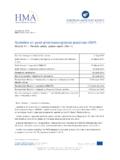
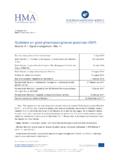
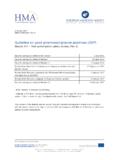
Transcription of Guideline on registry-based studies
1 Official address Domenico Scarlattilaan 6 1083 HS Amsterdam The Netherlands An agency of the European Union Address for visits and deliveries Refer to Send us a question Go to Telephone +31 (0)88 781 6000 European Medicines Agency, 2021. Reproduction is authorised provided the source is acknowledged. 22 October 2021 EMA/426390/2021 Committee for Human Medicinal Products (CHMP) Guideline on registry- based studies Draft approved by the Cross-Committee Task Force on Registries 25 May 2020 Draft sent to the EU Regulatory Network for consultation including EMA committees, Patients' and Consumers' Working Party and Healthcare Professionals' Working Party 9 July 2020 Start of public consultation 24 September 2020 End of consultation 31 December 2020 Final Guideline agreed by the Cross-Committee Task Force on Registries 7 September 2021 Final Guideline adopted by CHMP 16 September 2021 Keywords Patient registry, Real World Evidence, Real Word Data, registry- based study.
2 Feasibility analysis Guideline on registry- based studies EMA/426390/2021 Page 2/35 Table of contents Abbreviations .. 3 Glossary .. 4 1. Introduction .. 5 2. Scope and objective .. 5 3. Methods and processes .. 6 Differences between a registry- based study and a patient 6 Use of registry- based studies for evidence generation .. 7 Planning a registry- based study .. 8 Study protocol .. 9 Study population .. 10 Choice of study population .. 10 Informed consent .. 11 Data protection .. 11 Data collection .. 12 Data quality management .. 12 Data analysis .. 13 Data reporting .. 14 4. Legal obligations and regulatory requirements.
3 15 Annex: Considerations on patient registries .. 20 Introduction .. 20 Registry population .. 20 Data elements .. 21 Quality management in patient registries .. 23 Governance .. 25 Data sharing outside the context of registry- based studies .. 26 References .. 27 Appendices .. 31 Appendix 1. Checklist for evaluating the suitability of registries for registry- based studies . 31 Appendix 2. Safety reporting .. 33 Appendix 3. Examples of recommended international terminologies for data elements .. 34 Guideline on registry- based studies EMA/426390/2021 Page 3/35 Abbreviations ADVANCE Accelerated Development of VAcciNe benefit-risk Collaboration in Europe (a project of the Innovative Medicines Initiative (IMI)) AESI Adverse Event of Special Interest AHRQ US Agency for Healthcare Research and Quality ATMP Advanced Therapy Medicinal Product CHMP Committee for Medicinal Products for Human Use (at EMA)
4 EMA European Medicines Agency ENCePP European Network of Centres for Pharmacoepidemiology and Pharmacovigilance EUnetHTA European Network for Health Technology Assessment (Joint Action on Health Technology Assessment) EU PAS Register European Union Electronic Register of Post-Authorisation studies EU RD Platform European Platform on Rare Diseases GCP Good Clinical Practice GDPR General Data Protection Regulation GVP Good Pharmacovigilance Practices ICH International Council for Harmonisation of Technical Requirements for Pharmaceuticals for Human Use ITF Innovation Task Force (at EMA) HTA Health Technology Assessment MAA Marketing Authorisation Applicant MAH Marketing Authorisation Holder MedDRA Medical Dictionary for Regulatory Activities NCA National Competent Authority OMOP Observational Medical Outcomes Partnership PAES Post-Authorisation Efficacy Study PARENT Cross border PAtient REgistries INiTiative (Joint Action under the EU s Health Programme 2008-2013) PASS Post-Authorisation Safety Study PRAC Pharmacovigilance Risk Assessment Committee (at EMA) PRIME PRIority MEdicines (at EMA)
5 QPPV Qualified Person Responsible for Pharmacovigilance RCT Randomised Clinical Trial REQueST Registry Evaluation and Quality Standard Tool (developed by EUnetHTA) RMP Risk Management Plan RRCT Registry- based Randomised Clinical Trial SAP Statistical Analysis Plan SAR Serious Adverse Reaction SmPC Summary of Product Characteristics SUSAR Suspected Unexpected Serious Adverse Reaction US United States Guideline on registry- based studies EMA/426390/2021 Page 4/35 Glossary Patient registry (synonym: registry): Organised system that collects uniform data (clinical and other) to identify specified outcomes for a population defined by a particular disease, condition or exposure (1).
6 The term patient highlights the focus of the registry on health information. It is broadly defined and may include patients with a certain disease, pregnant or lactating women or individuals presenting with another condition such as a birth defect or a molecular or genomic feature. Disease registry: Patient registry whose members are defined by a particular disease or disease-related patient characteristic regardless of exposure to any medicinal product, other treatment or particular health service. Registry- based study: Investigation of a research question using the data collection infrastructure or patient population of one or several patient registries.
7 A registry- based study is either a clinical trial or a non-interventional study as defined in Article 2 of Regulation (EU) No 536/2014. The table in Annex I of the Questions & Answers Document - Regulation (EU) 536/2014 provides the difference between non-interventional studies and interventional trials. A registry- based study may apply primary data collection in addition to secondary use of the existing data in the registry. Registry- based randomised clinical trial: Randomised clinical trial embedded in the data collection infrastructure of one or several patient registries ( randomisation, data collection or follow-up). Registry database (synonym: register): Database derived from one or several registries.
8 Primary data collection: Collection of data directly from patients, caregivers, healthcare professionals or other persons involved in patient care. Secondary use of data: Use of existing data for a different purpose than the one for which it was originally collected. Harmonised or mapped data elements: Data elements that have been harmonised or mapped across data sources to facilitate the implementation of a common data quality system, data exchange, data analysis and/or the interpretation of results from a study. Competent authority: This term should be understood in its generic meaning of an authority regulating medicinal products and/or an authority appointed at national level for being in charge of all or individual pharmacovigilance processes.
9 For the purpose of this Guideline , the term competent authority covers the competent authorities in Member States (or National Competent Authorities - NCAs) and the Agency. Guideline on registry- based studies EMA/426390/2021 Page 5/35 1. Introduction The European Medicines Agency (EMA) Patient Registry Initiative and the EMA Cross-Committee Task Force on Registries (2) have explored ways to improve the use of patient registries to support regulatory decision-making on medicinal products within the European Union (EU). Recommendations on aspects to be addressed for registry- based studies were issued in five workshops on specific patient registries (3) and in the Committee for Medicinal Products for Human Use (CHMP) Qualification Opinions for two networks of registries via the EMA Scientific Advice Working Party (4) (5).
10 The EMA s Cross-Committee Task Force on Registries also published for consultation a discussion paper on methodological and operational aspects of the use of patient registries for regulatory purposes. The information gained in these activities has been integrated in this new Guideline on registry- based studies , which also uses recommendations from the PARENT Joint Action Methodological Guidance (6), the EUnetHTA s Registry Evaluation and Quality Standards Tool (REQueST) (7), the US Agency for Healthcare Research and Quality (AHRQ) s Users Guide on registries (1), and the European Reference Network Patient Registries platform (8).