Transcription of Guidelines for Applying Protected Area Management …
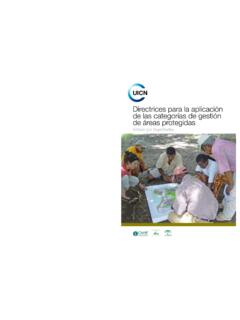
1 Guidelines for Applying Protected area Management Categories Edited by Nigel Dudley Including IUCN WCPA Best Practice Guidance on Recognising Protected Areas and Assigning Management Categories and governance Types by Sue Stolton, Peter Shadie and Nigel Dudley Developing capacity for a Protected planet Best Practice Protected area Guidelines Series No. 21. IUCN WCPA's BEST PRACTICE Protected area Guidelines SERIES. IUCN-WCPA's Best Practice Protected area Guidelines are the world's authoritative resource for Protected area managers.
2 Involving collaboration among specialist practitioners dedicated to supporting better implementation in the field, they distil learning and advice drawn from across IUCN. Applied in the field, they are building institutional and individual capacity to manage Protected area systems effectively, equitably and sustainably, and to cope with the myriad of challenges faced in practice. They also assist national governments, Protected area agencies, non- governmental organisations, communities and private sector partners to meet their commitments and goals, and especially the Convention on Biological Diversity's Programme of Work on Protected Areas.
3 A full set of Guidelines is available at: Complementary resources are available at: Contribute to developing capacity for a Protected Planet at: IUCN Protected area DEFINITION, Management CATEGORIES AND governance TYPES. IUCN defines a Protected area as: A clearly defined geographical space, recognised, dedicated and managed, through legal or other effective means, to achieve the long-term conservation of nature with associated ecosystem services and cultural values. The definition is expanded by six Management categories (one with a sub-division), summarized below.
4 Ia Strict nature reserve: Strictly Protected for biodiversity and also possibly geological/ geomorphological features, where human visitation, use and impacts are controlled and limited to ensure protection of the conservation values Ib Wilderness area : Usually large unmodified or slightly modified areas, retaining their natural character and influence, without permanent or significant human habitation, Protected and managed to preserve their natural condition II National park: Large natural or near-natural areas protecting large-scale ecological processes with characteristic species and ecosystems, which also have environmentally and culturally compatible spiritual, scientific, educational, recreational and visitor opportunities III Natural monument or feature: Areas set aside to protect a specific natural monument, which can be a landform, sea mount, marine cavern, geological feature such as a cave, or a living feature such as an ancient grove IV Habitat/species Management area .
5 Areas to protect particular species or habitats, where Management reflects this priority. Many will need regular, active interventions to meet the needs of particular species or habitats, but this is not a requirement of the category V Protected landscape or seascape: Where the interaction of people and nature over time has produced a distinct character with significant ecological, biological, cultural and scenic value: and where safeguarding the integrity of this interaction is vital to protecting and sustaining the area and its associated nature conservation and other values VI Protected areas with sustainable use of natural resources: Areas which conserve ecosystems, together with associated cultural values and traditional natural resource Management systems.
6 Generally large, mainly in a natural condition, with a proportion under sustainable natural resource Management and where low-level non-industrial natural resource use compatible with nature conservation is seen as one of the main aims The category should be based around the primary Management objective(s), which should apply to at least three-quarters of the Protected area the 75 per cent rule. The Management categories are applied with a typology of governance types a description of who holds authority and responsibility for the Protected area .
7 IUCN defines four governance types. governance by government: Federal or national ministry/agency in charge; sub-national ministry/agency in charge; government-delegated Management ( to NGO). Shared governance : Collaborative Management (various degrees of influence); joint Management (pluralist Management board; transboundary Management (various levels across international borders). Private governance : By individual owner; by non-profit organisations (NGOs, universities, cooperatives);. by for-profit organsations (individuals or corporate).)
8 governance by indigenous peoples and local communities: Indigenous peoples' conserved areas and territories;. community conserved areas declared and run by local communities For more information on the IUCN definition, categories and governance type see the 2008 Guidelines for Applying Protected area Management categories which can be downloaded at: Guidelines for Applying Protected area Management Categories Edited by Nigel Dudley IUCN (International Union for Convention on Biological Diversity Conservation of Nature) The Convention on Biological Diversity (CBD), which entered IUCN helps the world find pragmatic solutions to our most into force in December 1993, is an international treaty for pressing environment and development challenges.
9 The conservation of biodiversity, the sustainable use of the IUCN's work focuses on valuing and conserving nature, components of biodiversity and the equitable sharing of the ensuring effective and equitable governance of its use, and benefits derived from the use of genetic resources. With deploying nature-based solutions to global challenges in 193 Parties, the Convention has near universal participation climate, food and development. IUCN supports scientific among countries. The Convention seeks to address all threats research, manages field projects all over the world, and to biodiversity and ecosystem services through scientific brings governments, NGOs, the UN and companies assessments, the development of tools, incentives and together to develop policy, laws and best practice.
10 Processes, the transfer of technologies and good practices, IUCN is the world's oldest and largest global environmental and the full and active involvement of relevant stakeholders organization, with more than 1,200 government and including indigenous and local communities, youth, NGOs, NGO Members and almost 11,000 volunteer experts in women and the business community. The tenth meeting of the some 160 countries. IUCN's work is supported by over Conference of the Parties to the CBD, held in 2010, adopted 1,000 staff in 45 offices and hundreds of partners in a revised and updated Strategic Plan for Biodiversity for 2011- public, NGO and private sectors around the world.