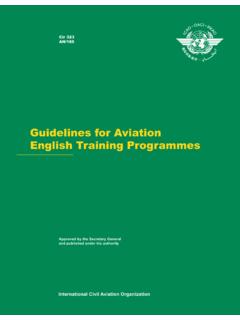
Transcription of Guidelines for Aviation English Training Programmes
1 Cir 323. AN/185. Guidelines for Aviation English Training Programmes Approved by the Secretary General and published under his authority international Civil Aviation Organization These Guidelines were developed based on the expertise and experience of the Board and members of the international Civil Aviation English association (ICAEA) ( ) as an integral part of its commitment to enhancing standards in Aviation English Training ; their commitment is instrumental in improving the standard of Aviation communications worldwide. ICAO is grateful for this important contribution. _____. Cir 323. AN/185. Guidelines for Aviation English Training Programmes _____. Approved by the Secretary General and published under his authority international Civil Aviation Organization Published in separate English , Arabic, Chinese, French, Russian and Spanish editions by the international CIVIL Aviation ORGANIZATION. 999 University Street, Montr al, Quebec, Canada H3C 5H7. For ordering information and for a complete listing of sales agents and booksellers, please go to the ICAO website at Cir 323, Guidelines for Aviation English Training Programmes Order Number: CIR323.
2 ISBN 978-92-9231-403-3. ICAO 2009. All rights reserved. No part of this publication may be reproduced, stored in a retrieval system or transmitted in any form or by any means, without prior permission in writing from the international Civil Aviation Organization. TABLE OF CONTENTS. Page INTRODUCTION .. (vii). Chapter 1. Aviation English Training Design and Development .. 1. Definition of Training objectives .. 1. Use of operationally relevant, work-related language .. 1. Development of communicative language 2. Coverage of all six ICAO Rating Scale and Holistic Descriptors skill areas .. 2. Achievement of ICAO Operational Level 4 in all six skill areas .. 2. Training provider information .. 2. Training design and development team .. 2. Qualification and experience .. 3. Definition of Training curriculum .. 3. Definition of Training curriculum development process .. 3. Justification of Training 3. Curriculum content and order .. 4. Pilot and controller streams .. 4. Professional and ab initio students.
3 4. Consistent use of a communicative approach .. 4. Effective coverage of all six ICAO skills and achievement of Operational Level 4 .. 5. Professional relevance and student motivation .. 5. Use of technology .. 6. Appropriate quality and quantity of audio and visual media .. 6. Blended learning .. 7. Training duration .. 7. Cost-effectiveness of Training .. 8. Monitoring and 8. Student progress monitoring .. 8. Training effectiveness and feedback monitoring .. 9. Questionnaire .. 10. Chapter 2. Aviation English Training Delivery .. 12. Factors impacting the delivery process .. 12. Integration of classroom and distance learning .. 12. Means of enhancing learner motivation .. 12. Communicative Training techniques .. 13. Applicability of Training content, activities and level to operational objectives .. 13. Adaptability of Training materials to meet specific individual and local requirements .. 13. Training activities .. 14. (iii). (iv) ICAO Circular 323-AN/185. Page Trainers .. 14. Demonstration of teacher qualifications, Training , experience and treatment.
4 14. Qualities of teacher/facilitator/technical instructor to deliver materials .. 15. Provision for Training in tandem when required .. 15. Logistics .. 16. Elements of a supportive and appropriate learning environment .. 16. Definition of appropriate lesson duration and frequency .. 16. Demonstration of the technical infrastructure required to support the Training .. 17. Training materials .. 17. Instructor manuals with practical notes, examples and keys .. 17. User-friendly student manuals and materials, including detailed lesson plans .. 17. An introductory programme tutorial for both classroom and distance-learning materials .. 18. Student follow-up and assessment sheets .. 18. Monitoring, testing and remedial Training .. 18. Appropriate placement, progress and exit tests .. 18. Segregation between Training -related tests and any licensing 19. Appropriate means of student monitoring and needs analysis (manual or computerized) .. 19. Learning Management System .. 19. Means and materials for remedial Training .
5 19. Quality assurance .. 20. Means of trainer monitoring and feedback .. 20. Means of assessing professional objectives met .. 20. Questionnaire .. 21. Chapter 3. Aviation English Trainer Profiles and Background .. 23. Basic qualifications for Teaching English as a Foreign Language (TEFL) .. 23. Prior experience teaching English for Specific Purposes (ESP) .. 23. Combination of linguistic skills and operational familiarity .. 23. Exposure to an operational Aviation environment .. 24. In-depth knowledge of Doc 9835 .. 24. Familiarity with ICAO Rated Speech Samples Training Aid .. 24. Attitudes related to Training .. 25. Ability to enhance conditions for students' language production .. 25. Ability to motivate and support students .. 25. Ability to see beyond grammatical accuracy and native-speaker pronunciation to communicational effectiveness .. 25. Willingness to support, observe, coordinate and 26. Attitudes specific to teaching Aviation English .. 26. Commitment to a communicative approach to language teaching.
6 26. Awareness of specific operational objectives and functions .. 26. Awareness of the distinction between standardardized phraseology and plain 27. Awareness of aspects of the language that may be critical in abnormal situations .. 28. High-stakes testing and Training .. 29. ICAO Circular 323-AN/185 (v). Page Class management techniques .. 29. Ability to organize and coordinate group and pair activities .. 29. Ability to act as a facilitator .. 29. Sensitivity to specific group and individual needs .. 29. Questionnaire .. 30. Chapter 4. Aviation English Trainer Training .. 32. Exposure to an Aviation environment .. 32. Flight crew environment .. 32. Controller environment .. 33. Instructional environment .. 33. Theoretical Training curriculum .. 33. Flight operations, airlines and staff .. 34. Airspace and types of ATC .. 34. Aircraft systems and flight .. 35. Airport environment and ground operations .. 35. Meteorology and environmental hazards .. 35. Navigation and charts .. 35. Safety, Human Factors and Crew Resource Management (CRM).
7 35. In-flight incidents and emergency situations .. 35. Aviation language continuum, phraseology and plain language .. 36. Regulatory environment: ICAO and civil Aviation authorities .. 36. international 36. Resources .. 36. Practical trainer Training activities .. 36. Listening practice in ATC lab .. 37. Practice using ICAO Rated Speech Samples Training Aid and rating samples .. 37. Developing and delivering communicative language lessons from raw data .. 37. Group management in communicative language teaching .. 37. Adapting lesson plans and content to meet specific 37. Observing and working in tandem with experienced trainers .. 37. General practical trainer Training exercises and qualification/certification .. 38. Specific linguistic awareness .. 38. Analysing language functions in Aviation .. 39. Identifying language objectives and proficiency criteria in Aviation English .. 39. Criteria for content-based language Training in Aviation English .. 39. Safety-critical nature of language in Aviation .
8 40. Social and personal impacts of Aviation English Training .. 40. Blended learning and student monitoring .. 40. Types of Training delivery with respect to various ICAO Rating Scale skills .. 40. Potential and limits of computer-assisted language learning .. 41. Blended learning curriculum design .. 41. Means of student monitoring and Learning Management System (LMS) .. 42. Benchmark, entry, progress, exit and proficiency testing .. 42. (vi) ICAO Circular 323-AN/185. Page Questionnaire .. 43. CONCLUSIONS .. 45. APPENDICES. Appendix A. Aviation English Training resources .. 49. Appendix B. Provider organizational information and infrastructure protocol form .. 54. Appendix C. Curriculum information form .. 55. Appendix D. Instruction and curriculum development .. 58. Appendix E. Delivery checklist .. 59. Appendix F. A few facts about ICAEA .. 61. _____. INTRODUCTION. BACKGROUND. While there are internationally recognized bodies providing accreditation for schools teaching English as a Foreign Language (see Appendix A, Section A1) and qualifications for teachers of English as a Foreign Language (see Appendix A, Section A2), there is no system of accreditation or qualification for schools or teachers developing and delivering Aviation English Training .
9 Like Aviation English testing, Aviation English Training is an unregulated industry. Yet, language Training in Aviation has specific objectives, content, criteria of proficiency, conditions of use and professional and personal stakes that set it apart from the teaching of language in any other area of human activity: Language is designed to ensure unambiguous pilot-controller communication;. The language used employs a very specific set of vocabulary, expressions and functions;. Operational efficiency, rather than linguistic correctness, is the ultimate criterion by which proficiency is assessed;. Communication is predominantly oral and most often with no visual contact;. The question of communication may not only impact the safety of the travelling public and individual careers, but also potentially have considerable economic repercussions on all individuals involved in the Aviation industry, directly through testing and Training costs and indirectly by its effect on staffing. In the absence of any system of accreditation, validation or qualification for schools or teachers developing and delivering Aviation English Training , these Guidelines for Aviation English Training Programmes have been drawn up in order to assist the Aviation community in selecting and contracting with Aviation English Training providers and in setting appropriate standards of good practice for them.
10 The ICAO Language Proficiency Requirements apply to achieving and maintaining proficiency in all languages used in radiotelephony communications. However, as English is the language most widely used in common by the global Aviation community, and the one which there is a requirement to provide, it is in improving levels of spoken English that the community's main focus currently lies. The introduction of the ICAO Language Proficiency Requirements (LPRs) in 2003 and the subsequent steps to assist their implementation have significantly altered the environment in which Aviation English Training is carried out. From an optional and irregular activity on the periphery of professional Training , entirely dependent on available funds, Aviation English Training is in the process of becoming a subject driven by specific objectives: attaining and maintaining the language proficiency defined as ICAO Operational Level 4. This transition has considerable repercussions. As long as the language Training delivered was entirely constrained by budgetary limits, there was little awareness of the considerable time required for a learner to make significant progress in a language (see , Training duration), nor was much attention given to the differences in the rates at which learners effectively acquire language.