Transcription of GUIDELINES FOR COMPLETING THE MODEL FORM
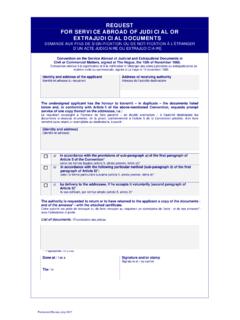
1 GUIDELINES FOR COMPLETING THE MODEL FORM These GUIDELINES will help you complete the MODEL Form annexed to the Hague Convention of 15 November 1965 on the Service Abroad of Judicial and Extrajudicial Documents in Civil or Commercial Matters. The MODEL Form is comprised of three (3) parts: Part 1 Request Part 2 Certificate Part 3 Summary + Warning Which parts to complete? Choosing a bilingual or trilingual MODEL Form: The Permanent Bureau has developed several bilingual and trilingual fillable forms in both Word and PDF formats, which can be easily completed and saved (available on the Service Section of the Hague Conference website (< >)). Check if there is a bilingual or trilingual form that would suit your needs.
2 In the absence of a trilingual form in the desired language, use the bilingual forms (English/French or French/English). Filling out the fields: Complete the MODEL Form electronically using a word processor. Use plain, understandable language and avoid unnecessary legal or technical language. Do not change or rearrange the items in the MODEL Form. Write out dates in full ( , 1 January 2014). If a particular item does not apply, insert not applicable or n/a or otherwise indicate that this item is not applicable. The notes accompanying this form provide further information on filling out each field. If you are using the main channel of If you are using an alternative channel of The use of the MODEL Form is mandatory.
3 The use of the MODEL Form is recommended (but not mandatory). Complete Part 1 (Request) and Part 3 (Summary + Warning). The use of the Warning is recommended (but not mandatory) Complete Part 3 only (Summary + Warning). Do not complete Part 2, which will be completed later by the Central Authority or other competent authority in the requested State. Do not complete Part 1 and Part 2. Language: The fields in the MODEL Form must be filled out in English, French, or (one of) the official language(s) of the requested State (Art. 7(2)). Copies: Part 1 of the MODEL Form (Request for service) and the document to be served must be furnished in duplicate (Art. 3(2)), except if service is made in electronic form. No legalisation: The Request does not need to be legalised (or apostillised) (Art.)
4 3(1)). This exemption also applies to the documents to be served. Translation of the documents to be served: The requested State may require that the documents to be served be translated into (one of) its official language(s) (Art. 5(3)). To find out the requirements of the requested State, check the practical information chart for that State or contact the Central Authority of that State. Costs: Although services rendered by the Central Authority are free of charge, you may be required to reimburse the costs occasioned by the employment of a judicial officer or other competent person to effect service, or for the use of a particular method of service requested by you (Art. 12(2)). To find out whether service in the requested State gives rise to these costs, and whether the requested State requires reimbursement of them, check the practical information chart for that State.
5 Terminology: In this Form: Applicant means the forwarding authority (see below). Central Authority means the authority designated by a Contracting State to receive requests for service from the requesting State and to execute them or cause them to be executed. C&R of the SC refers to the Conclusions & Recommendations of the Special Commission. Convention means the Hague Convention of 15 November 1965 on the Service Abroad of Judicial and Extrajudicial Documents in Civil or Commercial Matters, the full text of which is available on the Service Section of the Hague Conference website. Forwarding authority means the authority or judicial officer competent under the law of the requesting State to forward requests for service to the Central Authority of the requested State.
6 Hague Conference on Private International Law (or Hague Conference) means the intergovernmental organisation under whose auspices the Convention was negotiated and adopted. MODEL Form means the form annexed to the Service Convention. Practical information chart means the chart for a given Contracting State, which is available on the Service Section of the Hague Conference website under Central and other Authorities . Requested State means the State to which the request for service is addressed. Requesting authority means the forwarding authority (see above). Requesting State means the State from which the request for service is issued. Further information: For further information on serving documents abroad under the Convention, visit the Service Section of Hague Conference website, at < >.
7 NOTES ON THE MODEL FORM Note 1: The blanks of the MODEL Form must be filled out in English or in French or in the language of the requested State. Note 2: Where service is to be effected on multiple persons, a separate request for service may need to be issued for each person. If in doubt, contact the Central Authority of the requested State to check whether separate Requests for Service are needed. NOTES ON PART 1 REQUEST Item 1: The name of the plaintiff, or of the counsel representing the plaintiff (when different from the forwarding authority), should not be included in this box. A current list of forwarding authorities is available on the Service Section. Item 2: A comprehensive and updated list of contact details of Central Authorities is available on the Service Section.
8 Item 3: Fill out this field carefully. The Convention does not apply if the address of the person to be served with the document is not known (Art. 1(2)). Where available, insert the addressee s date of birth (C&R No 30 of the 2009 SC). For Requests addressed to Contracting States that use a writing system other than the Latin alphabet, it might also be helpful to include the name and address of the recipient in (one of) the official language(s) of that State. Option a): Select this option (by checking the corresponding box) if you would like the documents to be served by a method prescribed by the internal law of the requested State (formal service) and chosen by that State. The most common methods of service are personal service or service by post.
9 Costs may be incurred if a judicial officer or a person competent under the law of the State of destination is employed to effect service (Art. 12(2)(a)). Option b): Select this option (by checking the corresponding box) if you would like the documents to be served by a particular method. Describe the specific method requested in the field. Note that costs may be incurred when a particular method is chosen (Art. 12(2)(b)). Option c): Select this option (by checking the corresponding box) if you would like the documents to be served by delivery to an addressee who accepts it voluntarily (informal delivery). The available methods of effecting informal delivery vary among Contracting States and may include postal service, personal service in court in response to summons to attend for service, or service by procedural agents or police.
10 NOTES ON PART 2 CERTIFICATE Note 1: The Certificate is to be completed by the Central Authority or other competent authority of the requested State (Art. 6). As such, the forwarding authority should leave the Certificate blank. Note 2: Properly completed Certificates should be returned to the forwarding authority (C&R No 26 of the 2014 SC). The Certificate contemplates two main options depending on whether or not the documents have been served: Option 1: Select this option (by checking the corresponding box) if the documents have been served and proceed to answer items 1-4. Option 2: Select this option (by checking the corresponding box) if the documents have not been served and proceed to answer item 5. Do not complete items 1-4.