Transcription of GUIDELINES FOR MOBILE ELEVATING WORK PLATFORMS
1 1 GUIDELINES FOR MOBILE ELEVATING WORK PLATFORMS 2 SCOPE, APPLICATION, AND DEFINITIONS This document will effectively serve as an Environment, Health and Safety (EH&S) Guideline for California State University Dominguez Hills (CSUDH) departments who possess and operate MOBILE ELEVATING Work PLATFORMS (MEWPs). This document will outline the safety controls that shall be confirmed by trained and licensed personnel prior to start of work to ensure the necessary regulatory protocols are met. Furthermore, the safety requirements referenced in this protocol are mandated by the California Occupational Safety and Health Administration (Cal/OSHA) Department of Industrial Relations (DIR) unit and as such, set forth only the minimums required by state law. What are MOBILE ELEVATING Work PLATFORMS ? MOBILE Elevated Work PLATFORMS (MEWPs) are used to raise people from ground/floor level to conduct work aloft. They may be used indoors or outdoors and for any purpose when a person needs to work at an elevated location.
2 There are different kinds of MEWP equipment and they are selected and used based upon work need and site conditions. They include: - scissor Lifts - Aerial ladders - Vertical towers - Articulating boom lift - Extensible (telescoping) boom platform - Vehicle mounted lift - Any combination of the above Aerial lifts have replaced ladders and scaffolding on many job sites due to their mobility and flexibility. They may be made of metal, fiberglass, reinforced plastic, or other materials. They may be powered or manually operated, and are considered to be aerial lifts whether or not they can articulate, or rotate around a primarily vertical axis. 3 Types of MOBILE ELEVATING Work PLATFORMS ELEVATING Work Platform A device designed to elevate a platform in a substantially vertical axis. This device is stationary once raised and cannot be driven to another location. These devices are intended for use by individual operators.
3 May also be referred to as a single man lift. Fall Restraint is not required when operating this equipment unless indicated by the lift manufacturer. scissor Lift - A device designed to elevate a platform in a substantially vertical axis. This device can also be driven by an operator inside the work platform and is generally designed to carry more than one person. Fall Restraint is not required when operating this equipment unless indicated by the lift manufacturer. Articulating Boom Lift - An aerial device with two or more hinged boom sections. Fall Restraint is required when operating this lift. 4 Extensible Boom Platform - An aerial device with an extensible boom. Telescopic booms with personnel platform attachments are considered to be extensible boom PLATFORMS . Fall Restraint is required when operating this equipment. Vehicle Mounted Lift (Bucket Truck) These devices typically have a Bucket in place of a basket, which is designed for one person.
4 Vehicle must have the brakes set, wheels chocked, and outriggers in place while operating this device. Fall Restraint is required when operating this Lift. Who is a Qualified Operator? All CSUDH faculty and staff who are required or request to operate MEWP, or who must oversee persons operating MEWP, must know about the requirements of this program. Operators are trained in the safe operation of MEWP and receive a 3-year training certification from an approved training vendor to operate specific types of MEWP equipment. Do these GUIDELINES apply to my department? This program applies to all CSUDH faculty and staff who are required or request to operate MOBILE ELEVATING Work PLATFORMS (MEWP), or who must oversee persons operating MEWP, for any portion or aspect of their research, instruction and/or work. Departments that own, lease, rent or otherwise operate MOBILE ELEVATING Work PLATFORMS (MEWP) must implement these GUIDELINES into their business/research operations to comply with Cal/OSHA and other regulatory requirements.
5 Contractors we hire use MEWPs on CSUDH property. What do we have to do? Departments hiring contractors are NOT responsible in ensuring the contractor s compliance with the CSUDH MEWP GUIDELINES . However, Contractor or Vendor employees that have been trained under their company s MOBILE ELEVATING Work Platform Safety program, and have CSUDH Department s permission, may operate MEWP equipment owned/leased/rented by their employer on CSUDH premises. Contractors may not operate any CSUDH-owned, rented, or leased MEWP equipment. Whether the operator is a vendor or contractor, they may be required to show verification that they have been trained and certified on the specific MEWP equipment being operated to any CSUDH EH&S personnel. If contractor/vendor employees are found to be uncertified, all work using the MEWP equipment must stop immediately until properly certified personnel are present to operate the equipment.
6 5 If one of our employees operates the lift, can the vendor be in the lift as well? Yes, the vendor can be in a MEWP while a CSUDH employee operates the MEWP if the vendor can provide documentation of current MEWP training on that equipment. CSUDH Responsibilities CSUDH EH&S is responsible for assisting departments with compliance with these GUIDELINES . If necessary EH&S can also review contractor MEWP training documentation. CSUDH will also ensure that copies of Contractor MEWP programs and training documentation is kept on file with the CSUDH representative that established the vendor contract(s). MOBILE ELEVATING WORK PLATFORM OPERATION What procedures are required prior to conducting work with MEWPs? Prior to conducting work with an MEWP, an Operator conducts a Site Evaluation and a Lift Selection Assessment . This assessment is conducted as environmental hazards and job requirements dictate, but is formally completed by every Operator at the beginning of working in a new or unfamiliar location, or when new or unfamiliar hazards are identified.
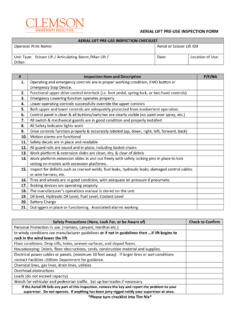
7 This assessment ensures that the proper MEWP equipment is selected for the work, and that all hazards in the work area are identified and mitigated prior to commencing work. On the reverse side of each lift Pre-Operation Inspection Form (Attachments 3 and 4) is a written checklist for Site Evaluation that may be used to document the Operator s assessment of their work environment. This site evaluation checklist may also be used to assess the Department s general work environment to determine appropriate equipment procurement needs. At the beginning of each work shift, or prior to using MEWP equipment for a new work assignment, the Operator conducts a documented Pre-Operational Inspection of the equipment. This inspection is specific to the type of lift equipment, and includes visual and auditory inspection of all safety and operational components of the equipment. Results of this inspection are documented on inspection checklists. Copies of the Pre-Operation Inspection are to be kept on the MEWP.
8 Operating Procedures/Hazard Identification and Controls At the beginning of each work shift, or prior to using MEWP equipment for a new work assignment, Operators must review and assess the following equipment/work area conditions and document findings using the inspection form provided (Attachment X): 1. Review work area for hazards, and remove/control them prior to operation. 2. Always conduct an environmental hazard assessment prior to selecting/using MEWP equipment. 3. Only use MEWP equipment designed to safely work in the conditions observed. 4. Review operating instructions, warnings, and precautions for the types of MEWP being operated. 5. Keep a copy of the equipment manual on the lift at all times. 6. Inspect and document the equipment s proper function of controls and instrumentation, engine/motor operation, and inspect steering and maneuvering. 6 7. Familiarize yourself with visibility. 8. Inspect basket or platform capacity and equipment stability.
9 9. Check fuel and/or charging of batteries, and refuel/recharge as needed. 10. Review and understand equipment operating limitations. 11. Review other operating instructions, warnings, or precautions listed in the operator's manual for the types of MEWP that you will operate. 12. Alert all persons in the area of intended work activities and hazards. 13. Control access to the area below the MEWP equipment s work zone. 14. Always face the direction of travel. 15. Don t travel horizontally with the platform elevated or extended. 16. Don t exceed the basket or platform capacity. 17. Position equipment on a firm level surface and minimize the usage of blocks or ramps for leveling the MEWP equipment. 18. Always set outriggers prior to use if the MEWP is equipped with them. 19. Wear proper safety harnesses and only tie off to the work platform s fall restraint tie-off point. (Refer to Types of Lifts and the Inspection Forms in the Attachments to determine if safety harnesses are required to be worn.)
10 20. Don t climb on guardrails, work or reach between the guardrails, climb on ladders or stand on other items when working on the platform. 21. Practice good housekeeping when working in and around the platform. Do not store items on the floor or guardrails of the basket/bucket. 22. Never drop or throw objects to or from the work platform. 23. Always look below platform and confirm it s safe to lower the equipment before doing so. 24. Never lean the platform on or against structures. 25. Never use the boom to push against something, or try and pull the MEWP equipment along in a horizontal direction. 26. Do not modify, alter, or otherwise tamper with the guardrails or any other component of the MEWP. 27. Observe the manufacturer s listed speed limit when operating the MEWP. What do I do if a deficiency is found during the Pre-Operation Inspection? MEWPs, or operations involving MEWPs, found to have deficiencies during the Pre-Operation Inspection are not to be used/completed until any deficiencies discovered during a Pre-Operation Inspection are corrected.