Transcription of GUIDELINES FOR SELECTIVE FEEDING: THE …
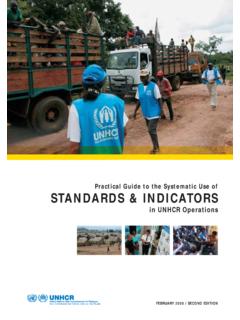
1 GUIDELINES . FOR SELECTIVE feeding : THE MANAGEMENT. OF MALNUTRITION. IN emergencies . January 2011. With the collaboration of the United Nations Standing Committee on Nutrition and the World Health Organization I. GUIDELINES FOR SELECTIVE feeding : THE MANAGEMENT OF MALNUTRITION. UNHCR, 2011. All rights reserved. Reproduction and dissemination for educational or other non-commercial purposes is authorised without any prior written permission from the copyright holders provided the source is fully acknowledged. Reproduction for resale or other commercial purposes, or translation for any purpose, is prohibited without the written permission of the copyright holders.
2 Applications for such permission should be addressed to the Public Health and HIV. Section of the Office of the United Nations High Commissioner for Refugees at All reasonable precautions have been taken by the United Nations High Commissioner for Refugees to verify the information contained in this publication. However, the published material is being distributed without warranty of any kind, either express or implied. The responsibility for the interpretation and use of the material lies with the reader. In no event shall the United Nations High Commissioner for Refugees be liable for damages arising from its use. Copies of this document can be obtained from: UNHCR Public Health and HIV Section CP 2500.
3 1202 Geneva, Switzerland and from the website: Cover Photo: UNHCR / S. Kritsanavarin / November 2008. Graphic Design: Alessandro Mannocchi, Rome Funded by the Global Nutrition Cluster II. CONTENTS. ACRONYMS .. 6. I. INTRODUCTION .. 8. Humanitarian Response Review: The Cluster Approach .. 8. Purpose and Scope of the GUIDELINES .. 8. How to Use the GUIDELINES .. 10. II. ACUTE MALNUTRITION IN emergencies .. 11. Major Causes .. 11. Assessment Using the New WHO Child Growth Standards .. 13. Indicators .. 14. Children 6-59 Months of Age .. 15. Adults .. 15. Classification and Management of Acute Malnutrition .. 17. III. MICRONUTRIENT DEFICIENCIES IN emergencies .
4 19. Major Causes .. 19. Major Micronutrient Deficiencies in emergencies .. 19. Indicators .. 20. Prevention and Control .. 21. Food fortification .. 21. Vitamin and Mineral Supplements .. 22. Vitamin A Supplementation .. 22. Iron Supplementation .. 23. Multiple Vitamin and Mineral Supplements .. 24. IV. FOOD AND NUTRITION ASSISTANCE IN emergencies .. 26. General Food Distribution .. 26. SELECTIVE feeding Programmes .. 26. Types of SELECTIVE feeding Programmes .. 26. Criteria for Establishing SELECTIVE feeding Programmes .. 27. Food Aid Commodities for SELECTIVE feeding Programmes .. 29. Therapeutic Milk .. 29. Breast Milk Substitutes .. 29. Key Considerations for Infants in Exceptionally Difficult Circumstances.
5 30. Key Considerations on the Prevention of Mother-to-Child Transmission (PMTCT) of HIV/AIDS .. 30. Fortified Blended Foods .. 31. Ready-to-Use Therapeutic Foods (RUTF) .. 31. Compressed Biscuits .. 32. Lipid-Based Spreads .. 32. Ready-to-Use Supplementary Foods (RUSF) .. 32. Soy-Based RUSF .. 32. Peanut-Based RUSF .. 33. Fortified Biscuits .. 33. 1. GUIDELINES FOR SELECTIVE feeding : THE MANAGEMENT OF MALNUTRITION. Other Commodities Included in SELECTIVE feeding Programmes .. 33. Iodised Salt .. 33. Vegetable Oil and Sugar .. 33. Resource Mobilisation for SELECTIVE feeding Programmes .. 33. Refugee and IDP Situations .. 34. Natural or Man-Made Disasters .. 34.
6 Calculating the Nutritional Value of Food Rations .. 34. V. THERAPEUTIC feeding PROGRAMMES (TFP) .. 35. Objectives of Therapeutic feeding .. 35. When to Start TFP .. 35. Therapeutic feeding Components .. 35. Inpatient Management of SAM with Medical Complications .. 37. Admission Criteria .. 37. Type of Facilities for Inpatient Management of SAM .. 38. Treatment Schedule .. 38. Discharge from Inpatient Treatment .. 41. Outpatient community-based treatment .. 41. Objectives of Outpatient treatment .. 41. Organization of Outpatient treatment .. 41. Admission Criteria to Outpatient Treatment .. 41. Discharge Criteria from Outpatient Treatment .. 42. Monitoring and Evaluation Indicators.
7 42. When to Close TFC .. 43. VI. SUPPLEMENTARY feeding PROGRAMME (SFP) .. 44. What is Supplementary feeding ? .. 44. Objectives of Supplementary feeding .. 44. Types of Supplementary feeding .. 44. Blanket Distribution .. 44. Targeted Distribution .. 44. When to Implement SFP .. 45. How to manage a Targeted SFP .. 46. Take-Home Rations .. 46. On-Site feeding .. 46. Take Home versus On-Site feeding .. 47. Targeted SFP: Criteria for Admission and Discharge .. 47. Moderately Acutely Malnourished Children 6-59 months .. 48. Moderately Malnourished Pregnant and Lactating Women .. 49. Moderately and Mildly Malnourished Chronically Ill Adults .. 50. Moderately Malnourished Older Persons.
8 51. Blanket SFP: Target Groups .. 52. Food Commodities and Rations for SFP .. 53. Routine Health-Related Interventions for Moderate Acute Malnutrition .. 54. Vitamin A .. 54. Antihelminths .. 54. Iron and Folic Acid .. 55. Other treatments .. 55. Monitoring and Evaluation Indicators .. 55. When to Close SFP .. 56. 2. VII. MONITORING AND EVALUATION (M&E) AND REPORTING .. 57. Indicators for M&E .. 57. Exit Categories: Definitions for Therapeutic feeding and Supplementary feeding .. 58. Indicators for In-patient TFP .. 59. Indicators for SFP .. 60. Instruments for Individual M&E .. 60. Individual Record Cards .. 60. Ration Cards .. 61. Referral Slips .. 61. Instruments for M&E of TFP and SFP Interventions.
9 61. Tally Sheets .. 61. Monthly Statistical Report .. 61. Monitoring and Reporting on Commodity Distribution .. 63. VIII. COMPLEMENTARY INTERVENTIONS .. 64. Health .. 64. Most Prevalent Communicable Diseases in Malnourished Populations .. 64. Measles .. 64. Malaria .. 64. Diarrhoeal diseases .. 65. Tuberculosis .. 65. HIV/AIDS .. 65. Minimum Environmental Health Standards for emergencies .. 65. Water .. 66. Sanitation .. 66. Care .. 66. IX. MANAGEMENT ISSUES .. 68. Mobilizing and Delivering Food .. 68. Providing non-Food Items (NFIs) .. 68. X. PENDING ISSUES .. 69. XI. ANNEXES .. 72. Annex 1 Global Nutrition Cluster .. 72. Annex 2 Public Health Cut-Off Points for Indicators of MNs.
10 73. Annex 3 UNHCR Policy on Acceptance, Distribution and Use of Milk Products in Refugee Settings .. 75. Annex 4 Definition of AFASS Replacement feeding .. 77. Annex 5 Various Formulations of CSB .. 78. Annex 6 Samples of Tally Sheets and Reports .. 79. Annex Sample of a Consolidated Report for Therapeutic Inpatient Care .. 79. Annex Site Tally Sheets for the Management of SAM .. 80. Annex 7 Guiding Principles on IYCF in emergencies .. 83. XII. GLOSSARY .. 85. 3. GUIDELINES FOR SELECTIVE feeding : THE MANAGEMENT OF MALNUTRITION. XIII. BIBLIOGRAPHY .. 95. BOXES. Box 1 Criteria for SAM with/without Medical Complications .. 69. Box 2 Dietary Management of Severely Malnourished Young Infants (<6months).