Transcription of GUIDELINES FOR USING R-452A AND R-448A ... - …
1 GUIDELINES for USING R449A and R452A in new and existing GUIDELINES FOR USING R-452A AND R-448A /R-449A GUIDELINES for USING R449A and R452A in new and existing commercial refrigeration GUIDELINES for USING R-452A and R-448A /R-449A in new and existing commercial refrigeration systems 3 tecumseh reserves the right to change information in this document without notification 2018 tecumseh Products Company, Issued 05-2016, update 04-2018.
2 All rights reserved. GUIDELINES for USING R-452A and R-448A /R-449A in new and existing commercial refrigeration systems 1. R-452A and R-448A /R-449A refrigerants context tecumseh Products Company does not recommend the retrofit of existing refrigeration systems that are operating leak free. If the system is not leaking refrigerant to the atmosphere, and is operating properly, there is no reason to replace the refrigerant. Please check with the equipment manufacturer, as changing the refrigerant may void the safety certification.
3 This guideline aims to provide practical information and recommendations for USING R-452A and R-448A /R-449A in new and existing low, medium and high temperature commercial refrigeration systems. These recommendations are applicable to all tecumseh hermetic reciprocating and rotary compressors (includes tecumseh condensing units), with the exception of Masterflux ranges. R-452A and R-448A /R-449A should only be used in tecumseh compressors approved for these refrigerants. R-452A and R-448A /R-449A are not direct drop-in replacements for R-404A/R-507. The capacity and efficiency will somewhat vary and there are differences that must be considered when handling, processing, applying or retrofitting refrigerants.
4 Unlike R-452A , refrigerants R-448A and R-449A have higher discharge temperatures than R-404A (10 to 30K; 18 to 54F) particularly at lower evaporating temperatures . Therefore, special precautions must be taken to ensure reliable compressor operation. 2. Environmental Data R-452A and R-448A /R-449A are mixtures of common hydrofluorocarbons (HFC) and new hydrofluoro-olefin molecule R-1234yf (HFO), with composition changes detailed below. R-507 R-404A R-449A R-448A R-452A R-143a 50% 52% 0% 0% R-32 0% 0% 24% 26% 11% R-125 50% 44% 25% 26% 59% R-134a 0% 4% 26% 21% 0% R-1234yf 0% 0% 25% 20% 30% R-1234ze 7% R-452A and R-448A /R-449A are all non-flammable.
5 They have been assigned an A1 safety classification under ASHRAE 34 and EN 378 standards. A1 means that the substance is classified non- dangerous with the following nomenclature: A = Low toxicity 1 = No flame propagation at 18 C / F, 101300 Pa / PSI. However, because R-452A and R-448A /R-449A contain mildly flammable components R-32 and R-1234yf, they should not be mixed with air to check for system leaks as these mixtures can become combustible. 4 tecumseh reserves the right to change information in this document without notification 2018 tecumseh Products Company, Issued 05-2016, update 04-2018.
6 All rights reserved. GUIDELINES for USING R-452A and R-448A /R-449A in new and existing commercial refrigeration systems Other physical properties are shown in the following table. Refrigerant Properties R-404A R-448A / R-449A R-452A Boiling point at 1 bar ( C / F) / -46 / -47 / Critical temperature ( C / F) / / Critical pressure (bar abs / PSIG) / 541 / / Liquid density at 32 C / 90 F (kg/m3) 1010 1061 1093 Vapor density at -30 C / -22 F (kg/m3) Chlorine is not present in R-452A and R-448A /R-449A and consequently, these refrigerants have zero Ozone Depletion Potential (ODP).
7 Their Global Warming Potential is 45% and 64% respectively lower than R-404A. 3. Refrigerant Properties Glide and heat exchanger performance R-404A is a quasi-azeotrope refrigerant blend, which means it condenses and boils at nearly the same temperature for a given pressure (temperature glide lower than ). On the other hand, refrigerants R-452A and R-448A /R-449A exhibit to 5K ( to ) of temperature glide, depending on the operating conditions (see following table). 5 tecumseh reserves the right to change information in this document without notification 2018 tecumseh Products Company, Issued 05-2016, update 04-2018.
8 All rights reserved. GUIDELINES for USING R-452A and R-448A /R-449A in new and existing commercial refrigeration systems Effective Temperature Glide (K / F) Evaporator Condenser Fluid \ Tdew -35 C / -31 F -10 C / 14 F 0 C / 32 F 45 C /113 F R-404A / / / / R-448A /R-449A / / / / R-452A / / / / Effective glide takes into account the real inlet evaporator temperature Temperature will increase during the evaporation phase and decrease during the condensation phase.
9 Counter flow heat exchanger technology that has been utilized over the last 10 years will be less sensitive to this physical phenomenon vs. parallel flow. Also, average temperature during the evaporating phase, named mid temperature, increases the temperature difference (TD) between the primary and secondary fluids, compared to the dew temperature reference. These two (2) facts may counteract possible heat exchanger capacity losses. One remaining risk is ice-up of the evaporator which is dependent upon the secondary fluid type and the amount of flow across the heat exchangers.
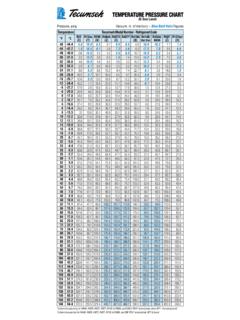
10 O The defrost control s time (frequency and duration) and temperature settings could be adjusted and/or reset to reduce the risk of ice build-up. The corresponding Pressure-Temperature of refrigerants R-452A and R-448A /R-449A vs. R-404A, including bubble and dew point data, is shown in the tables on pages 14 to 16. In order to properly feed the expansion device and to reach the expected capacity delivered by the evaporator, the technician should check to determine if there is sufficient sub cooling at the condenser outlet. The amount of sub cooling can be determined by referencing the bubble temperature column.