Transcription of Guidelines for Wind Resource Assessment: Best Practices ...
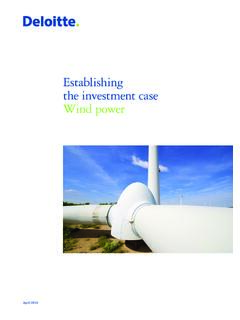
1 Guidelines FOR wind Resource Assessment: BEST Practices FOR COUNTRIES INITIATING wind DEVELOPMENTASIAN DEVELOPMENT BANKG uidelines for wind Resource AssessmentBest Practices for Countries Initiating wind DevelopmentWind Resource Assessment (WRA) is a pivotal step in the development phase because it determines the bankability of wind projects. The Asian Development Bank s Quantum Leap in wind Power Development in Asia and the Pacific project has developed WRA Guidelines that encapsulate best Practices for new and emerging wind energy markets with the goal of accelerating wind energy development.
2 The Guidelines address challenges to policy support for WRA, wind measurement, wind data processing, wind flow modeling, and estimation of losses and uncertainty. These are challenges faced in these markets by policy makers, implementation agencies, utilities, developers, and the Asian Development BankADB s vision is an Asia and Pacific region free of poverty. Its mission is to help its developing member countries reduce poverty and improve the quality of life of their people. Despite the region s many successes, it remains home to approximately two-thirds of the world s poor: billion people who live on less than $2 a day, with 733 million struggling on less than $ a day.
3 ADB is committed to reducing poverty through inclusive economic growth, environmentally sustainable growth, and regional in Manila, ADB is owned by 67 members, including 48 from the region. Its main instruments for helping its developing member countries are policy dialogue, loans, equity investments, guarantees, grants, and technical assistance. ASIAN DEVELOPMENT BANK6 ADB Avenue, Mandaluyong City1550 Metro Manila. DEVELOPMENT BANKGUIDELINES FOR wind Resource ASSESSMENT: BEST Practices FOR COUNTRIES INITIATING wind DEVELOPMENTMay 2014 Printed on recycled paper 2014 Asian Development rights reserved.
4 Published in the Philippines. ISBN Print , PDF Publication Stock No. TIM146446 Cataloging-In-Publication DataAsian Development Bank. Guidelines for wind Resource assessment: Best Practices for countries initiating wind City, Philippines: Asian Development Bank, wind . 2. wind energy . 3. Renewable energy . I. Asian Development views expressed in this publication are those of the authors and do not necessarily refl ect the views and policies of the Asian Development Bank (ADB)
5 Or its Board of Governors or the governments they does not guarantee the accuracy of the data included in this publication and accepts no responsibility for any consequence of their making any designation of or reference to a particular territory or geographic area, or by using the term country in this document, ADB does not intend to make any judgments as to the legal or other status of any territory or encourages printing or copying information exclusively for personal and noncommercial use with proper acknowledgment of ADB.
6 Users are restricted from reselling, redistributing, or creating derivative works for commercial purposes without the express, written consent of :In this publication, $ refers to US ADB Avenue, Mandaluyong City1550 Metro Manila, PhilippinesTel +63 2 632 4444 Fax +63 2 636 orders, please contact: Public Information CenterFax +63 2 636 of Tables and Figures ivForeword vExecutive Summary viiAbbreviations ixI.
7 Introduction to wind Resource Assessments 1II. wind energy Project Life Cycle 2 III. Importance of Accurate wind Resource Assessments 4A. wind Resource Assessment Challenges 4B. Impact of wind Resource Assessments on Financial Feasibility 5C. Impact of wind Resource Assessments on Grid Integration 6D. Special Note for Small and Medium-Sized wind Projects 6IV. wind Resource Assessment Process 7A. Loss and Uncertainty Estimation 8B. Bankable wind Resource Assessments 10V. Best Practices for wind Resource Assessments 11A.
8 Policy 111. Feed-in Tari 112. Licensing Guidelines 113. Grant or Low-Interest Loan for wind Resource Assessments 124. Long-Term (10 20 Years) Measurement for High-Quality Reference wind Data 13B. Countrywide Resource Assessment 14C. Project-Specifi c Measurement 14D. Managing Resource Assessment Uncertainty 15VI. Conclusions 18 VII. References 19 Appendixes 1.
9 Nuts and Bolts of wind Resource Assessments 202. wind Measurement 223. Prospecting and Methodology and Tools for Micrositing of Met-masts 29ivTables and FiguresTA B L E S 1 Description of the Activities in the Life Cycle of a wind energy Project 3 2 Description of the Five Stages of a wind Resource Assessment 8 3 Best Practices from the Perspectives of the Five Stakeholders 16 List of Measured Parameters in a wind Resource Assessment 20 List of Computed Parameters in a wind Resource Assessment 21 Description of Met-Towers, Sensors.
10 And Confi guration 22 Description of the Tasks for Estimating Annual energy Production 26 FIGURES 1 Activities in the Life Cycle of a wind energy Project 2 2 Five Stages of a wind Resource Assessment 7 3 Illustration of Exceedance Probabilities 10 Process for Estimation of Annual energy Production 26vForewordWind energy enjoys a unique place in climate change mitigation. It is the most mature and the most cost-e ective solution to reducing global greenhouse gas (GHG) emissions from the electricity sector, which is the largest contributor of GHG emissions.