Transcription of Guitar Scales - Corgol
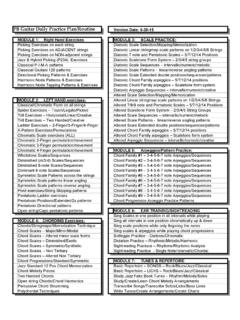
1 Guitar ScalesGuitar ScalesRegardless what instrument you play, learning to play Scales is a rite of passage. This is the foundation to becoming a learned musician, rather than merely a recreational good news here is: you play the Guitar !The Guitar neck itself looks like a chart: The parallel lines of the frets and string work in your favor. We clearly and precisely show you every note in all 12 keys of the major and natural minor Scales . Simply follow the chart which represents your Guitar neck. We have designed these pages so they will print out clearly, so you can take this reference guide with you everywhere you go. We have highlighted the root notes (your starting note) for each of the keys in blue for the major scale , and red for the minor scale .
2 After the major and minor Scales , we have charted the pentatonic scale and examine at its usage as well as the Chromatic scale which contains all 12 notes and how you can apply Scales and their charts are presented in the order they appear in the Circle of Fifths. The Circle of Fifths is a musician s tool use to show the number of altered notes (generally referred to as sharps or ats) in a scale . It is also used to help transition from one key to another. For our purpose here, we use it to introduce you to each successive scale adding one altered note after the C scale (which has no sharps or ats) through F# (Gb), then working through the Flat Keys removing one altered scale tones per this is a scale study and not necessarily a music theory lesson, there are a couple of things that are bene cial for you to know:Enharmonic Equivalent: Essential the same note, usually an altered note, has two names.
3 For example, G# and Ab (G sharp and A at) is the exact same note (hence the name, they are harmonically equal). The name depends on what key the scale is being played in. There is no scale step between B and C, nor between E and F. So it is extremely rare to see music that has B #, Cb, E# or Fb written in there s no need to get overly involved in that now. Learn the Scales , have fun, and then we ll give you some exercise ideas to help you apply these Scales in a musical of ContentsTABLE OF CONTENTSG uitar ScalesReading InstructionsKey of C major (A minor )Key of G major (E minor )Key of D major (B minor )Key of A major (F# minor )Key of E major (C# minor )Key of B major (G# minor )Key of F# major (D# minor )Key of Db major (Bb or minor )Key of Ab major (F minor )Key of Eb major (C minor )Key of Bb major (G minor )Key of F major (D minor )G major (E minor ) pentatonic scaleAll the notes of the fretboardPage 4 Page 5 Page 6 Page 7 Page 8 Page 9 Page 10 Page 11 Page 12 Page 13 Page 14 Page 15 Page 16 Page 17 Page 18 Reading InstructionsGuitar ScalesKey of C major (A minor )
4 Guitar ScalesKey of G major (E minor ) Guitar ScalesKey of D major (B minor ) Guitar ScalesKey of A major (F# minor ) Guitar ScalesKey of E major (C# minor ) Guitar ScalesFret#12345678910111213 1415 EBGDAEFCG#D#A#FF#C#AEBF#GDA#FCGG#D#BF#C# G#AECGDAA#FC#G#D#A#BF#DAEBCGD#A#FCC#G#EB F#C#DAFCGDD#A#F#C#G#D#EBGDAEFCG#D#A#FF#C #AEBF#GDA#FCGKey of B major (G# minor ) Guitar ScalesKey of F# major (D# minor ) Guitar ScalesKey of Db major (Bb or minor ) Guitar ScalesAs we discussed in our introduction, some notes can be referred to by di erent names. In this case the Db scale is EXACTLY THE SAME as the C# scale , only the note s name has changed. The notes are Harmonic Equivalents. Typically, musicians would call this a Db scale , because there are less notated accidentals (altered tones) than in the C# spelling of this of Ab major (F minor ) Guitar ScalesKey of Eb major (C minor ) Guitar ScalesKey of Bb major (G minor ) Guitar ScalesKey of F major (D minor ) Guitar ScalesG major (E minor ) pentatonic scaleGuitar ScalesThe pentatonic scale is a favorite of many guitarists and it s easy to see why.
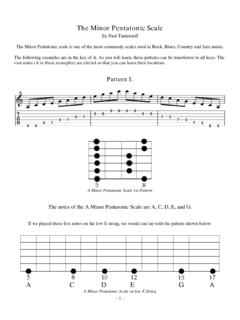
5 As its name implies, it only uses ve tones. Its minor form is simple to nger and remember (it is the box pattern that so many musicians get locked into). Plus, it sounds great!Use the E minor pentatonic scale when playing 12 Bar blues in either E major or E minor , it works equally well over both. Use the G major pentatonic in Folk, Country and Rock in the key of G when you don t want the blues sound. The lack of the major scale s 4th and 7th scale tones makes the pentatonic sound wonderfully the notes of the fretboardUsing sharps for accidentals:Using ats for accidentals: Guitar ScalesFret#123456789101112131415 EBGDAEFCG#D#A#FF#C#AEBF#GDA#FCGG#D#BF#C# G#AECGDAA#FC#G#D#A#BF#DAEBCGD#A#FCC#G#EB F#C#DAFCGDD#A#F#C#G#D#EBGDAEFCG#D#A#FF#C #AEBF#GDA#FCGG uitar ScalesAs you learn these Scales we d like to suggest playing along with a drum machine or metronome to help keep you in time.
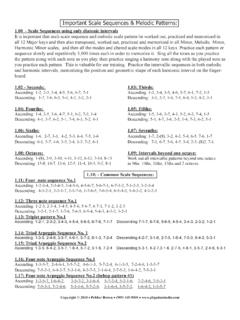
6 Start with quarter notes at a moderate tempo and play the Scales ascending and descending. Then try playing two eighth notes per note of the scale using alternate picking (down-up), then triplets and so speeding up the tempo at bit at a time as you get more comfortable playing these Scales . And you can try slower tempos as these Scales will help you break out of the box that so many guitarist nd themselves in by merely playing patterns, such as the pentatonic box pattern. But, of course, you ll rarely nd yourself in a situation where you d want to play the scale steps in chronological order, so we d like to suggest the following ideas for exercises that ll open your mind and teach your ngers playing the Scales a note at a time alternating octaves.
7 Try starting on the highest note and play three notes descending, then back up one note and play another three notes descending, and so a pattern starting on the root, then playing the seventh below, back up to the root, up to the second scale step, back down to the root, back up to the second, up to the third, down to the so on for an interesting building sincerely hope you nd these Scales and exercises helpful. Feel free to drop us a line if you would like recommendations for further study. And of course, we ll keep you posted as new products and resources become available. Thanks again for signing on. We hope all your musical endeavors are successful ones! Guitar Smith