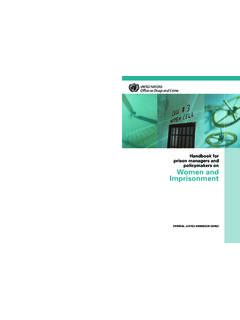
Transcription of Handbook for prison leaders
1 Handbook for prison leaders A basic training tool and curriculum for prison managers based on international standards and norms CRIMINAL JUSTICE Handbook SERIES. Cover images: Left and right: , Centre: united nations office ON DRUGS AND crime . Vienna Handbook for prison leaders A basic training tool and curriculum for prison managers based on international standards and norms CRIMINAL JUSTICE Handbook SERIES. united nations . New York, 2010. united nations PUBLICATION. Sales No. ISBN 978-92-1-130292-9. united nations office on Drugs and crime , March 2010. The designations employed and the presentation of material in this publication do not imply the expression of any opinion whatsoever on the part of the Secretariat of the united nations concerning the legal status of any country, territory, city or area, or of its authorities, or concerning the delimitation of its frontiers or boundaries.
2 This publication has not been formally edited. Publishing production: UNOV/DM/CMS/EPLS/Electronic Publishing Unit. ii Acknowledgements This Handbook for prison leaders was prepared for the united nations office on Drugs and crime (UNODC) by Vivienne Chin, Associate, International Centre for Criminal Law Reform and Criminal Justice Policy, Vancouver, Canada, with the assistance of Robert E. Brown, Yvon Dandurand and Eric McAskill. The Handbook was reviewed by a group of international experts. UNODC wishes to acknowledge the valuable contribution of experts who reviewed this tool and helped finalize it: Elias Carranza, Aggrey Nyapola, Michael Langelaar, and Richard Kuuire.
3 UNODC also wishes to acknowledge the support provided by the Government of Canada. iii Contents Page Acknowledgements .. iii Introduction .. 1. How to use the Handbook .. 7. Chapter 1. Identification of current challenges .. 11. Chapter 2. Effective leadership .. 17. Chapter 3. Human rights, international standards and . good prison management .. 25. Chapter 4. Importance of the legal framework, policies . and regulations .. 35. Chapter 5. Management and accountability .. 39. Chapter 6. Management of human and financial resources .. 51. Chapter 7. Management of physical facilities .. 63.
4 Chapter 8. Meeting the basic needs of prisoners .. 69. Chapter 9. Vulnerable prisoners .. 77. Chapter 10. Children and youth in prison .. 85. Chapter 11. Managing the prison population .. 91. Chapter 12. Safety and security, control and discipline within prisons 99. Chapter 13. Early or conditional release of offenders .. 111. Chapter 14. Alternatives to imprisonment .. 115. Chapter 15. Oversight mechanisms .. 125. Chapter 16. Overcoming challenges: strategic approaches .. 135. Annexes I. Five-day training course curriculum for prison leaders .. 137. II. List of additional resources.
5 139. v Introduction Several very good manuals on human rights in prisons and on prison policy are already widely available. Some of them are listed at the end in annex II listing other useful resources. This Handbook focuses on an overview of key issues which should be of concern to prison managers and the reforms they must often engage in and promote as prison leaders . It is meant to support a basic five-day training workshop for prison officials responsible for leading and managing prisons in developing or post-conflict countries. A prison system based on international standards and norms is a good system, one which is grounded in a deep respect for the rule of law and human rights.
6 Therefore, one of the major objectives of the Handbook is to explore and understand practical ways in which prison leaders can more effectively implement international standards and norms in the institutions for which they are responsible. Developing countries often lack the necessary resources to bring their prison system and their prisons up to internationally accepted standards. They lack the funds, trained personnel, technology, infrastructure, or expertise to proceed with all of the necessary reforms at the same time. This is not to say however that dedicated leaders cannot accomplish significant progress, particularly when they can count on a little help from friends from other jurisdictions.
7 This Handbook tries to cover the aspects of effective, fair and just prison management. prison leaders will be challenged to identify the reforms that they must contemplate in order to bring their institutions into compli- ance with international standards. They will also be challenged to reflect on the most effective ways to bring about the necessary change. The Handbook and the workshop curriculum that accompanies it provide a rough template to help leaders identify the changes that are required in their own environment and to reflect on the challenges they are likely to encounter in bringing about these changes.
8 The Handbook does not underestimate the complexity of the task of prison reform and it therefore does not propose ready-made solutions. It does not even attempt to anticipate and answer all the questions that will come up in the process. However, together with the proposed curriculum, the Handbook should facilitate some fresh thinking about the many common issues and challenges prison leaders often face and about possible solutions to them. With these new tools, prison leaders will hopefully 1. 2 Handbook FOR prison leaders . identify practical ways to approach the prison management problems they face.
9 We hope that it will help them do so with renewed confidence in their own leadership abilities and a fresh outlook on how they may succeed in their prison reform and capac- ity building efforts. It is hoped that the facilitators or trainers using the Handbook will feel free to tailor some of the questions and exercises to local circumstances therefore making it more relevant to the participants. prison reform can be a daunting task. In fact it usually is, and attempts at reform tend to fail at least as often as they succeed. This is not an excuse for giving up, but a good reason for approaching the task cautiously and recognizing the difficult and complex role that prison leaders play in bringing about effective and sustainable reforms within the system in which they work.
10 Prisons are harsh and difficult environments, particu- larly when they operate without the necessary human, physical and financial resources. The job of a prison leader is inevitably a very challenging one. It clearly requires the full commitment of a strong, dedicated, creative and persevering individual. The purpose and justification of a sentence of imprisonment or a similar measure deprivative of liberty is ultimately to protect society against crime . This end can only be achieved if the period of imprisonment is used to ensure, so far as possible, that upon his return to society, the offender is not only willing but able to lead a law abiding and self-supporting life.