Transcription of hat are Phonological Processes? - Super Duper Publications
1 Phonological processes are the patterns that young children use to simplify adult speech. All children use these processes while theirspeech and language are developing. For example, very youngchildren (ages 1 to 3) may say wa-wa for water or tat for cat. Other children may leave out the final sound in words (for example, pi for pig or ha for hat. ) Up to age 3, these are appropriateproductions. As children mature, so does their speech and they stopusing these patterns to simplify words. In fact, by age 5, most childrenstop using all Phonological processes and their speech sounds morelike the adults around children stop using Phonological processes , their speechbecomes more understandable.
2 This allows them to become bettercommunicators. For example, between 11 2and 2 years of age, typically developing children may produce around 50 the ages of 41 2and 5 years, children are able to produce up to 2,000 words. When children continue to apply these processesor patterns to their speech AND learn new words at the same time,their speech can become very difficult to understand. Many times thechildren do not hear the differences in the words and will say oneword to mean three different ones. For example, children who continue to delete the initial consonant from a word may say all to mean each of these words: fall, ball, wall.
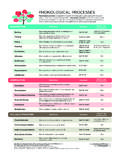
3 What are PhonologicalProcesses? Super Duper Handy Handouts! Number 66 2004 Super Duper Publications . All rights Toll Free 1-800-277-8737 FaxToll Free 1-800-978-7379 Online! 2004 Super Duper Publications . All rights Toll Free 1-800-277-8737 FaxToll Free 1-800-978-7379 Online! changes that cause sounds or syllables to be reduced in number, deleted, or Consonant Deletionis the deletion of the final consonant or consonant clusterin a syllable or : soap /sop/ is pronounced sew /so/; pig /p g/ is pronounced pi /p /Cluster Reductionis the deletion of one or more consonants from a two or threeconsonant : spot /spat/ is pronounced pot /pat/; clown /kla n/ is pronounced cown /ka n/Syllable Reductionis the deletion of a syllable from a word containing two or moresyllables.
4 The deletion usually occurs in the unstressed : computer /k mpjut / is pronounced puter /pjut /Sound changes in which one sound class replaces another class of when /r/ becomes /w/ or /l/ becomes /w/ or /j/.Ex: rail /rel/ is pronounced whale /wel/; leap /lip/ is pronounced weep /wip/Vocalizationoccurs when one of the following, /l/, / /, or / /, is replaced by a more neutral : seal /sil/ is pronounced sio /sio/; computer /k mpjut /is pronounced computa /k mpjut /Fronting(Velar and Palatal)is the substitution of sounds in the front of the mouth,usually alveolars, for velar or palatal : key /ki/ is pronounced tea /ti/; gate /get/ is pronounced date /det/Deaffricationis the deletion of a stop component from an affricate leaving only the continuant : cheese / iz/is pronounced sheese / iz/.
5 Jar / a / is pronounced zhar / /Stoppingis the substitution of a stop consonant for a fricative or an : sail /sel/ is pronounced tail /tel/; knife /naif/ is pronounced knipe /naip/Sound changes in which one sound or syllableinfluences another sound or Voicingis the voicing of an initial voiceless consonant in a : peach /pit / is pronounced beach /bit /Postvocalic Devoicingis the devoicing of a final voiced consonant in a : bag /b g/ is pronounced back /b k/Types of Phonological ProcessesSyllable Structure ProcessesAssimilation ProcessesSubstitution processes