Transcription of HBR Article Proposal: Look for the Loops
1 HBR Article Proposal: look for the Loopsby Robert E. PowellStrategy isn t a one-shot affair. For a reality check, use systems thinking to look for virtuous cycles that aren t restrained by limits to growth. proposal answering the requested questions: What is the message of the Article you propose to write? For strategy to be sustainable it must create virtuous cycles; after all, nothing grows without a reinforcingprocess. An effective strategy assures a virtuous cycle does not become a vicious cycle. And becausenothing grows forever, an effective strategy must identify and address limits to growth to assure they do notnegatively impact virtuous cycles. What are the implications of the message? Or, as Harvard Business Review editors often say, What sthe so what ? Why should a busy manager stop and read your Article ? What is new, unusual, useful,counterintuitive, or important about your message? Managers and leaders should care about this because it s important for their long-term success, indeed it svital for their long-term survival.
2 The lens of systems thinking allows organizations to think more effectivelyabout, communicate explicitly about, and resolve conflicts around their most important issues. Systemsthinking is a lens that surfaces the reasons behind organizational behaviors that are perceived to be coun-terintuitive; practice using this lens helps change intuition .. the counterintuitive becomes intuitive. Who is the targeted audience? All leaders who read the Harvard Business Review and want to better test the validity of what they read. What research have you conducted to support the argument or logic in your Article ? What company ex-amples can you cite to support your argument? Company examples are drawn directly from the pages of the Harvard Business Review. Systems thinkingcausal loop diagrams show visually why the principles and recommendations in the HBR articles are referenced articles are:wGordon Shaw, et al., Strategic Stories: How 3M is Rewriting Business Planning, HBR May-June 1998wJim Collins, Turning Goals into Results: The Power of Catalytic Mechanisms, HBR, Jul-Aug 1999wDavid P.
3 Norton; Robert S. Kaplan, Having Trouble with Your Strategy? Then Map It , Sep-Oct 2000 and Using the Balanced Scorecard as a Strategic Management System , Jan-Feb E. Greiner, Evolution and revolution as organizations grow, HBR, May-June 1998 (orig. 1972)Other referenced articleswNigel Nicholson, How Hardwired Is Human Behavior?, HBR, Jul-Aug 1998wClayton Christensen, Making Strategy: Learning by Doing, HBR, Nov/Dec 1997 What is the authority or expertise that you will draw on to make your argument convincing? The authority and expertise that makes the argument convincing are the fields of systems thinking and sys-tem dynamics. Causal loop diagrams allow readers to test the logic of the argument and convince them-selves that the systems approach brings clarity to the recommendations in the referenced HBR articles. Bob Powell, , MBA PP Continuous Improvement Associates PP 6992 Blackhawk Place PP Colorado Springs, CO 80919 Phone (719) 599-0977 PP Fax (719) 599-0564 PP E-mail: P P Copyright 2002 (07/28/02) Outline: look for the Loopsby Robert E.
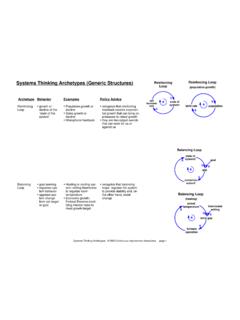
4 Outline the manuscript, offering enough detail for an editor to be able to understand the Article s mainpoints and the evidence or examples that will support those points. Strategy and FeedbackExplains why using the lens of systems thinking is so necessary for organizations. Using this lens we can un-derstand the organic processes behind strategic approaches found in HBR articles. Loops are everywhere,we only need to look ; Loops determine our fate; we d better 1: Stories vs. Lists .. the Language of Causal LoopsDescribes why stories are better for defining strategy than lists (our evolutionary tendency) and how strategicstories are feedback Loops . Shows an example of how two different linear strategic stories are obviously a from: Nigel Nicholson, How Hardwired Is Human Behavior? , Harvard Business Review, HBR, Jul-Aug 1998 Gordon Shaw, et al., Strategic Stories: How 3M is Rewriting Business Planning, HBR, May-June 1998 There s More to the Systems Thinking LanguageExplains how to read systems thinking causal loop 2: A Catalytic Mechanism Shows the structure of the Granite Rock short pay catalytic mechanism and shows that it is really an or-ganic process.
5 Draws from: Jim Collins, Turning Goals into Results: The Power of Catalytic Mechanisms, HBR, Jul-Aug 1999 Example 3. High Level StrategyShows that the Balanced Scorecard is a very high-level definition of the feedback process for growth, the ra-tionale or theory behind why growth is expected to occur. It calls for measures that test whether the rationale iscorrect. Draws from: David P. Norton; Robert S. Kaplan, Having Trouble with Your Strategy? Then Map It , HBR, Sep-Oct 2000; and Using theBalanced Scorecard as a Strategic Management System , HBR, Jan-Feb Powell, , MBA PP Continuous Improvement Associates PP 6992 Blackhawk Place PP Colorado Springs, CO 80919 Phone (719) 599-0977 PP Fax (719) 599-0564 PP E-mail: P P Copyright 2002 (07/28/02) Example 4. Organizational Evolution and RevolutionShows how each organizational phase is composed of an evolution stage where a balancing loop increases to-ward, and is eventually held back by, its limit.
6 Until a revolutionary reinforcing feedback is introduced toovercome the limit. With each new phase comes another new evolution and revolution (if the organization sur-vives). Revolutions are required, not only to meet the challenges of a changing environment, but also to meetthe challenges created by success in an unchanging environment as the organization itself from: Larry E. Greiner, Evolution and revolution as organizations grow, HBR, May-June 1998 (orig. 1972)So What Good are these Causal Loop Diagrams?Extends Christensen s strategy matrix and shows how to use it to practically move from making causal loopstructures explicit to creating strategy and defining action from: Clayton Christensen, Making Strategy: Learning by Doing, Harvard Business Review, Nov/Dec 1997 From Catalytic Mechanisms to Organic Processes Explains the systems thinking rationale behind the characteristics of Jim Collins catalytic mechanisms. Or-ganic processes is a more appropriate metaphor.
7 Systems thinking provides a theoretical understanding ofCollins characteristics and also provides what might be called a meta-mechanism to describe, analyze, anddesign catalytic or tangible from: Jim Collins, Turning Goals into Results: The Power of Catalytic Mechanisms, HBR, Jul-Aug 1999 Loop LeadershipConclusion. A test of the validity of a strategy or improvement initiative is whether it has the feedback struc-tures and measures that will allow the strategy or improvement initiative to work over time and be tested forlearning. If feedback is not there, the approach is likely to thinking is about leadership. Leadership is understanding, designing, and nurturing the feedbackprocesses and information systems that foster organizational performance that displays desired behaviors. It sthe leadership style we take in a garden. We nurture a garden, we don t drive it. Bob Powell, , MBA PP Continuous Improvement Associates PP 6992 Blackhawk Place PP Colorado Springs, CO 80919 Phone (719) 599-0977 PP Fax (719) 599-0564 PP E-mail: P P Copyright 2002 (07/28/02) Draft: look for the Loops by Robert E.
8 Write a draft of the first few paragraphs of the Article , which contains the central message of the piece. Strategy and FeedbackAn effective strategy must work over time, it isn t a one-shot set of ac-tions. A sustainable strategy must foster reinforcing processes overtime, reinforcing processes that create virtuous cycles. After all, nothinggrows without a reinforcing process. Because reinforcing processes can go up or down, an effective strategy assures virtuous cycles do not be-come vicious cycles. And because nothing grows forever, an effective strategy must identify and address lim-its to growth in order that they not limit virtuous feedback Loops are structure, the relationships among the parts of a systems. Structure tells stories,stories that explain the behaviors we observe in systems. A key principle of systems thinking is that the behav-ior of the system is determined primarily by its internal structure, not by external influences. It s not that exter-nal influences do not affect system behavior, it s that we first look for how the system itself may be creating (orwill create) behavior.
9 When considering external influences, we understand that the system s response is de-termined by its internal structure, not by the external vision and purpose are vital, but if our organizations do not have structures that support visionand purpose, we are unlikely to achieve our desired outcomes. Instead, we experience counterintuitive and un-intended consequences. When something happens we don t expect, we say that the decisions we ve madehave side-effects; but there are no side-effects, there are only effects, some of which we do not intend orforesee .. and we call those side-effects. Once we begin to look for them, we see feedback Loops everywhere. That s because living beings, organiza-tions and societies are systems. Feedback Loops are the simple act of filling a glass with water (we observe thelevel and turn off the tap when the glass is full), in our organizations (TQM is a feedback process: observe, ap-ply corrective action, and observe some more), and in our economy (business cycles arise from the entrainedcycles of filling and depleting company inventories).
10 Systems thinking allows us to see the long-term payoff (or cost) of our actions. Systems thinking isn t a it, organizational performance suffers and they may not survive. With it, they can go beyond survivalto learn and thrive. It s an enduring practice because it s based on principles that are absolutely fundamental tothe nature of reality: Feedback is ubiquitous, like the air we breathe. There is a primacy of the whole. Systems have emergent properties that do not belong to the parts. Our instincts fail us in the face of dynamic complexity, which is an environment with multiple feedbacks andlong delays. Because of long delays in the system, humans have as much difficulty managing organizationsas they do driving while drunk. Reality is both objective and subjective, not everything that s important can be measured ( , creativity,morale, burnout, etc.). These important factors are considered in systems thinking approaches. Systems thinking recognizes interdependence and the collective nature of self.