Transcription of Health equity toolkit
1 equity Page 1 September 2021 Health equity toolkit The new Washington State Health Care Authority (HCA) Health equity policy No. 1-36 requires all analyses of core business and processes, including bill analysis and issue papers, to include an equity lens. To assist in implementing this policy , HCA has created this Health equity toolkit that all employees can access and use to guide their work. Foreword This toolkit is a guide to help employees apply an equity lens to their work and will continue to be transformed according to the needs of the agency. The HCA Health equity team recognizes that parts of this toolkit may not be useful or applicable for some staff and divisions. Thus, we will rely on the collective wisdom of our Health equity liaisons from all 18 divisions to help us transform and add to this document over time so that it can be useful for all. Additionally, each divisions Health equity liaison, under the guidance of the equity , Social Justice and Strategy Manager, will build division-specific tools relevant to the functions of their divisions.
2 This toolkit serves as an overarching, high-level guide and as the umbrella under which the individual divisions tools will reside. In this way, HCA will work together across and within our divisions and programs. Definitions equity lens equity lens means to evaluate an action, policy , or program for disparate or inequitable Health impacts on people when they are grouped into categories including (but not limited to): Age Disability Gender, gender identity, sex, sexual orientation, or marital or pregnancy status Employment, employment status, or access to sustainable job opportunities Housing, housing status, access to safe and affordable housing, or housing location Income level, education level, or socioeconomic status Language preference or English proficiency National origin, citizenship, or immigration status Race, ethnicity, or color Religion or creed Veteran or military status Health disparities Health disparities refer to avoidable differences in Health outcomes experienced by people with one characteristic (race, gender, sexual orientation) as compared to the socially dominant group ( , white, male, cis-gender, heterosexual, etc.)
3 Measuring disparities can help benchmark progress toward equity . Health equity Health equity means that everyone has a fair and just opportunity to be as healthy as possible. This requires removing obstacles to Health such as poverty, discrimination, and their consequences, including powerlessness and lack of access to good jobs with fair pay, quality education and housing, safe environments, and Health 1 Adopted from the Robert Wood Johnson s definition of Health equity Page 2 Health inequity Health inequity refers to Health disparities that are unfair and unjust without comparison to another group. An equity frame connects the dots between disparate outcomes and the disparities in power and privilege in which they are rooted. Focusing on disparities can lead to the assumption that one group s behavior, intelligence, or genetics are the cause of any differences. Focusing on inequities draws attention to the root causes of these differences. Intersectionality Intersectionality is a framework for understanding how multiple social identities such as race, gender, sexual orientation, and disability intersect to reflect interlocking systems of privilege and oppression ( , racism, sexism, classism).
4 The term refers to the interconnected nature of social categories that can create overlapping systems of discrimination or One person might fit into several categories ( , transgender veteran, or pregnant person who is experiencing homelessness). Social determinants of Health Social determinants of Health are the conditions in which people live, work, play, pray, and age and that affect Health . Social determinants of Health encompass multiple levels of experience from social risk factors (such as socioeconomic status, education level, job opportunities) to structural and environmental factors (such as structural racism, poverty, and localized air and water pollution created by economic, political, and social policies). Social determinants of Health contribute to wide Health disparities and inequities. For example, lack of access to grocery stores with healthy foods is an obstacle to good nutrition, which raises the risk of Health conditions like heart disease, diabetes, and obesity and even lowers life expectancy relative to people who have access to healthy Health equity lens tool Purpose The purpose of a Health equity lens tool is to: 1.
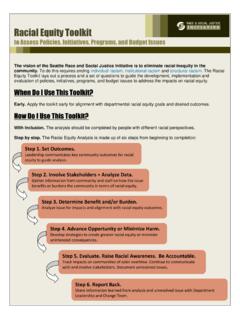
5 Identify potential unintended Health impacts (positive or negative) of a planned action, program, or policy on the people we serve; 2. Develop recommendations to mitigate negative outcomes and to maximize positive outcomes on the Health of people who experience Health inequities; 3. Embed equity across HCA s existing and prospective decision-making models, so that it reflects our core value; 4. Support equity -based improvements in program, service design or resource allocation; 5. Raise awareness about Health equity as a catalyst for change throughout the organization. While the tool can be applied to individual policies, programs and initiatives at the micro level, it can also be applied to processes and policies at the macro level. Process: How to use this tool As policies and programs are being designed, reviewed, or implemented, HCA staff and leadership will: 1. Apply this equity toolkit by answering all appropriate questions; 2 Adapted from The Problem with the Phrase: Women and Minorities: Intersectionality an Important Theoretical Framework for Public Health , American Journal of Public Health , June 2012 3 Adapted from Healthy People 2030: , Office of Disease Prevention and Health Promotion, Office of the Assistant Secretary for Health , Office of the Secretary, Department of Health and Human Services; and Promoting Health equity in Medicaid Managed Care: A Guide for States: , State Health and Value Strategies Page 3 2.
6 Consult with Health equity liaisons, other Health equity entities, resources within and outside the agency, and leadership; 3. Eliminate the inequities or, at the minimum, mitigate negative outcomes by making changes to the programs or policies; 4. Report potential negative outcomes/inequities and program and policy changes to appropriate leadership; 5. Disseminate and communicate learned lessons. The tool Please answer all these questions to the best of your ability. If you feel uncertain about your assessment or feel like the tool/questions do not apply to your work, then it might be helpful to talk through this assessment and its application with your division s Health equity liaison. The action 1. What is the action/program/ policy being considered? a. What is the scope ( , budget, policy , program)? b. What is the intended outcome? c. Who is the executive sponsor for this action/program/ policy ? d. Is there a target population? If yes, how and why was the target population selected?
7 E. What quantitative and qualitative data was used to support the need for this action/program/ policy ? f. What current Health disparities and Health inequities exist around this issue? In addition to Health outcomes, consider access to services or resources and social determinants that might be driving the Health outcomes? g. How easy or hard would it be to reverse or modify the action/program/ policy should there be unintended consequences which further inequities and/or cause harm? Accountability and bias 2. Who is accountable for the action/program/ policy ? a. Who is involved in the action/program/ policy ? b. What biases might the accountable party hold? c. Have alternative perspectives been taken into account? d. How is the outcome of the assessment being communicated? 3. Analysis, monitoring, and mitigation of outcomes4 a. What are the intended outcomes and possible unintended outcomes of the action/program/ policy ? (Consider the various social determinants of Health that may be present.)
8 B. Will any groups or communities disproportionately benefit from the action/program/ policy ? c. Will any groups or communities experience unintended consequences or greater burden, or be left out by this action/program/ policy ? d. Given the above, will the action/program/ policy worsen or ignore existing Health disparities or Health inequities? e. If the action/program/ policy may have negative impacts on multiple types of groups, consider the multiplier effects for individuals who fall into multiple groups (see definition of intersectionality above). 4. What can and should be done to monitor and mitigate unintended harmful outcomes? a. How is the action/program/ policy being monitored for harmful outcomes once it has been implemented? b. What quantitative and qualitative data are to be used to monitor outcomes? c. What is the strategy to mitigate harmful outcomes before they occur? After they occur? 4 Adapted from the Health equity Impact Assessment, Ontario Ministry of Health Page 4 d.
9 What is the strategy to mitigate the compounding of harmful outcomes on intersectional individuals? Community involvement 5. How were different communities involved in the development of this action/program/ policy ? a. Which communities or populations will be most affected? Consider different social determinants of Health . b. Were known obstacles to Health equity considered, such as structural racism or sexism? c. Which members of these communities or populations have been informed, involved, and represented in the decision-making process? If none, why? Tribal implications 6. Are there tribal implications for this action/program/ policy ? a. What data or analyses were used to determine whether there are tribal implications? b. If there are tribal implications, was the Office of Tribal Affairs consulted? Note: A slightly different analysis is necessary for identifying tribal implications, because the Indian Health care delivery system is very different from other Health care systems and because federal and state laws require HCA to collaborate with tribes and Indian Health care providers as partners.
10 End result 7. What recommendations will you make based on this assessment? a. What needs to change in the proposed action/program/ policy to ensure equity ? b. Who is responsible for implementing these changes? c. What competing interests, external to HCA, may influence the ability of the recommendations to be taken? d. How will the assessment findings and final decision be communicated back to those most affected by the decision? e. Were learned lessons disseminated, communicated or applied to other efforts within HCA? Additional resources Inside HCA Health equity webpage Inside HCA Diversity and inclusion webpage Health equity webpage What Is The equity Lens? Multnomah County (Oregon) Office of Diversity and equity Health equity Impact Assessment, Ontario Ministry of Health Healthy People 2030, Office of Disease Prevention and Health Promotion, Office of the Assistant Secretary for Health , Office of the Secretary, Department of Health and Human Services Promoting Health equity in Medicaid Managed Care: A Guide for States, State Health and Value Strategies