Transcription of Healthcare Professional User Guide
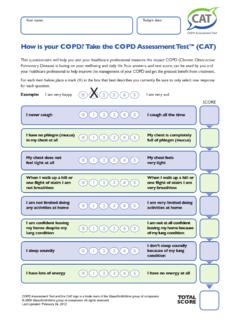
1 Healthcare Professional user Guide Expert Guidance on Frequently Asked Questions Issue 3: December 2016 RECE/RESP/0018/12(2) 1 Introducing the COPD Assessment Test (CAT) The COPD Assessment Test (CAT) is a patient-completed instrument that can quantify the impact of COPD on the patient s health. It complements existing approaches to assessing COPD, such as FEV1 measurement. It was initially designed, using a rigorous scientific development process, to provide a simple and reliable measure of health status in COPD to aid assessment of patients and promote communication between patients and clinicians. Validation studies conducted during the development of CAT and in the years since it was launched in 2009 have shown that it has properties very similar to much more complex health status questionnaires such as the St George s Respiratory Questionnaire (SGRQ)1. A recent systematic review2 confirmed that the CAT provides reliable measurement of health status and is responsive to change with treatment and exacerbations.
2 Since 2013 it has been incorporated as the preferred measure of symptomatic impact of COPD into clinical assessment schemes and is also included in the COPD Foundation Guide . Although it was developed in English nearly one hundred validated translations have been made and local validation studies have been conducted in countries that include China, Arabic-speaking countries, Brazil, Greece, Japan, South Korea, Turkey and Thailand. All have shown that the CAT is reliable in those setting and that both patients and researchers find it easy to use. Since the launch of CAT, guidance has been provided for Healthcare professionals on how to use and interpret CAT scores in the form of a user manual available through the website ( ). As it is increasingly used in research this update to the user manual has been expanded to include information and advice to both academic and commercial researchers, based upon our current knowledge of the CAT and its measurement properties.
3 The information in this Guide is accompanied by some frequently asked questions in order to make it accessible and applicable to both practice and research. We look forward to hearing and reading about your experiences using the CAT in the near future! Professor Michael Polkey Professor Claus Vogelmeier Dr Nadia Hansel Independent Chair GOLD Science Committee Chair COPD Foundation Consortium Chair On behalf of the CAT Governance Board 2 The COPD Assessment Test (CAT) the basics What is the CAT? The CAT is a validated, short (8-item) and simple patient completed questionnaire, with good discriminant properties, developed for use in routine clinical practice to measure the health status of patients with COPD1. Despite the small number of component items, it covers a broad range of effects of COPD on patients health. Studies have shown that it is responsive to change and to ,3,4 Why has the CAT been developed? COPD represents a major burden on patients and Healthcare systems.
4 Despite the fact that it is projected to become the third leading cause of death by 20305, c ommunicating the impact of COPD can be difficult and this can contribute to under-management of COPD in a significant proportion of people who may suffer increased disability and reduced quality of life as a result. The care of COPD patients can only be optimised if there is a reliable, standardised measure of the overall effect of disease on each patient s health. Unfortunately, commonly used lung function measurements such as FEV1 percent predicted do not reflect the full impact of COPD. CAT was developed to address the need for a simple-to-use tool which can measure the effect of COPD on the patient s health and enhance understanding between patients and physicians of the disease s impact, in order to manage patients optimally and reduce the burden of disease as much as possible. Development and Governance of the COPD Assessment Test (CAT) How was the CAT developed?
5 The development of the CAT involved well accepted methodologies used to develop psychometric ,6 The initial item generation process involved literature reviews, physician interviews and, most importantly, patient A structured, rigorous scientific approach was then used in the item reduction process to select the best items and generate the final 8-item The CAT was initially validated in prospective studies conducted in the USA and Europe1 and in In the years since launch further validation studies have been conducted around the world, which show that the CAT is globally applicable. Since 2009 the CAT has been translated and validated for use in more than 90 languages other than English. Only validated translations of the CAT should be used. You can gain access to these translations on the CAT website. Who developed the CAT? The CAT was developed by a multidisciplinary group of international experts who have expertise in developing patient reported outcomes tools/questionnaires.
6 The group included pulmonary specialists, primary care physicians, experts in the development of Patient Reported Outcome measures and representatives from patient bodies. Patients with COPD were integral to the development and validation of the tool. The CAT development was commissioned and funded by GlaxoSmithKline (GSK). 3 How is the CAT governed? Use and further development of the CAT is overseen by a Governance Board established in 2015. The board has an independent, academic chair. The Global Initiative for Chronic Obstructive Lung Disease (GOLD) and The COPD Foundation (COPDF) nominate and confirm representatives on the CAT Governance Board. GOLD is represented by the chair of the Science Committee and COPDF is represented by a member of the Board. Other members of the Governance board represent research in industry and academia. The Board also includes a scientific adviser with expertise in the development and use of PRO.
7 GSK continues to own the copyright for the CAT to ensure its integrity, maintains the CAT websites and is responsible for the administrative support of the CAT Governance Board in addition to making translations of the CAT available to users. Who are members of the CAT Governance Board? Current Membership of the CAT Governance Board (2016): Independent Chair: Professor Michael Polkey, NIHR Respiratory Biomedical Research Unit at the Royal Brompton and Harefield Foundation NHS Trust and Imperial College GOLD Scientific Committee Chair: Professor Claus Vogelmeier, Professor of Medicine and Chair Department of Medicine, Pulmonary and Critical Care Medicine, University Medical Center Giessen and Marburg, Philipps-University Marburg, Germany, COPD Foundation Consortium Chair: Dr Nadia Hansel, 12037 Broad Meadow Lane, Clarksville, MD, USA 21029 Academic Research user : Dr Tomoko Betsuyaku, Daikocho 28-1, Shinjuku-ku, Tokyo, JAPAN, 160 0022 Industry Research users: Ruth Tal-Singer, Vice President, COPD Clinical Discovery, Respiratory R&D, GSK Professor Steve Rennard, University of Nebraska Medical Center, 985910, Omaha, NE, USA 68198-5910 PRO Scientific Adviser: Foundation Chair.
8 Maggie Tabberer, Director, Patient Focussed Outcomes, Value Evidence and Outcomes GSK Professor Paul Jones, Global Medical Expert, GSK 4 What does the CAT Governance Board do? The CAT Governance Board is accountable for the oversight of CAT in terms of materials, platforms and developments. Key activities will include: Maximising the value of CAT by promoting uptake and usage as widely as possible and ensuring adoption of terms of use Maintaining the integrity of CAT by developing and approving translations available via the website Expanding the use of the CAT in clinical practice and in research The Governance Board will also contribute to the Regulatory qualification efforts of the CAT as a drug development tool by the COPD Foundation Biomarker Qualification Consortium. How does the Governance Board regulate the use of the CAT? GSK and the CAT Governance Board have decided that the CAT is free to use in clinical practice and in research within the terms of use there are set out on the CAT website ( ).
9 Please review these terms to ensure that your proposed use of the CAT is covered. If your proposed use of the CAT is not covered by the terms of use, please contact GSK with your proposal and GSK will consider the proposal with the CAT Governance Board on a case-by-case basis having regard to the aims set out above. Why does GSK hold the copyright for CAT? GSK continues to hold copyright to ensure that translations of the CAT are conducted appropriately and are collected and made available to clinicians and researchers. Translations of the CAT have been approved by the CAT Governance Board and are available from the website. GSK also provides administrative support to the Governance Board. In all activities related to the CAT, GSK will be guided by the advice and direction given by the CAT Governance Board. To get valid results from the CAT all eight questions must be used, in the order they are presented on the website.
10 Using the CAT in everyday clinical practice: why, who and when? Why should I use the CAT? The CAT is a short, simple questionnaire which is quick and easy for patients to complete. It provides a framework for discussions with your COPD patients and should enable you and them to gain a common understanding and grading of the impact of the disease on their life. It should also help you to identify where COPD has the greatest effect on the patient s health and daily life. As a result you may be better informed when discussing and making management decisions with your patients and be able to ensure that his or her health status is as good as it can be. Where and how does the CAT fit into the clinical assessment of COPD? The CAT provides a reliable measure of the impact of COPD on a patient s health ,2 It therefore provides supplementary information to that provided by other 5 aspects of COPD clinical assessment recommended by current management guidelines ( assessment of exacerbation risk and degree of airway obstruction, assessed using spirometry)8.