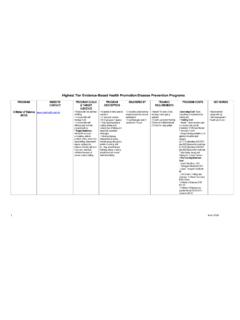
Transcription of Healthy IDEAS (Identifying Depression, …
1 1 Program approved by AoA and NCOA Web Site: Program Synopsis Year Program First Implemented in Community Settings o Healthy IDEAS was first implemented in 2002 and has been replicated in communities within 15 states. It is a model program with dissemination and training activities administered nationally. Healthy IDEAS has been designated as an evidence-based program by the US Administration on Aging, and it has received a Science and Service award for mental health promotion from the Substance Abuse and Mental Health Services Administration.
2 General Description of Program o Healthy IDEAS ( identifying depression , Empowering Activities for Seniors) is a community depression program designed to detect and reduce the severity of depressive symptoms in older adults with chronic health conditions and functional limitations. The program incorporates four evidence-based components into the ongoing service delivery of care/case management or social service programs serving older individuals in the home environment over several months. Healthy IDEAS program components include screening and assessment of depressive symptoms, education about depression and self-care for clients and family caregivers, referral and linkage to health and mental health professionals, and behavioral activation.
3 Behavioral activation is a brief, structured approach to help clients reduce depressive symptoms through increased involvement in meaningful activities, which are pleasurable or reduce stress. Program Goals o Reduce the severity of depressive symptoms in older clients of community agencies. o Reach the intended population of frail, high-risk and diverse older adults, often overlooked and under-treated (older adults with lower socioeconomic status, who belong to an ethnic minority and lack knowledge about depression care are less likely to access treatment).
4 O Train agency staff to provide and deliver an evidence-based intervention for depression to older adults in their caseloads. o Improve linkage between community aging service providers and healthcare professionals through appropriate referrals, better communication and effective partnerships. Healthy IDEAS ( identifying depression , Empowering Activities for Seniors Evidence-based Disease Self-Management for depression 2 Reasoning Behind the Program Design and Elements o About 15-20% of US adults aged 65 and older experience depressive symptoms.)
5 The signs of depression include sadness, inactivity, trouble concentrating or making decisions, and sleep problems. depression negatively affects the quality of life of older adults and can be life-threatening. o The incidence of depression can soar in specific subpopulations of at-risk elders. One investigation of home healthcare recipients found that 73% met the Diagnostic and Statistical Manual of Mental Disorders (DSM-IV) criteria for major depression (Bruce et al., 2002). Because many losses and changes in older adults lives appear as both risk factors for and consequences of depression , providers and older adults may not readily recognize depression as a clinically distinct problem, as they would other medical problems (Charney et al.)
6 , 2003). depression often remains undiagnosed and untreated, leading to a loss of physical, social, and mental functioning and increasing levels of disability (US Department of Health and Human Services, 1999). o Early recognition of depression facilitates treatment and prevents life-threatening outcomes (Fiske, Kasl-Godley, & Gatz, 1998). o Healthy IDEAS uses practical interventions with individual clients in their home setting, rather than in a group format. The Healthy IDEAS steps are incorporated into routine case-management duties and provided during regular home visits and phone calls.
7 O The program is adaptable to culturally diverse populations with different education levels. o Healthy IDEAS uses effective interventions that incorporate relevant leadership and intervention roles for community organizations and bring together aging services, health care and mental health providers Target Population o Ethnically and socioeconomically diverse populations of older adults and caregivers, living in the community, who are at high risk for depressive symptoms are the target group. Common psychosocial risk factors for older adults with depression include death of a spouse or loved one, chronic medical conditions, disability, loss of functioning, caregiving and social isolation.
8 Essential Program Components and Activities o Screening for symptoms of depression o Performing basic assessments for severity of depressive symptoms using a standardized tool o Educating older adults and caregivers about depression , effective treatment and self-care o Referring and linking clients to treatment and follow-up with primary care and mental/behavioral health providers o Empowering clients through behavioral activation o Assessing client progress and identifying a plan to maintain gains or pursue other assistance.
9 Length/Timeframe of Program 3o The presence and severity of depressive symptoms will determine the scope and duration of the intervention. The core program components/steps are delivered over 3 to 6 months through a minimum of three in-person visits in the client s home and five or more telephone contacts. Desired Outcomes o The primary goal of Healthy IDEAS is to reduce the severity of depressive symptoms in older clients of community agencies. Evaluation Measures and Activities o With some technical assistance and toolkit resources, agencies establish a plan for collecting basic process and outcome measures based on a menu of measures.
10 Agency leaders are advised to embed the data collection within routine agency forms and data collection and reporting systems. o Minimum performance and outcome data need to be collected and reviewed to examine levels of depressive symptoms, client acceptance and participation in each program component (screening, education etc.), and contacts involved in intervention completion. o Other key areas for optional client outcome measurement are quality of life, level of physical and social activity, self-reported pain, knowledge of depression self-management, use of medical and mental health services and client satisfaction.