Transcription of Helicopter Firefighting - SONNET
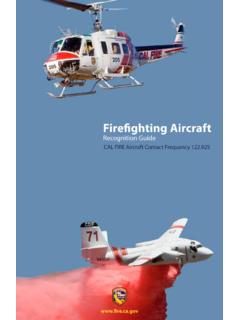
1 Helicopter FirefightingByThomas Eggleston1998 IntroductionThe Helicopter water bucket is used extensively as a tool for wildland fire suppression. The bucketis slung externally below the Helicopter , utilizing the Helicopter 's cargo hook. It has a low cost whencompared to fixed tanks, a simple installation, is easily jettisoned, and is readily filled from lakes andstreams. The SEI Bambi Bucket is extremely reliable and is almost foolproof in its response in initial attack is important in containing a wildfire to a small size and preventing large conflagrations. The bucket fills this need quite well, allowing it to be carried internally while enroute at high cruise airspeeds. Since a cargo hook is standard equipment on almost all civil andmilitary helicopters, a water bucket is an efficient accessory that can be shared among severalhelicopters. The light weight and portability of the Bambi Bucket makes it possible to carry one within anaircraft most of the time.
2 This is especially useful when operating in remote regions far from otherfirefighting , swift wildland Firefighting has become an important issue as natural resources becomemore scarce and as populations move into heavily vegetated areas, further and further from localfire agencies. The Bambi Bucket provides an exceptional and cost-effective tool for aerialfirefighting. This document describes Firefighting terminology, safety issues, fire behavior and flight techniques for use with the water bucket. Basic information on wildland tactics is given and a troubleshooting section on the Bambi Bucket is author operates a wildland Firefighting information WebSite at: ContentsIntroduction to Wildland Fire Fuel 12. 23. 24. 3 Tactical Plan of Execution of Maximizing Water 55. Standard 56. Special Installation 72. Bucket Trouble Shooting - Preventative Foam System Preflight Fill Lakes and Slow-Moving 102.
3 Large Bodiesof Fast-Moving Portable Airspeed/Altitude Basic Flying with a Water Wind Flight 131. Mid-Air Flight Unimproved Landing 8. Safety 151 Introduction to Wildland Fire BehaviorFire is the combustion of a fuel in the presence of oxygen. Heat is needed to start and maintaincombustion. The three factors that make up combustion are Heat, Fuel, and Oxygen, commonlycalled the "fire triangle. By removing any one of these three elements we can interrupt thecombustion process. The method most often used in fighting fires, is to remove heat by theapplication of Fuel TypesFuel types are categorized as light, medium and heavy and these would correspond to grass, brush and timber, the most commonly found fuels in wildland Firefighting . Each fuel type hasdistinct characteristics that require different techniques for fire suppression.
4 Obviously,combinations of these fuel types are commonly is a light fuel that is greatly affected by the relative humidity. When a rain storm occurs, the grasses rapidly increase in humidity. However, when the relative humiditydrops, especially with any wind, grass loses humidity almost as fast as the surrounding air. Grasses burn readily and with much heat energy but, they burn so rapidly that they oftenrun by structures and heavier fuels without igniting them. Extreme heat, but of a very short and heavier vegetation absorb and lose moisture more slowly than grass and are thereforeless affected by rain or changing humidity levels. Brushes are frequently ignited by the underlyinggrasses. The heat energy from the grass is driven by the wind, preheating the bushy fuels,allowing them to ignite. Due to their greater bulk and density the bushy fuels burn longer than the grasses.
5 This presents an ignition source for structures and heavier and other large woody fuels hold moisture well, due to their thickness. Several years ofdrought may be needed to appreciably reduce moisture levels in these heavy fuels. Conversely, ifthe fuel moisture in heavy fuels is low, it would take considerable rainfall and time to increase themoisture level. Although more difficult to ignite, these heavy fuels are the most difficult toextinguish. Water drops are less effective because of poor penetration due to the thickness andthe high heat different fuel types aid each other in maintaining the fire. Grasses burn hot enough to ignitebrush. Brush is taller than the grass and can carry the flames up into branches, igniting timber, aneffect called laddering. Once timber is burning, flames reach the tops of the trees where thewind carries fire brands, or burning pieces, forward ahead of the main fire.
6 When these firebrands fall to the ground, they can start new fires in the grass called spot fires. This process can continue until something interrupts WindThe driving force behind wildland fires is wind. Wind is the source of oxygen and is a propellingforce in the forward movement of a fire. A wildland fire that starts on a calm day tends to drawwind inward from the sides of the fire as the convective column rises. A fire in this situation isactually fighting to expand outwardly. These are relatively easy to control as they do not haverapid horizontal a windy day the situation is very different. The wind propels the fire along, providing ampleoxygen for combustion. Additionally, the wind carries the heated air from the fire forward,preheating and drying the fuels that are ahead of it, making them ignite more readily. Wind alwayspresents the possibility of spot fires, from sparks being carried by the wind.
7 Wind on a wildlandfire must be constantly monitored since all strategic planning is dependent on it. If a wind shiftoccurs, the fire will move in a new direction and the efforts that have been made to contain thefire may now be rendered knowledge of local weather conditions is very useful in fighting a fire. In mountainous terrain it is normal to have down canyon winds beginning in the late evening and continuing until latemorning. As the day proceeds, these winds will shift to up canyon winds as a result of solarheating and rising air. Similar effects can be found near large bodies of water, with daily onshoreand nightly offshore Terrain/SlopeThe surface features of the terrain have a great influence on fire behavior. If a fire starts in a lowarea, the heated air from the fire will warm and dry the fuels that are above it. These fuels willburn readily and will warm and dry the fuels above them, all in the absence of a prevailing effect is even more pronounced in rising troughs or gullies in hilly or mountainous are called chutes and they funnel and increase the action of this preheating, making theseareas burn with great will continue until reaching the top of a slope.
8 When a ridge top is reached, the fire loses itsenergy since the heated air is rising above the surrounding fuels, no longer preheating them. Firesthat are burning down-slope tend to progress slowly as the preheating effect is not very , open terrain is influenced dramatically by surface winds. If there is little or no wind, the fireactivity will be low but, if there are strong winds, the fire will move very rapidly and burn withgreater intensity. Open fields, with few trees to shelter the surface from the wind, are affected WeatherWeather plays an important role in fire behavior. Thunderstorms provide strong winds which candrive fires and often bring lightning strikes that are frequent humidity affects the rate of burning, and when relative humidity decreases, light fuelssuch as grasses burn more rapidly. As noted earlier, an increase in the relative humidity, whetherfrom an air mass or from precipitation, will quickly increase the fuel moisture of light fuels.
9 Thiswill cause the rate of burning to decrease. A water drop can have a pronounced effect on thehumidity in localized areas, slowing or stopping the fire even though water is not placed directlyon the weather must be monitored since the associated wind shifts may cause the fire to go in anew direction and could place ground fire fighters in weather conditions must always be considered since they influence other Considerations1. PlanningStrategic planning is done by the Incident Commander ( ) and his or her staff. However, ahelicopter on initial attack may be the only fire personnel for some time. In this case it is thehelicopter crew that must plan both the long range strategy and the immediate tactical methodsuntil other forces must be given to protecting persons and property, while at the same time makingthe most effective use of the terrain and available resources to stop the fire.
10 If the fire can bestopped quickly, that is the most effective way to protect people and property. It is not efficient to work to save one home while the fire races by, getting larger and becoming an even moreformidable threat to many the United States, an Air Tactical Group Supervisor (AirTac), when present, is thecontrolling person for all aircraft. He receives his orders from the Incident Commander. If noAirTac is on the scene, then the Helicopter crew will work directly with the or his OperationsOfficer. On large fires which include many aircraft, both fixed and rotary wing, a HelicopterCoordinator may be assigned to direct all Helicopter Execution of the PlanOnce a plan is formulated and personnel are briefed, it must be implemented. The aerial fire-fighter is in an excellent position to observe the fire and as such should be prepared to deal withunexpected situations and to keep ground personnel advised on changes in fire behavior, both forsafety and for planning.