Transcription of 香港中學文憑考試 評級程序與水平 ... - HKEAA
1 Grading Procedures andStandards-referenced Reportingin the HKDSE examination Hong Kong Diploma of Secondary education examination 1 Introduction .. 2 2 The reporting system .. 3 3 Le vel descriptors .. 5 4 The grading procedures .. 8 5 Setting the standards .. 11 6 Maintaining the standards .. 14 7 Reporting the results .. 17 Appendix 1 : Group Ability Index .. 18 1 Appendix 2 : Equipercentile method .. 19 2 Appendix 3 : Latent trait model .. 20 3 Refer ence materials .. 22 Tab le of Contents 1211In the Hong Kong Diploma of Secondary education (HKDSE) examination , standards-ref er enced reporting (SRR) is adopted to report candidates' assessment results.
2 What this means is that for a given subject, candidates' levels of performance ar e reported with ref er ence to a set of explicit and fi xed standards of is not a new ap proach in public examinations in Hong Kong. It has been in use for the subjects of Chinese language and english language in the Hong Kong Certifi cate of education (HKCE) examination since 2007. This step was undertaken in response to demands that results should be reported with reference to standards that ar e internationally recognised, transparent, explicit, and that remain constant over cater for the SRR approach, the Hong Kong Examinations and Assessment Authority ( HKEAA ) has established a grading system which aims to maintain standards between successive years and inter-subject comparability within the same purpose of this booklet is to explain the rationale, approaches and key features of the grading procedures and the SRR approach.
3 The HKEAA will review the grading mechanism and the SRR approach in the light of experience fr om the fi rst administration of the HKDSE examination in 2012. Schools will be inf ormed of an y changes with an adequate period of notice. 2007 2012 Introduction 32 There are three categories of HKDSE subjects: Categories A, B and y A subjectsThe HKEAA is responsible for the grading of all Categor y A subjects.
4 Candidate performance will be reported on the HKDSE certificate at five levels (1 5), with 5 being the highest. The highest-achieving Level 5 candidates will be awarded Level 5** ; the next highest-achieving Level 5 candidates will be awarded Level 5* and the remaining Level 5 candidates will receive simply Le vel 5. Performance below the Le vel 1 standard for a subject will be designated as 'Unclassifi ed'. This will not be reported on the certifi y B subjectsThe assessment of Category B Applied Learning subjects will be undertaken by the organisations pr oviding relevant courses (course pr oviders). After moderation by the HKEAA , the fi nal results will be recorded on the HKDSE certifi cate.
5 The results will be reported at two levels: 'Attained' and 'Attained with Distinction'. Performance below 'Attained' will be designated as 'Unattained'. This will not be reported on the certifi y C subjectsCategor y C subjects comprise six other language subjects at Advanced Subsidiary (AS) level. Question papers will be set and the marking and grading will be conducted by Cambridge International Examinations (CIE). Results will be reported in five grades (A-E) on the HKDSE certificate, with grade E being the lowest and grade A being the highest. Achievements below grade E will be designated as 'Ungraded'. This will not be reported on the certifi cate. 1 5 5 5 5** 5* 5 1 CIE A-E E A E 2 The reporting system 4 Special arrangements for individual subjectsChinese language and english language In addition to the overall subject level, candidates' performance in individual components ( Reading) will also be reported.
6 Perfo rmance below the Level 1 standard for individual components will be designated as 'Unclassifi ed'. Candidates whose perfo rmance is designated as 'Unclassifi ed' in some components but who achieve Level 1 or above at subject level will have all component and subject levels reported on the HKDSE certifi cate. However, if the subject level is below Level 1, neither the subject level nor individual component levels will be reported on the certifi english language , Pap er 1 Reading and Pap er 3 Listening and Integrated Skills both comprise a compulsory section and a section where candidates can choose between an easier or a more difficult option. Candidates attempting the more diffi cult option can attain up to Level 5** in the relevant component, while those who attempt the easier option can only attain up to Level candidate may take the Compulsory Part only or take both the Compulsory Part and one of the tw o modules in the Extended Part.
7 The results of the Compulsory Part and the Extended Part will be reported ScienceThe overall subject le vel will be reported, as well as the le vels for the tw o chosen components (Biology, Chemistry, or Physics). Candidates whose performance is designated as 'Unclassifi ed' in one component but who achieve Le vel 1 or above at the subject le vel will ha ve all component and subject le vels reported on the HKDSE ce rti fi ca te . However , if th e su bje ct le vel is be lo w Le vel 1, ne it her th e su bje ct le vel nor individual component levels will be reported on the certifi cate. 1 1 1 5** 4 1 1 5 Under the standards-referenced reporting system, a set of descriptors is written for each subject to describe what a candidate performing at a giv en le vel is typically able to do.
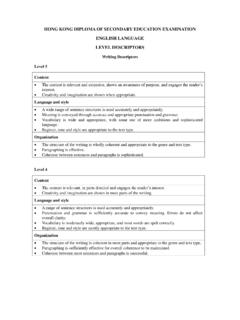
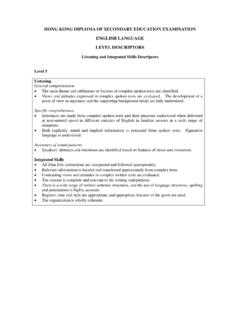
8 The principle used in preparing these descriptors is to describe the achievements that candidates are able to demonstrate in positive terms and to avoid describing what candidates cannot their nature, these descriptors represent 'on-average' statements, and may not precisely describe the actual performance of individual candidates. A given candidate may demonstrate, across the examination papers for a single subject, some elements of performance that ar e characteristic of more than one le vel. The assessment process that is applied within each subject aggregates and combines such variation to derive a final result that provides a 'best fit' between a given candidate's performance and a level addition to the subject level descriptors, a set of generic descriptors has been developed to provide an overall brief description of the performance standards of candidates at different levels across subjects (Table 1).
9 The generic descriptors encompass the major learning outcomes that are common across subjects, including knowledge and understanding of the curriculum, the ability to apply concepts and skills, higher order abilities such as interpretation, analysis, synthesis and evaluation, and the ability to descriptors for individual subjects were developed by a working group that comprised members fr om differ ent sectors, including offi cers fr om the Curriculum Development Institute (CDI), school principals, secondary school teachers, and university subject experts. Close reference was made to samples of the actual performances of candidates in previous public examinations and in the pilot tests which used the HKDSE sample papers.
10 The development of level descriptors was completed in 2009 and they wer e published in the 'Standards-ref er enced Reporting Information Packages', together with samples of student work that illustrate the relevant of level descriptorsLe vel descriptors ar e important sources of ref er ence for subject experts to make judgments in grading, standards setting and maintenance. For details, please ref er to sections 4 to lev el descriptors also facilitate learning and teaching. Students can make use of the descriptors to set their goals and assess their learning progress. Teachers also know explicitly what they have to do to assist students to achiev e a higher lev el of performance. Moreover, the level descriptors are useful for other users, such as tertiary institutions or employers, in enabling them to better understand what candidates at differ ent le vels of performance can do in or der for them to make more appr opriate selection decisions.