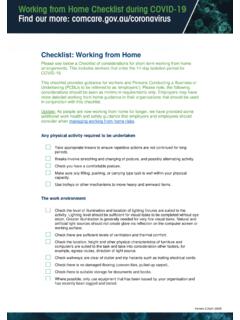
Transcription of Home Working Policy - Eden District
1 1 home Working Policy Version Date Status Comments June 2010 Draft August 2010 Draft Policy sent out for consultation via JCC and Corporate Bulletin Board. November 2010 Final Resources Portfolio Holder for approval. 2 Contents Page Introduction uction 3 Scope 3 What is home Working 3 Definition 3 Benefits 3 Types of home Working 4 Occasional home Working 4 Regular home Working 4 Permanent home Working 4 Suitability of home Working 4 Posts 4 Employee Characteristics 5 Requests to Work from home 5 Application Process 5 Assessing the home Environment 6 Risk Assessment 7 Managing a home Working Arrangement Managing a home Working Arrangement 7 Communication to and Management of home Working Staff 8 Provision of Equipment 8 Insurance 8 Health and Safety 9 Data Security 9 Working Hours 9 Visits to the home Worker 9 Contractual Terms 9 Expenses 10 Dependant Care 10 Review of a home Working Agreement 10 Termination of a home Working Agreement 10 Appendices 1 home Working Application Form e Working Application Form 11 2 Health and Safety home Worker Self-Assessment Checklist th and Safety home Worker Self-Assessment
2 Checklist 13 3 home Working Agreement e Working Agreement 16 3 1. Introduction Eden District Council is committed to promoting flexible Working in order to facilitate effective and efficient Working . This Policy outlines the circumstances under which the Council will allow employees to work from home . It also details the actions required to facilitate a home Working arrangement. 2. Scope This Policy applies to all employees of the Council. 3. What is home Working Definition home Working is about using the employees home as a base for work instead of the employee coming into a workplace. The home Working Policy is one of a number of policies under the Work Life Balance initiative. Benefits of home Working There are many benefits to home Working . For the Council these include: Reduced accommodation costs and better use of existing premises and resources; Contributing towards the reduction of the Councils CO2 emissions by reducing unnecessary employee commuting; The retention of valued and skilled employees for whom the ability to work at home is the preferred option; Well motivated staff who feel that they work for an organisation that is prepared to be flexible and which trusts them; Potentially increased output and quality of work due to fewer distractions than Working in an office environment; Accommodation of the requirements of disabled employees or employees with temporary health conditions; Promotion of a positive image as a good employer; Potential to reduced costs in terms of travelling allowances.
3 For the employee these include: Increased discretion in the management of their work and personal time; Increased motivation; A saving of travel time and costs; The ability to work without distraction; Improvements in work-life balance issues. While there are many advantages of home Working , a detailed assessment needs to be made, by both the employee and the Council, as to whether the individual will be a suitable home worker and whether the role to be performed is appropriate. 4 Types of home Working There are various ways that home Working may operate, ranging from rare occasions that arise and do not form a routine, to formal arrangements that are identified as such in the contract of employment: Occasional home Working Taking work home occasionally, on an ad hoc basis, to concentrate on a particular project or task may be suitable in the following circumstances: Where a specific task needs dedicated and focussed input and/or could be dealt with more efficiently at home eg saved travelling time and lack of interruptions; Where it is difficult for staff to get in to work eg adverse weather, a short but unavoidable commitment at home , or field work is being undertaken out of the office near to home .
4 Regular home Working Working from home for a percentage of the time on a regular basis, the individual would come into the office for the balance of time. This may be suitable in the following circumstances: Where the function of the post requires little face to face contact with colleagues and/or clients; To facilitate a more flexible work pattern, perhaps to accommodate other demands; Where an individual plans his/her work arrangements to enable the achievement of defined outputs each week/month from home ; The job involves frequent/regular outside visits. Permanent home Working Working from home 100% of the time, or spending a percentage of time Working from home and making outside visits for the balance of time. This may be suitable in the following circumstances: Where the job can be done just as effectively and efficiently from home ; Where ICT systems exist, or can be created, to support the job at home ; Where communications systems exist, or can be created, to support the job, and the employee effectively The job involved frequent/regular outside visits.
5 Suitability of home Working Posts Many jobs may be considered for home Working . Generally speaking any job that does not require time spent in one location or high visibility (eg to operate 5 machinery or to deliver face to face customer care), may be adapted for home Working . Jobs that involve project work or identifiable output, or those which provide services within the community, may in particular lend themselves to home Working . Consideration should also be given to the impact on and inter-relationship with other jobs, access by the public, access to/by colleagues, access to required information, technology, costs and savings etc. The following job characteristics may lend themselves to home Working : Defined output tasks; Discrete projects or functions; Relatively autonomous jobs; Jobs requiring frequent travelling; Jobs requiring high periods of concentration. Employee Characteristics Having established the suitability of the job for home Working the suitability of the employee needs to be considered.
6 home Working does not suit everyone. Office dynamics and informal information flows may have a significant impact on the employee s performance. Some employees may develop better in a traditional office environment, and those without very much experience in their role are likely to need closer supervision which would not be possible if they were Working from home . Individuals may also have a distorted view of home Working often rose coloured with little recognition or understanding of the potential drawbacks, and it is important that both the advantages and the disadvantages are considered. A trial period may be appropriate in order to gauge suitability before any longer term arrangements are put in place. Helpful personal qualities are likely to include: Self-motivated; Self-disciplined; Enjoy the challenge of Working on their own; A flexible approach; Able to organise Working time effectively; Able to work without direct supervision; Confident to work away from the office environment; Able to work on their own without day to day social interaction with colleagues; Able to travel to meetings and site visits; Able to switch off from work and maintain a proper balance between Working and non- Working hours.
7 4. Requests to Work from home The process for dealing with requests to work from home consists of two steps. Firstly, the individual s application is assessed by their Chief Officer, focussing on whether their post and personal characteristics are suitable for home Working . The 6 second step of the process is to assess the home environment of the employee to identify whether it is suitable for home Working . Application Process Employees wishing to be considered for home Working should complete the application at Appendix 1 and submit this to their Chief Officer for consideration. The relevant Chief Officer will be responsible for considering applications to work from home in a fair and consistent manner, taking account of the Councils Equal Opportunities Policy . One of the most important factors to consider is the individual employees role in providing a service to the people of Eden. A focus on specific job tasks should identify those tasks that can be performed away from the main office.
8 The following issues should be taken into consideration: Service provided and impact upon the individual s work load and the work of the team; Does the job require long periods of uninterrupted mental concentration? Does the job require a lot of ad hoc communication between the groups of staff? Can the work be measured in terms of output, or if not, is it possible to come to an agreement with the employee about the amount of time particular outputs will take? What will be the effect on services to the public? Can the work readily be undertaken at home ? How can the work be monitored? How should contact be made? What equipment would be required? What costs would be incurred? Is the employee likely to be suited to home Working ? (see earlier section on Employee Characteristics) It is the Councils Policy to view any requests for home Working in a positive light and the Council will, wherever possible and practicable, agree to the employee s request.
9 If the request is accepted in principle, a health and safety assessment of the home Working environment must be carried out (see section titled Assessing the home Environment ) before a home Working Agreement can be drawn up. If the Chief Officer is not able to accept the application at this step, s/he should provide the employee with a written response to their request including details of the reasons for rejecting the application. Assessing the home Environment An employee who works from home is afforded the same protection under health and safety legislation as an employee who is office based. It is therefore vital to ensure the home Working environment is suitable before any home Working agreement is reached. 7 The employee needs to take personal responsibility for the health and safety aspect of home Working . An employee needs an environment at home which offers the following: Suitable office space, ideally a separate room but at least a dedicated space; Freedom from interruptions and distractions; Security and confidentiality; Ability to meet Health and Safety requirements; It is not considered appropriate to combine home based Working with dependant care.
10 Employees will be required to demonstrate that they do not have dependant care responsibilities within their contracted Working hours. In addition to this employees need to be aware that the Council reserves the right to ask them to attend Council premises at short notice. In order to ensure that s/he has all the relevant information, the Chief Officer may wish to meet with the employee and their manager to discuss the application prior to reaching a decision. Advice from the HR section is also available to assist Chief Officers in considering home Working applications. If an application for home Working has been accepted in principle by the relevant Chief Officer, the employee concerned should complete a Health and Safety home Worker Self-Assessment Checklist (see Appendix 2) and submit this to their Chief Officer. If this assessment identifies any particular risks it will be the responsibility of the Chief Officer, Manager and employee to discuss ways in which the risks may be minimised or eliminated.