Transcription of How Afterschool Programs Can Support Employability …
1 DECEMBER 2015 How Afterschool Programs Can Support Employability Through Social and Emotional LearningBEYOND the BELL at American Institutes for Research A Planning ToolContentsIntroduction ..1 How to Use This Tool ..1 PART 1: Identifying Interests ..2 PART 2: Action Planning ..6 American Institutes for Research (AIR) developed this tool to accompany our Research to Action brief Ready for Work? How Afterschool Programs Can Support Employability Through Social and Emotional Learning. The brief and this tool aim to provide Afterschool program staff with information about how they can foster the building of Employability skills in their Programs . Beyond the Bell 1 IntroductionFor educators and employers, understanding the knowledge, attitudes, and skills that ultimately contribute to success in school, work, and life is a priority. Although young people need many skills to be successful in the workplace, one aspect of Employability has gained attention in recent years the need for workers to have strong social and emotional skills.
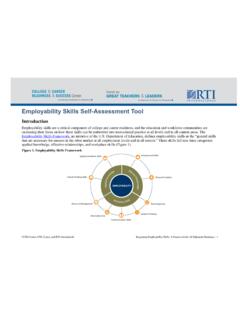
2 Afterschool Programs have a role to play in supporting the development of these skills for all youth. How to Use This ToolThis tool is based on the Office of Career, Technical, and Adult Education s (OCTAE s) Employability Skills Framework. Table 1 provides a description of four Employability skills from the framework that can be developed through social and emotional learning. Table 1. Employability SkillsSkill CategorySpecific Employability SkillsCritical Thinking Thinks critically Thinks creatively Makes sound decisions Solves problems Reasons Plans and organizesInterpersonal Skills Understands teamwork and works with others Responds to customer needs Exercises leadership Negotiates to resolve conflicts Respects individual differencesPersonal Qualities Demonstrates responsibility and self-discipline Adapts and shows flexibility Works independently Demonstrates a willingness to learn Demonstrates integrity Demonstrates professionalism Takes initiative Displays positive attitude/sense of self-worth Takes responsibility for professional growthCommunication Skills Communicates verbally Listens actively Comprehends written material Conveys information in writing Observes carefullyThis tool has two
3 Parts. Part 1 will help you identify your priority areas for Employability skills building based on youth and employer input. Part 2 will help you plan next steps based on that input. Refer back to our accompanying brief for more information on the research behind these action steps. Feel free to adapt the tool to your own needs, and, above all, be creative and think broadly about how you can Support the development of Employability skills in youth through social and emotional and Emotional LearningThe process through which children, youth, and adults acquire and effectively apply the knowledge, attitudes, and skills necessary to understand and manage emotions, set and achieve positive goals, feel and show empathy for others, establish and maintain positive relationships, and make responsible : Collaborative for Academic, Social, and Emotional Learning.
4 (2015). What is social and emotional learning? Chicago, IL: Author. Retrieved from 2 American Institutes for ResearchPART 1: Identifying InterestsStep 1: Listen to YouthTalk to youth about their interests and career goals. Share the diverse skills that people need in order to get and keep jobs. Understand what youth want to learn. This is an opportunity to better understand what jobs and careers youth are interested in, which jobs may fit their skills and interests ( , a youth who loves to talk and interact with people may be interested in learning more about the human resources field), and where they may have opportunities to build their Employability skills through social and emotional learning. With older youth, you might organize a brainstorming session or a discussion group in which you ask them the following guiding questions. With younger youth, you might need to get answers to these questions through individual conversations and observations.
5 Use the space below to record what you What jobs are you most interested in learning more about? What do you see yourself doing when you finish school? What kind of jobs can you imagine yourself in? Why?Critical Thinking What kinds of information do you need when making a decision? What factors do you consider or think about when making a decision? Can you tell me about a time when you had to think creatively to solve a problem? How can critical thinking skills ( , being able to make decisions, plan, and think creatively) help you in a job?Beyond the Bell 3 Interpersonal SkillsHow do you feel about talking to or meeting new people? What do you like and not like about working in groups? Do you consider yourself a leader? Why or why not? How can interpersonal skills ( , respecting individual differences, being able to work in a team, taking on leadership) help you in a job?
6 Personal QualitiesWhat do you think it means to have integrity? Would you rather have more or less responsibility in a job and why? When you are working, what does it mean to be professional? How can personal qualities ( , taking on initiative, being independent, being flexible and professional) help you in a job?Communication SkillsWhat is your preferred way to communicate? Do you enjoy talking? Singing? Writing? What makes an active listener? How can communication skills ( , being able to observe, listen, and communicate in various ways) help you in a job? 4 American Institutes for ResearchStep 2: Listen to EmployersMore than ever, companies want to prepare the next generation of the workforce. Include them in your programming! Talk to employers and recruiters about your program s goals for helping prepare youth for the workforce, and find out what skills they expect employees to have.
7 You may want to share OCTAE s Employability Skills Framework or skills areas to help guide your conversation. Make a list of possible employers in your community to contact. Think about a range of employers ( , the tech industry, manufacturing, sales, small business, social services, and the public sector). If your community is small or does not have many potential employers, consider the closest city or use your personal and professional networks to identify additional employers to contact. Set up individual interviews or host a meeting in which you bring employers together and ask them about the skills they want to see in their employees. Record those skills in Table 2. Skills That Employers Want to SeeType of EmployerDesired SkillsCritical Thinking Interpersonal SkillsPersonal QualitiesCommunication SkillsOtherHuman Resources department at local company Assesses problems quickly and identifies solutions Thinks on his/her feet Friendly Respectful of diverse staff Works well with wide range of staff Professional work ethic Positive disposition at work Always ready to help Able to communicate online, via phone, and in person Listens to employees needs and is responsive Punctual Can-do attitudeUse information collected from youth to focus on the employers that are a good match for youth the Bell 5 Step 3.
8 Compare NotesOnce you have gathered information from employers and youth, it is time to review what you learned and make some this step, you may want to bring together a group of youth, key community partners or employers, staff, school partners, and family members. Look at the list of skills that youth in your program want to develop (Step 1) and compare them to the skills that employers are interested in (Step 2). Answer the guiding is there overlap? How are the two lists different? What areas do you want to focus on? 6 American Institutes for ResearchPART 2: Action PlanningOnce you have completed Part 1 of this tool and identified your overarching priorities based on youth and employer input, it is time to start planning program strategies to address these priorities. First, using the information you gathered in Part 1, review the skills in the first column of Tables 3 6.
9 Identify which skills in each table are the biggest priorities for your program and check them , review the skills you checked off in the first column as priorities. What specific activities are you going to use to Support the development of these skills? We have provided some examples of social and emotional learning practices and activities for inspiration. Remember, your program activities can Support the development of more than one skill. Record your ideas in the space below each 3. Critical ThinkingCritical ThinkingSkillsSEL Practices to Support SkillsProgram Ideas Thinks critically Thinks creatively Makes sound decisions Solves problems Reasons Plans and organizes Challenge youth to come up with solutions to problems they encounter in the program. Provide opportunities to practice making authentic decisions. Engage youth in planning the program and its activities.
10 Encourage youth to problem-solve together when they have a conflict rather than solve it for them. Use hands-on, inquiry-based approaches to learning so that youth can be creative and think critically about a topic or issue. Role-play provide a scenario to act out that requires youth to decide between two different and difficult choices. Discuss the decision-making process with them. Provide a challenge ( , how to decrease the amount of trash at the school), and have youth identify possible solutions. Engage youth in the scientific method ask them to develop and test a hypothesis, reflect on their results, and then change and retest their methods. Start your activity with a planning session. Suggest different planning strategies that youth can use to determine what they want to learn and how they are going to learn it. Provide guiding questions and ideas for inquiry-based learning Steps/Activity Ideas to Support Skills Development Beyond the Bell 7 Table 4.