Transcription of How to build a WIND TURBINE - Scoraig Wind
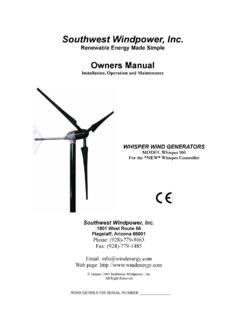
1 How to build a wind TURBINEA xial flux alternator windmill plans8 foot and 4 foot diameter machines Hugh Piggott -May 2003 How to build a wind generator - the axial flux alternator windmill plans - May 2003 version Hugh Piggottpage IntroductionBladesThese plans describe how to build two sizes of diameter of the larger wind -rotor is 8 feet [ m].The smaller machine has 4' diameter [ m].The diameter is the width of the circulararea swept by the energy produced by wind turbinesdepends on the swept area more than itdoes on the alternator maximum plans describe how to build a permanent alternator can be wired for 12, 24 or 48-volt batterycharging. Essentially this choice only affects the size ofwire and the number of turns per coil. But the towerwiring for the 12-volt version will be much heavier thanthe others. And the stator for the small machine isdifferent in alternator design is integrated into a simple tower-topmounting arrangement (called a 'yaw bearing').
2 A tailvane faces the TURBINE into the wind . A built in rectifierconverts the electrical output to DC, ready to connect to wind turbines need low speed alternators. Lowspeed usually also means low power. The large machinealternator is exceptionally powerful because it contains 24large neodymium magnets. The power/speed curve for avery similar design is shown below. Maximum output isabout 500 watts under normal circumstances, but it iscapable of more than 1000 watts for short starting torque (force required to get it moving) isvery low because there are no gears, nor are there anylaminations in the alternator to produce magnetic means that the wind TURBINE can start in very lowwinds and produce useful power. Power losses are low inlow winds so the best possible battery charge is higher winds the alternator holds down the speed of theblades, so the machine is quiet in operation, and theblades do not wear out.
3 You can easily stop the windturbine by short-circuiting the output with a 'brakeswitch'. These features make the wind TURBINE pleasant tolive blades are carved from wood with hand tools. Youcan also use power tools if you prefer. Carved blades aregood for homebuilders because the process is pleasant andthe results are quick for a one-off product. Mouldedfibreglass blades are usually better for batch blades will last for many systemThe plans include a description of how to construct afurling tail for the larger machine. This tail preventsoverload in high winds. This type of furling system hasbeen in use on Scoraig for decades and has passed the testof document caters for both American readers andEuropean/UK readers, so the dimensions are in bothinches and millimetres. The mm figures are in brackets[like this]. In some of the theory sections I use metricalone, because it makes the mathematics so much some cases, the metric dimensions will be directconversions of the English dimensions, but not reasons are that different size magnets are used forthe metric design, metric wire sizes are different fromAWG, and some important physical dimensions arerounded off to make more sense in US version typically uses a standard GM hub(Citation, Cavalier, etc) with five studs and a bearing at theback.
4 The bearing housing needs a large circular hole inthe mounting at the suggest you use only one system of measurement, eithermetric or 'English' and stick to that system. Your bestchoice of measurement system will depend on the magnetsize you of the dimensions given are nominal - the accuracy isnot critical, so you need to not follow the shapes of the blades are important near the tip butmuch less so near to the root (the larger, inner end of theblade).The alternator parts must be constructed and assembledwith enough accuracy that the magnets pass the coilscentrally as the machine to build a wind generator - the axial flux alternator windmill plans - May 2003 version Hugh Piggottpage 2 Furling system .. 2 Tolerances .. for the large on workshop safety ..8 GENERAL .. 8 SPECIFIC HAZARDS .. 8 METALWORK .. 8 WOODWORKING .. 8 RESINS AND GLUES .. 8 MAGNETS .. 8 BLADE power.
5 9 Blade speed .. 9 Blade number .. 9 Blade shape .. 9 Carving the blades ..10 STEP ONE is to create the tapered shape..10 STEP TWO carving the twisted windward face ..10 STEP THREE carving the thickness .. 11 STEP FOUR Carve the curved shape on the back of 12 STEP FIVE Assembling the rotor hub..12 ALTERNATOR the bearing out the 1/2' [12 mm] holes in the the alternator mounts ..17 Drilling the magnet rotor the coil the the coils ..22 Hints for 22 Soldering the coil tails .. 22 The ring neutral .. 22 The output wiring .. 23 Making the stator mould ..23 Mark out the shape of the stator.. 23 Cut out the stator shape in plywood.. 24 Wiring exit 24 Screw the mould to its 24 Casting the 25 Putting it 25 Removing the casting from the 26 The magnet-positioning jig ..26 Making the two rotor hole .. 28 Parts of the moulds ..28 Casting the rotors .. the magnets ..29 Dry run.
6 29 Checking for magnet polarity ..29 Putting it together ..29 FURLING SYSTEM 30 Why furl? ..30 How the furling tail works ..30 Controlling the thrust force .. 31 Fabricating the tail 32 The tail itself .. 33 Cutting out the tail vane .. 34 Mounting the heatsink .. 34 Assembling the 35 Hub and shaft .. 35 Back magnet rotor .. 35 The 35 Front magnet the alternator .. 36 Short circuit tests ..36AC voltage tests ..36DC voltage tests ..36 Connecting the rectifier .. 37 Connecting the battery .. 37 Fuses or circuit breakers .. 37 Connections .. 37 Brake switch .. 37 Choosing suitable wire 37 Wire type ..38 Fitting and balancing the blades .. 39 Checking the tracking ..39 Balancing the tuning ..39 ADDITIONAL 40 Guyed tower ideas .. 40 Controlling the battery charge 41 Shunt regulator circuit .. 41 List of components required .. 41 Using polyester 42 Mould preparation ..42 Small machine 43 Blades.
7 43 Bearing hub ..43 The shaft ..44 Rotor moulding ..44 Stator of the yaw bearing .. 47 The tail bearing and tail .. 47 Wiring up the battery ..48 How to build a wind generator - the axial flux alternator windmill plans - May 2003 version Hugh Piggottpage current as produced by the - USA word for 'threaded' or 'spun' rod orstuddingBrake switch - A switch used to short-circuit the wiresfrom the alternator so that it - A chemical used to make the polyester resin setsolid. Catalyst reacts with 'accelerator' already present inthe resin mix. The heat of reaction sets the - A make of car. The cavalier in the UK is not thesame as the Cavalier in the USA but both have usefulwheel - direct current with a positive and a negative side, asin battery - The distance from one side of a circle toanother. The width of a disk right across the - A force exerted by the wind on an object.
8 Drag isparallel to the wind direction at the object. (see Lift)Drop - Used here to describe a certain measurement of theshape of a windmill blade. The 'drop' affects the angle ofthe blade to the - The 'stuff' of magnetism. Similar to 'current' inelectricity. It can be visualised as 'lines' coming out of onepole and returning to the - A protective action that reduces exposure toviolent winds by facing the blades away from - A device used to hold the magnets in place beforesetting them in edge - The edge of a blade that would strike anobject placed in its path as the rotor - A force exerted by the wind on an object. Lift is atright angles to the wind direction at the object. (see Drag)Mould - A shaped container in which resin castings areformed. The mould can be discarded after the casting - A versatile electrical test instrument, used tomeasure voltage, current and other - The name given to a type of permanentmagnet containing neodymium, iron and boron.
9 Thesemagnets are very strong and getting cheaper all the - An eccentric position, off - The timing of the cyclical alternation of voltage ina circuit. Different phases will peak at different - A type of resin used in fibreglass work. Alsosuitable for making - the rate of delivery of energyRectifier - A semiconductor device that turns AC into DCfor charging the - The widest part of the blade near to the hub at thecentre of the - A rotating part. Magnet rotors are the steel diskscarrying the magnets past the stator. Rotor blades are the'propeller' driven by the wind and driving the - A method for making electrical connectionsbetween wires using a hot 'iron' and coating everythingwith molten - An assembly of coils embedded in a slab of resinto form part of the alternator. The magnets induce avoltage in the coils and we can use this to charge a monomer - A nasty smelling solvent in thepolyester resin powder- A cheap filler powder used to thicken theresin and slow its reaction (prevent it overheating).
10 Tail - A projecting vane mounted on a boom at the back ofthe windmill used to steer it into or out of the - a tool for making thread inside holes so you can fit ascrew into the - The force of the wind pushing the - The mast supporting the edge - The blade edge furthest from the leadingedge. The trailing edge is sharpened, so as to release thepassing air without - Tapered pieces of wood used to build up theblade thickness and increase its angle to the wind near - The piece of wood or metal being shaped inthe bearing - the swivel at the top of the tower on whichthe windmill is mounted. The yaw bearing allows thewindmill to face the to build a wind generator - the axial flux alternator windmill plans - May 2003 version Hugh Piggottpage toolsMECHANICALTOOLS electric welder 'saws-all' oxy-acetylene torch welding mask chipping hammer vice G clamps pillar drill cordless drill handheld electric drill-- 1/2" [13mm] chuck drill bits holesaws 1/2" [M12] tap angle grinder belt sander cut-off machine hacksaw cold chisel hammer centre punch files tin snips tape measure steel ruler set square protractor scriber chalk compasses angle/bevel gauge spirit level vernier calipers ear protectors safety glasses/goggles face masks screwdrivers pliers vice grips 10"adjustable wrench combinationwrenches 3/8"-3/4"[10-19mm]